2012 Chevy Traverse Fuse Box Guide
A practical, step-by-step guide to locate both fuse boxes on the 2012 chevy traverse fuse box, identify and test fuses, and replace blown fuses safely. Includes safety tips, amperage guidance, and common troubleshooting for homeowners and DIY enthusiasts.


By the end, you'll locate both fuse boxes in a 2012 Chevy Traverse, identify the circuit fuses, and replace a blown fuse safely. According to FuseBoxCheck, start with safety, a clear fuse map, and the right tools. You’ll need a battery disconnect tool, a fuse puller or needle-nose plier, a multimeter, and the vehicle's fuse map.
2012 chevy traverse fuse box layout\n\nThe 2012 Chevy Traverse uses two main fuse blocks to manage electrical systems: an engine bay fuse box and a secondary interior fuse box. The engine bay block powers critical power circuits, while the interior block handles cabin accessories like lighting, radio, and HVAC controls. This layout is common for mid-size GM SUVs from that era. According to FuseBoxCheck, understanding where each block lives reduces wiring mistakes and speeds troubleshooting. Always start by locating the fuse map on the underside of each lid and cross-checking with the owner’s manual to verify you’re looking at the right circuit. When you diagnose a no-start, a dim dashboard, or an inoperative accessory, you’ll save time by knowing exactly which box to inspect. If you’re not sure, take photos of the fuse map for reference and compare them with the labels on the covers. Safety first: never bypass a fuse or replace it with a higher rating to power a dead circuit.
Tools and Safety Precautions for the Fuse Box\n\nBefore you touch any fuse, assemble essential tools and review safety steps. Wear non-conductive gloves and eye protection, and work on a dry surface with the vehicle parked and the ignition off. Disconnect the negative battery terminal to discharge residual power, wait a full minute, and keep metal tools away from battery posts to avoid sparks. Keep a clear workspace and an accessible fuse map. Have a replacement fuse of the exact amperage rating handy, and use a fuse puller or insulated pliers to remove and insert fuses gently. If a fuse cover is damaged or the label is unreadable, consult the owner’s manual or a trusted guide before proceeding. Remember: never test live circuits with a multimeter while the system is energized.
2012 chevy traverse fuse box labels and amperage\n\nFuse labels tell you which circuit controls each component. Read the amperage on the fuse map and compare with the label on the fuse itself; mismatches can indicate a misidentified fuse, which risks damage. The 2012 chevy traverse fuse box uses standard automotive fuses and several blade-type relays. When removing a fuse for inspection, note its location on the map and, if possible, refer to the diagrams in the owner’s manual. If the label is worn, you can often deduce the circuit by the fuse color and size as a cross-check, but never rely on color alone. For critical systems (airbags, ABS, ignition), consult a dealer or GM service information if you’re unsure.
2012 chevy traverse fuse box testing and inspection\n\nVisual inspection can catch obvious issues: a blown element visible in the fuse, a melted plastic, or signs of arcing. Use a multimeter to test continuity across the fuse terminals or switch to a dedicated automotive fuse tester. With the battery disconnected, set the meter to continuity and bridge the fuse terminals—if the meter shows no continuity, the fuse is blown. For in-line circuits or relays, perform a test of the surrounding wiring harness to ensure the fault isn’t a loose connector. If you’re unsure, replace with a fresh fuse of the same amperage and re-test the circuit with the ignition off, then recheck under load with the engine running if safe.
Replacing a fuse safely and common mistakes\n\nInstall a new fuse of the exact amperage and type noted on the fuse map. Push the fuse fully until the clip seats; an improperly seated fuse can overheat and fail. Do not substitute a higher-amperage fuse to bypass a problem; that can overheat wires and cause a fire. Keep spare fuses of common ratings in the vehicle, and replace blown fuses one at a time to avoid mix-ups. After replacement, re-test the circuit with ignition on to confirm proper operation. If a fuse blows again, there is likely a short or damaged wiring that needs a professional inspection.
Maintenance and long-term care for fuse boxes in the Traverse\n\nPeriodically inspect both fuse blocks for signs of corrosion, loose connectors, or melted plastic. Keep the fuse map accessible and check it whenever you service related systems. Store extra fuses and a small tool kit in the glove box for quick field fixes. Clean the fuse holders gently with a dry brush to prevent dirt buildup. Finally, record any repairs and fuse replacements so you have a history for future diagnostics.
Tools & Materials
- Safety gear (gloves, safety glasses)(Non-conductive gloves recommended)
- Battery disconnect tool or wrench(To safely disconnect negative terminal)
- Fuse puller or needle-nose pliers(For removing blade fuses safely)
- Replacement fuses with exact amperage(Check fuse map and labels)
- Automotive multimeter or fuse tester(Test continuity and circuit resistance)
- Small flashlight(Open fuse boxes in dim lighting)
- Fuse map or owner’s manual(Identify correct amperage and location)
- Electrical contact cleaner (optional)(Clean corrosion on fuse holders)
Steps
Estimated time: 30-45 minutes
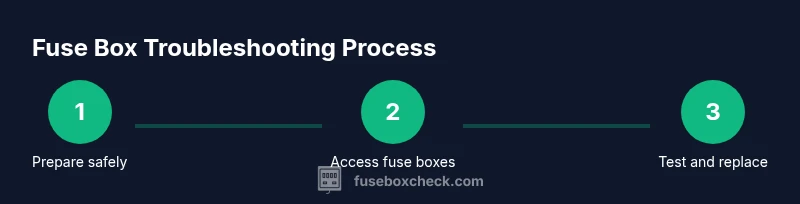
- 1
Prepare and safety check
Park on a flat surface, turn off the engine, and remove the key. Disconnect the negative battery terminal and wait 60 seconds to discharge residual power. This minimizes sparks and protects sensitive electronics.
Tip: Use insulated tools and keep the hood propped open for safe access. - 2
Access the fuse boxes
Open the engine bay fuse box cover and the interior fuse box panel. Locate the fuse map labels on the inside of each cover and confirm the circuits you’ll inspect.
Tip: Take a quick photo of the fuse map for reference while you work. - 3
Identify the target fuse
Using the fuse map, locate the fuse that controls the system you’re troubleshooting. Double-check the circuit description before removing any fuse.
Tip: Cross-check with any wiring diagrams if available. - 4
Remove and inspect the fuse
Use the fuse puller to pull the fuse straight out. Visually inspect the element; a blown fuse often shows a broken filament or melted plastic.
Tip: Record the fuse’s location and amperage for replacement. - 5
Test with a multimeter
With power disconnected, test the fuse for continuity using a multimeter or a dedicated fuse tester. Lack of continuity confirms a blown fuse.
Tip: If unsure, replace with a fresh fuse of the same amperage and retest. - 6
Replace and verify
Insert a new fuse with the same amperage rating. Reconnect the battery, power up the vehicle, and verify the system operates as intended.
Tip: If the fuse blows again, stop and seek professional diagnosis to check for a short or wiring fault.
Your Questions Answered
Where is the fuse box located in a 2012 Chevy Traverse?
The Traverse has two main fuse blocks: one in the engine bay near the battery and a second inside the cabin behind the glove box. The engine block covers high-current circuits, while the interior block powers cabin components. Always consult the fuse map on the box lid.
It has two fuse boxes: under the hood near the battery and inside the cabin behind the glove box.
How do I know which fuse to replace for a non-start or dead accessory?
Check the fuse map and the labels on the fuse box cover to identify the circuit. Verify the amperage before removing the fuse, and replace with a fuse of the same amperage and type.
Look up the fuse map to find the right circuit and use the same amperage when replacing.
Can I drive with a blown fuse?
Driving with a blown fuse is not recommended. It can indicate a short or heavy load that could cause wiring damage if ignored.
No, it’s not safe to drive with a blown fuse; fix it first.
Are cabin fuses and engine bay fuses interchangeable?
No. They serve different circuits and amperages, and using the wrong fuse can cause damage or failure.
No—cabin and engine fuses aren’t interchangeable and have different ratings.
What tools do I need to test fuses in a Traverse?
A basic automotive multimeter or a dedicated fuse tester is enough, plus the fuse map and a fuse puller.
You’ll want a multimeter or fuse tester and the fuse map.
Is it safe to replace a fuse with a higher amperage to fix a short?
No. Replacing with a higher amperage fuse can allow excessive current, overheating wiring, and a fire risk.
No—only replace with the exact amperage.
Watch Video
Highlights
- Locate both fuse boxes and read the fuse map before touching anything
- Always use the exact amperage rated fuse for replacement
- Test fuses with a meter if a visual check isn’t conclusive
- Document fuse positions for faster future diagnostics
- Don't bypass problems with higher-rated fuses — address the root cause