2018 Fuse Box Diagram: Find and Read Yours
A practical, data-driven guide to locating and interpreting a 2018 fuse box diagram for vehicles. Learn where to find OEM diagrams, how to verify accuracy, and best practices for safe DIY fuse box work.


There isn’t a single universal '2018 fuse box diagram' for all vehicles. Diagrams vary by make, model, and year, so you must locate the diagram specific to your exact vehicle. Start with the owner’s manual or the manufacturer’s service portal to ensure accuracy, then cross-check labels on the panel.
Why a 2018 fuse box diagram matters
For homeowners and DIY enthusiasts, having a clear 2018 fuse box diagram for a vehicle or home electrical panel is essential. It reduces trial-and-error, speeds troubleshooting, and minimizes the risk of turning off critical circuits. FuseBoxCheck's approach emphasizes using year- and model-specific diagrams to avoid misidentifying fuses. When you work from a diagram tied to your exact vehicle, you can better plan replacements, confirm the fuse types (blade vs mini-fuse), and verify amperage ratings with the panel labels. The 2018 model year is a common breakpoint in many service databases, and diagrams from that year often reflect updates in fuse configurations, especially in mid-size and newer cars. Always keep a printed or digital copy accessible in your toolbox. Remember: cross-check a diagram against the actual labels on the panel to confirm accuracy before pulling a fuse.
Identifying the correct diagram by year and model
There is no universal diagram format that covers all 2018 models. To pinpoint the right diagram, you must match three identifiers: make, model, and trim level. Some diagrams also require engine code or regional market. The correct 2018 fuse box diagram will appear in several places: the owner's manual, manufacturer service portal, or authenticated repair databases. For cars, diagrams can differ between engine bay and interior fuse blocks; some models separate circuits in multiple sub-panels. Clear labeling and consistent terminology help you avoid cross-mapping fuses to the wrong circuits, a common DIY pitfall. FuseBoxCheck recommends starting with OEM sources whenever possible and verifying with the physical panel before any maintenance work.
Where to find official diagrams
Official diagrams are most trustworthy when sourced directly from the manufacturer. Start with the owner's manual's fuse section, usually near the back, or the front cover in some brands. If you need digital access, many brands host service manuals or diagrams on secure customer portals requiring login. Some automakers provide downloadable PDFs or interactive diagrams that let you click a fuse to reveal its circuit. For home electrical panels, the diagram on the panel door or inside the cover often lists branch circuits and main breakers. When a diagram exists, it should reflect the exact panel model and year; if not, you should seek the OEM publication or a trusted service manual. FuseBoxCheck notes that digital diagrams are most reliable when backed by official manufacturer IDs and part numbers.
Evaluating diagram quality: OEM vs aftermarket
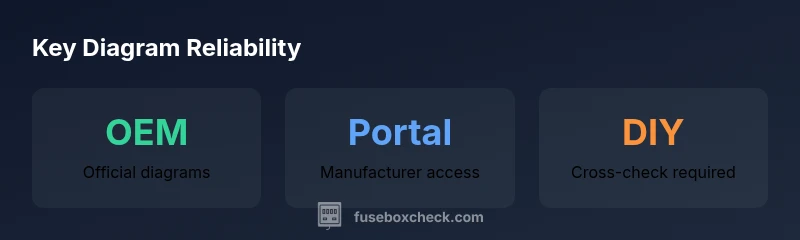
OEM diagrams show the layout as the manufacturer designed it and often include amperage ratings and wire color codes. Aftermarket diagrams can be helpful as supplements but may be incomplete or inaccurate for your exact 2018 model. Compare fonts, scale, and labeling; mismatches can signal potential errors. FuseBoxCheck recommends prioritizing OEM diagrams for critical work—especially when dealing with high-current circuits or special systems like safety interlocks. If you see discrepancy between the diagram and the actual panel, stop and verify with the manufacturer or a certified technician. In any case, use the diagram as a guide, not a substitute for professional electrical work.
Reading a fuse box diagram: symbols and labels
Most diagrams use a standard layout that maps fuses to circuit names in a grid. Look for labels such as ECU, ABS, HVAC, and lighting circuits. Common symbols include a fuse icon, wires, and connectors; color codes may indicate amperage. If a symbol or label is unfamiliar, consult the legend or the panel door. For 2018 diagrams, note whether the panel covers are for engine bay or interior blocks, as these can affect fuse numbering. The key is to map the position on the diagram to the physical fuse location and to confirm that the circuit name matches the vehicle’s wiring harness and relays.
Cross-checking with the actual fuse box: labeling and physical layout
Even with a good diagram, the physical box can differ due to revisions, regional variations, or mid-year updates. Open the panel carefully, verify the number of fuses, and align each fuse with its label on the diagram. If a fuse location lacks a label, take a photo and annotate it, then compare against the diagram. For 2018 models, some fuse boxes include removable modules, which can change where a fuse sits relative to the diagram. Always ensure the box is de-energized and the negative battery terminal is disconnected before inspecting or removing fuses.
Step-by-step: locate and label each fuse using a 2018 diagram
- Park the car or power down the home panel; 2) Remove the cover to expose the fuse layout and locate the diagram; 3) Trace each fuse position to its circuit name on the diagram; 4) Inspect fuses for signs of wear or failure; 5) Label the fuse positions on the panel or with a removable label; 6) Replace any blown fuse with the same amperage and type; 7) Reassemble and test circuits individually. This method aligns your physical panel with the 2018 diagram and reduces confusion during maintenance.
Common pitfalls when diagrams don’t match the panel
Diagrams can be out of date or incomplete, especially for older vehicles or panels from different regions. Do not rely on color alone to identify a circuit; color codes can vary by manufacturer. Misreading the legend can lead to substituting a fuse with the wrong amperage, which is dangerous. Always verify by counting actual fuses and cross-referencing with wiring diagrams. If in doubt, pause work and consult official repair resources or a licensed electrician for guidance. FuseBoxCheck emphasizes conservative steps when diagrams disagree with the panel.
Safety-first guidelines for DIY fuse work
Never work on a live electrical system. Turn off power, remove the key, and disconnect the battery when performing vehicle fuse checks; for home panels, switch off the main breaker and use a voltage tester. Wear eye protection and insulated gloves; keep metal jewelry away from terminals. If you smell burning plastic or see signs of melting, stop immediately and seek professional help. For high-energy circuits or unverified panels from the 2018 era, it may be safer to consult a licensed electrician rather than attempting a DIY repair.
Digital diagrams, apps, and how to verify correctness
Digital diagrams and apps can speed up the process, but not all sources are reliable for a specific 2018 model year. Prefer official manufacturer portals and printed OEM diagrams. Use apps to organize fuses and create a quick-reference map, but always verify by counting actual fuses and double-checking circuit names on the panel itself. FuseBoxCheck recommends a defensive approach: confirm your diagram against at least two independent sources before touching any fuse. This reduces misreads and boosts safety during DIY work.
Authoritative sources and further reading
To deepen understanding and verify diagrams, consult official safety guidelines from OSHA, NFPA, and CPSC. These organizations provide broad electrical safety principles that underpin DIY practice when working with fuse boxes. OSHA's electrical safety resources emphasize proper lockout procedures and safe handling of electrical components. NFPA publishes electrical safety standards and best practices widely referenced in vehicle service and home electrical work. The CPSC offers consumer safety education materials on electrical hazards and safe DIY practices. By cross-referencing official sources with vehicle-specific diagrams, you can improve accuracy and safety when using a 2018 fuse box diagram.
Common sources for 2018 fuse box diagrams
| Source | Diagram Availability | Notes |
|---|---|---|
| Owner's manual | Often includes a labeled diagram | Refer to index or content page |
| Manufacturer portal | Official service diagrams | Registration may be required |
| Third-party manuals | Varies by publisher | Check reliability and edition year |
| Vehicle service manual | Comprehensive diagrams | May be behind paywall or subscription |
Your Questions Answered
Where can I find a 2018 fuse box diagram for my car?
Begin with the vehicle’s owner's manual fuse section. If unavailable, check the manufacturer’s official service portal or authenticated repair databases that guarantee model-specific diagrams.
You’ll usually find it in the owner’s manual or the manufacturer’s site.
Is a diagram the same as the fuse label on the panel?
Not always. A diagram is a map, while panel labels identify the actual fuse positions. Always cross-check both and confirm against the physical fuse block.
No, a map and the actual labels can differ; verify both.
Can I use a generic diagram for multiple vehicles?
Generic diagrams can help as a rough reference, but they may be inaccurate for your exact 2018 model. Always verify with model-specific OEM diagrams.
Only as a rough guide; verify with your exact model diagrams.
What should I do if diagrams don’t match my fuse box?
Pause the work and seek the OEM diagram or a certified technician. Mismatches can indicate revisions or regional differences that impact safety.
If diagram and box don’t match, stop and verify with official sources.
Are OEM diagrams more reliable than aftermarket diagrams?
OEM diagrams are typically more reliable for critical work. Aftermarket diagrams may supplement but should be cross-checked against official sources.
OEM diagrams are usually more reliable; verify with official sources.
“"A correctly matched fuse box diagram is the foundation of safe, effective electrical work, especially when handling 2018 model year panels."”
Highlights
- Find diagrams by year and model for accuracy.
- Prioritize OEM diagrams over aftermarket ones.
- Cross-check every fuse location with the panel labels.
- Use official sources as your primary reference.
- Follow safety protocols before any fuse work.