Body Control Module vs Fuse Box: An In-Depth Comparison
An analytical, objective comparison of the body control module (BCM) and fuse box, exploring function, diagnostics, safety considerations, and practical guidance for DIYers and homeowners tackling electrical issues.


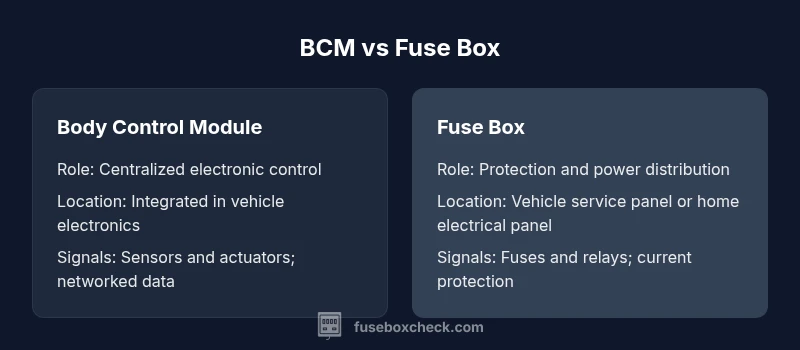
The body control module (BCM) and the fuse box serve different roles in vehicle and home electrical systems, and understanding their functions helps you troubleshoot more effectively. The BCM is the centralized controller for body electronics and sensor inputs, often linked to vehicle networks, while a fuse box provides protection and power distribution to circuits by hosting fuses and relays. Deciding which issue to address first depends on whether symptoms point to software-controlled functions or circuit protection.
What are the body control module and the fuse box?
In modern vehicles and many homes, the terms body control module (BCM) and fuse box describe two cornerstone components that manage electrical behavior, albeit in very different ways. When homeowners or DIYers encounter wiring problems, understanding the distinction between a BCM and a fuse box is essential for safe, effective troubleshooting. The body control module is essentially a small computer that coordinates signals from switches, sensors, and actuators, translating driver actions into electronic responses such as door locking, lighting, wipers, and climate controls. By contrast, the fuse box is a protective and distribution hub: it houses fuses and sometimes relays and ensures that each circuit only draws safe current. In a vehicle, the fuse box may sit in the engine bay or under the dash; in a home, the main electrical panel is the equivalent. The exact design and terminology can vary by manufacturer and jurisdiction, but the core difference remains: BCMs are software‑driven controllers, while fuse boxes are hardware-based protectors and distributors. Recognizing that distinction helps you triage symptoms and plan next steps.
Core differences in scope and function
BCMs and fuse boxes operate at different layers of the electrical stack. A BCM focuses on intelligence, sensing inputs from doors, seats, lights, climate control, and other body systems; it makes decisions and drives actuators. The fuse box, by contrast, protects circuits and distributes power, hosting fuses and relays to interrupt current when faults occur. The core differentiator is software-driven control versus hardware protection. On the vehicle side, the BCM integrates with networks such as CAN or LIN, sharing data with engine, transmission, braking, and comfort modules. In many homes, the fuse box (or electrical panel) serves a similar protective purpose for branch circuits, but without the centralized logic layer.
When diagnosing, the lens matters: are you dealing with a control decision that affects multiple features, or a protection issue that interrupts a circuit? Misidentifying the root cause can lead to chasing software glitches when the fault lies in wiring protection, or vice versa. Across contexts, standards compliance and OEM guidance remain essential to ensure both safety and compatibility with connected systems.
Vehicle BCM: role, layout, and interfaces
The body control module is the software brain for many body-related functions in a vehicle. It collects data from sensors (doors, seats, lighting, climate, wipers) and issues commands to actuators (locks, motors, relays). BCM placement varies by make and model but is commonly found in the dash area, under the instrument panel, or near the engine bay. It communicates over vehicle networks (such as CAN) and often coordinates with other ECUs for synchronized behavior. Because the BCM interfaces with software, a fault can manifest as intermittent functionality, warning lights, or uncommanded behavior in non-critical areas. Diagnosing BCM issues requires vehicle-specific diagnostic tools and sometimes programming or re-flashing to restore proper behavior. Understanding its role helps homeowners and DIY enthusiasts distinguish between software-driven faults and hardware or wiring problems, reducing unnecessary parts replacement and improving repair precision.
Vehicle fuse box: power distribution and protection
The fuse box in a vehicle is the hardware hub that protects circuits from overload and distributes power to a wide range of components, from headlights to infotainment. Each circuit is protected by a fuse or relay, and the panel wiring is designed to minimize fault propagation. When a fuse blows or a relay fails, symptoms are typically localized to that circuit: a non-working light, a dead power outlet, or a specific system outage. Unlike the BCM, the fuse box is not a processor; it is a protective layer that enforces electrical safety and circuit integrity. In many cases, diagnosing a fuse-box issue starts with visually inspecting fuses, checking for corrosion, and verifying continuity with a multimeter. In more complex cases, partial power loss can indicate multiple circuit issues or a shared feed problem, which may require more thorough electrical testing and schematic review.
Common failure modes and diagnostic signals
BCMs tend to fail in ways that degrade software logic rather than strictly hardware issues. Expect symptoms such as rattling digitized warnings, erratic feature behavior, or certain power features failing without obvious fuse-related signs. Diagnostic trouble codes (DTCs) accessed through specialized scan tools often reveal BCM‑level faults or network communication errors. Conversely, fuse box failures present as blown fuses, blown relays, or tripped protective devices. Symptoms include sudden circuit losses, a lack of power to specific areas, or a total power drop in a subsystem. In both cases, confirmation often hinges on isolating whether the issue precedes or follows a particular control loop or protective device. Correctly identifying the cause reduces the risk of cascading failures and improves repair outcomes.
Testing and fault isolation: tools and approaches
Diagnosis requires a mix of software tools and basic electrical testing techniques. For BCM issues, technicians use vehicle-specific OBD-II scanners or manufacturer tools to read DTCs and inspect network communication. You may need to access live data streams to see sensor values and actuator states, which helps confirm whether faults lie in software logic or sensor inputs. For fuse box problems, a multimeter and continuity tester are primary tools. Check each fuse for continuity and verify that the power feed is present. Inspect wiring for corrosion, loose connections, and signs of heat damage. In both domains, documenting symptom onset, environmental conditions, and any recent changes (updates, new components, or wiring work) supports a faster, more accurate root-cause analysis. Finally, always follow OEM service bulletins and safety procedures, since improper testing can damage sensitive electronics or create safety hazards.
Safety and risk considerations when working with these components
Electrical systems carry the potential for shock, arc flash, or unintended system resets. When dealing with BCMs in vehicles, ensure the ignition is off, disconnect the battery when performing certain tests, and avoid static discharge that could affect sensitive circuitry. For home or vehicle fuse boxes, observe standard electrical safety: turn off the main power before removing covers, use insulated tools, and follow local codes. Handling replacements or repairs on BCMs often requires programming and re-flashing, which is best left to trained technicians to avoid bricking modules or introducing network incompatibilities. The overarching rule is to respect the separation between software control and hardware protection while maintaining caution with live circuits.
DIY considerations: when to DIY vs call a pro
DIYers should approach BCM concerns with caution, especially when software reprogramming or network recalibration is involved. Minor diagnostics, visual inspections, and basic fuse checks are reasonable, but BCM repairs—particularly those involving re-flashing, module replacement, or deep network diagnostics—generally require professional tooling and expertise. For fuse boxes, some non-critical maintenance tasks like replacing a blown fuse or tightening a loose terminal can be done by homeowners who are careful and informed, but major panel work or service panel upgrades should be performed by licensed electricians. In both contexts, documenting the work and verifying that the system remains compliant with local codes helps prevent future issues.
Step-by-step diagnostic workflow (high level)
- Define the symptom: which system or circuit is affected? Is the issue software-related (BCM) or hardware-related (fuse box)?
- Gather data: read DTCs if available; note the timing and triggering conditions of the fault.
- Visual inspection: check for visible damage, corrosion, burned smell, or melted insulation.
- Electrical testing: verify power feeds, ground connections, fuse continuity, and network activity where applicable.
- Isolate and test modules: swap known-good components where possible or perform controlled tests to confirm function.
- Reconcile with documentation: use OEM diagrams and service bulletins to ensure correct wiring and behavior.
- Decide on remediation: repair wiring, replace a fuse or relay, or reprogram a BCM as directed by guidelines.
This workflow emphasizes disciplined diagnostic steps over guesswork, reducing the risk of collateral damage and ensuring safety during testing.
Replacement, repairs, and costs (non-specific)
Replacement and repair costs vary widely by context. BCM replacements can be substantial due to the need for programming, integration with other modules, and potential downtime. Fuse-box work tends to be more straightforward but still incurs parts, labor, and possible re-routing costs. The exact price range is highly dependent on make, model, regional labor rates, and whether professional programming is required. When planning, consider warranty implications and potential insurance coverage for electrical repairs. A careful assessment of the fault’s scope helps determine whether a repair is a short-term fix or a longer-term investment in reliability.
Compatibility, upgrades, and future-proofing
Car electronics and home electrical protection are both evolving toward greater integration and smarter protection. BCMs are central to implementing features like advanced driver assistance, personalized settings, and enhanced industry-standard communication protocols. When upgrading a system that includes a BCM, ensure compatibility with existing networks and software ecosystems. For fuse boxes, future-proofing centers on panel capacity, arc fault protection, and the ability to accommodate additional circuits or smart breakers. Regardless of context, opt for components that comply with current electrical standards and that can be serviced by qualified technicians if needed. Prepared homeowners and DIYers should maintain up-to-date documentation and diagrams to support diagnostics and future planning.
Deciding factors by scenario: home vs vehicle
If you manage a vehicle or a fleet, the BCM is the heart of body electronics and centralized control, and issues there often ripple through multiple features. In contrast, the fuse box is the backbone of power distribution and circuit protection; problems tend to manifest as isolated circuit faults or tripped protections. For homeowners, the fuse box is your primary interface with wiring protection and branch circuits, while a BCM-like controller is uncommon unless you’re dealing with smart home hubs that centralize appliance control. When evaluating repairs or upgrades, prioritize safety, system reliability, and compatibility with existing components. A structured approach—start with the known protection points (fuses and breakers) and then move to system-level controls if symptoms persist—helps ensure a robust and safe outcome.
Comparison
| Feature | body control module (BCM) | fuse box (main electrical panel) |
|---|---|---|
| Primary role | BCM: Centralized electronic control for body systems (lighting, locks, climate, wipers, sensors, and networked modules). | Fuse box: Protection and distribution of circuits; hosts fuses and relays to guard against faults. |
| Location in system | BCM: Integrated into the vehicle’s electronics cluster; located near the dash or engine bay. | Fuse box: Located in the vehicle’s service area or home electrical panel; serves as the main protection hub. |
| Failure symptoms | BCM: Erratic feature behavior, warning lights, intermittent control of doors/lights. | Fuse box: Blown fuses, tripped breakers, loss of power to specific circuits. |
| Diagnosis approach | BCM: Read DTCs with vehicle-specific tools; check network signals and module states. | Fuse box: Visual fuse inspection, continuity testing, and circuit tracing. |
| Repair complexity and cost | BCM: Software programming or module replacement; often higher cost and downtime. | Fuse box: Hardware replacement or wiring fixes; costs vary with part and labor. |
| Best for | BCM: Integrated control of body electronics and advanced vehicle features. | Fuse box: Robust protection and simple, reliable power distribution. |
Positives
- BCM centralizes control, enabling coordinated electronic features and diagnostics
- Fuse box provides clear protection and straightforward fault isolation for circuits
- Modular replacement options can reduce downtime and simplify certain repairs
- Standards-compliant panels and labeling aid safe maintenance
Disadvantages
- BCM faults can cascade across multiple systems, increasing repair scope
- Fuse box issues may require tracing multiple circuits and digging into wiring
- BCM repairs often need programming and OEM tooling, increasing cost
- Electrical panel work carries safety risks and requires careful adherence to codes
BCM offers centralized electronic control; fuse box provides essential protection—both are essential in their domains, with the best choice driven by the system context.
Choose BCM-focused solutions when centralized control and networked features matter. Favor fuse-box-based approaches for robust circuit protection and straightforward electrical distribution. In most cases, a balanced view that preserves both elements yields the most reliable results.
Your Questions Answered
What is a body control module (BCM)?
A BCM is the centralized electronics controller for many body-related vehicle functions, coordinating inputs from sensors and switches to drive actuators. It communicates over vehicle networks and may influence features like lighting, door locks, and climate controls. BCM faults usually show as software-related issues or erratic behavior rather than simple blown fuses.
A BCM is the centralized controller for body electronics in a vehicle, coordinating sensors and actuators. If it fails, you’ll see software-like problems and erratic feature behavior.
What is a fuse box and what does it protect?
A fuse box (or electrical panel) protects circuits by housing fuses or breakers and distributing power to loads. It acts as a hardware safeguard, interrupting current to prevent damage when faults occur. It does not perform decision-making logic.
A fuse box protects circuits with fuses and breakers and distributes power; it doesn't do software decisions.
Can I diagnose BCM vs fuse box faults myself?
Some basic fuse-box checks and visual inspections are appropriate for DIYers. More complex BCM diagnostics typically require vehicle-specific tools and expertise, especially when software updates or re-flashing are involved.
You can do simple fuse checks, but BCM diagnostics usually need specialized tools and knowledge.
What tools are needed to test a BCM or fuse box?
Testing BCMs usually requires OEM or vendor-specific diagnostic software and a compatible scanner. Fuse-box testing uses a multimeter, continuity tester, and basic hand tools, along with the car’s wiring diagrams or service manuals.
BCMs need OEM diagnostic tools; fuse boxes use a multimeter and continuity tester with wiring diagrams.
What signs indicate a potential BCM or fuse box failure?
BCM failures often show as intermittent or failing body-electronics functions and warning lights without a clear blown fuse. Fuse-box problems typically present as blown fuses, loss of power to circuits, or tripped breakers.
Look for erratic electronics with BCM; for fuse boxes, watch for blown fuses or circuit outages.
Highlights
- Identify function first: BCM handles control logic; fuse box handles protection
- Differentiate symptoms: software-controlled vs hardware-protection issues
- Safety first: avoid live testing on high-energy circuits without training
- DIY scope: basic fuse checks are often safe; BCM work merits professional tooling
- Plan upgrades with standards in mind: ensure compatibility and easy future servicing