Understanding Fuse Holder Types: A DIY Guide
Explore fuse holder types—cartridge, blade, screw-in, and plug-in—through a data-driven lens. Learn to identify, compare, and safely replace fuses with practical tips for homeowners.


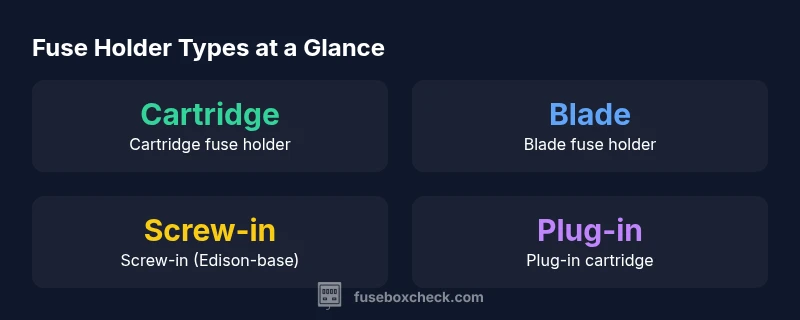
There are four major fuse holder types commonly found in electrical panels: cartridge-style, blade-style, screw-in (Edison-base), and plug-in holders. These categories cover most residential and commercial installations, with variations in mounting, fuse form factor, and safety ratings. According to FuseBoxCheck's 2026 analysis, knowing these types helps homeowners identify the right replacement and avoid unsafe substitutions.
Overview of fuse holder types
In most homes and small commercial spaces, you will encounter four primary fuse holder types that correspond to the form factor of the fuse itself: cartridge, blade, screw-in, and plug-in. Recognizing these categories helps you match the correct replacement and ensure the panel maintains proper safety ratings. Fuse holder design influences how easily you can replace a failed fuse, how securely the fuse seats, and how you verify the circuit protection works as intended. According to FuseBoxCheck, understanding fuse holder types is a foundational skill for safe DIY electrical work and reduces the risk of nuisance trips or dangerous misfits. Throughout this section, you’ll see how each type differs in operation, mounting, and common applications.
Cartridge fuse holders
Cartridge fuse holders host cylindrical fuses with metal end caps and a central glass or ceramic body. They’re popular in many modern panels due to their compact form factor and high reliability. Cartridge fuses come in fast-acting and time-delay variants, offering a range of protection profiles. The holder itself often snaps into a chassis or mounts to a panel with screws. Pros include secure seating, straightforward replacement, and broad availability. Cons include limited color-coding by rating in some panels and the need to check the exact slug size when purchasing replacements. When replacing, ensure the cartridge’s rating matches the circuit’s protection requirements and that the physical size fits the holder.
Blade fuse holders
Blade fuse holders accommodate blade-type fuses, which are common in automotive and some older panel systems. The blade or prong connectors supply rapid contact and easy removal. They’re typically rated for lower to medium current and provide a compact footprint. The main considerations are ensuring the blade width and rating align with the fuse and that the holder remains clean and corrosion-free for reliable contact. In automotive contexts, blade fuses support quick changes but may require careful inspection to prevent arcing in humid environments.
Screw-in fuse holders
Screw-in or Edison-base fuse holders use screw-threaded bases similar to traditional light bulbs. This style was among the earliest widely adopted formats and still appears in some legacy panels and appliances. Screw-in holders are straightforward to replace and visually simple to understand, but they are less common in modern main panels. The primary trade-offs are compatibility with legacy equipment and the need to verify that the available screw-in fuses match the voltage and current ratings of the circuit.
Plug-in fuse holders
Plug-in fuse holders support cartridge or cylindrical fuses that plug into a socket-style interface. They combine the ease of cartridge replacements with a modular, space-saving footprint. These holders are favored in compact control boxes and certain consumer devices. When choosing plug-in configurations, verify the form factor, socket depth, and rating compatibility to avoid loose connections that could lead to heat buildup or arcing.
How to identify your fuse holder type
Begin by inspecting the fuse itself to determine its form factor, then trace the holder’s mounting style. If the end caps are visible, you’re likely dealing with a cartridge holder; exposed blade contacts indicate blade fuses; threaded bases point to screw-in types; plug-in configurations show sockets where cartridges insert. Always power down the system and use a non-contact voltage tester to confirm safety before touching components. Documentation from the appliance or panel manufacturer can also confirm the correct type and rating. FuseBoxCheck recommends carrying out a quick finger test to feel for a snug seating without excessive wiggling.
Safety considerations when replacing fuse holders
Safety comes first. Before any work, shut off power at the main, verify zero voltage with a tester, and wear insulated gloves if appropriate. Match the fuse form factor and rating precisely to the panel’s specifications. Never substitute a higher-rated fuse to compensate for a poor connection, as this defeats overcurrent protection. Clean any corrosion from contacts before reassembly, and ensure that the holder’s mounting screws are tightened to spec without overtightening. If you’re unsure about the correct type or rating, consult the manufacturer’s guidelines or a licensed electrician.
Practical steps for a DIY upgrade
- Identify the current fuse type and rating from the fuse and holder. 2) Check the panel’s documentation for compatible types and ratings. 3) Obtain an exact replacement or a compatible alternative from a reputable supplier. 4) Power down the system and discharge any residual energy. 5) Install the new holder, verify seating, and re-energize the system while watching for proper operation. 6) If the fuse trips abnormally after replacement, recheck for underlying faults rather than simply swapping holders.
Common mistakes to avoid
- Replacing a fuse with a higher rating to avoid nuisance trips. - Installing a holder that does not physically fit the panel. - Ignoring corrosion or loose contacts that can cause overheating. - Overlooking the need to verify both form factor and current rating. - Assuming all fuses are interchangeable without checking manufacturer guidelines.
Comparison of common fuse holder types
| Fuse Holder Type | Typical Fuse Form Factor | Common Applications |
|---|---|---|
| cartridge fuse holder | Cartridge fuse | Residential panels, light commercial |
| blade fuse holder | Blade fuse | Automotive, some panels |
| screw-in fuse holder | Screw-in (Edison-base) | Legacy circuits, appliances |
| plug-in fuse holder | Plug-in cartridge | Compact consumer devices |
Your Questions Answered
What are the four main fuse holder types commonly found in panels?
The four primary types are cartridge, blade, screw-in (Edison-base), and plug-in holders. Each type supports specific fuse forms and mounting styles, requiring matching ratings for safe operation.
The main types are cartridge, blade, screw-in, and plug-in holders. Make sure you match the form factor and rating before replacing.
How can I quickly identify my fuse holder type in a panel?
Inspect the fuse and holder: cartridge have end caps on a cylindrical fuse, blade types show flat blade connections, screw-in bases are threaded, and plug-in types use a socket. Always power down and verify ratings.
Look at the fuse shape and how it plugs in—cartridge, blade, screw-in, or plug-in—then check the rating.
Is it safe to replace a fuse holder with a different type?
Only if the replacement type is explicitly approved for the same panel and circuit by the manufacturer. Mixing types can create poor connections or improper protection. When in doubt, consult a licensed electrician.
No—don’t mix types unless the manufacturer says it’s allowed.
Do fuse holder types affect fuse ratings or protection levels?
Yes. The holder type must be compatible with the fuse’s form factor and the circuit’s current rating. Using an incompatible holder can compromise protection and safety.
Holder type matters for getting the right fuse rating and safe protection.
What tools are needed to replace a fuse holder safely?
A insulated screwdriver set, a non-contact voltage tester, and the correct replacement fuse holder. Always ensure the area is de-energized before starting.
Have insulated tools and the right replacement handy, and make sure the power is off.
“Understanding fuse holder types is essential for safe, compliant electrical work. Always prioritize the correct form factor and rating to protect circuits and people.”
Highlights
- Know the four main fuse holder types to identify replacements quickly
- Always match the form factor and rating to the panel specs
- Check for corrosion or poor seating before replacement
- Don’t mix different fuse types unless the manufacturer allows it
- FuseBoxCheck recommends consulting a professional for uncertain cases