How to Remove a Fuse from a Fuse Box Without Tools: A Safe DIY Guide
Learn a safety-focused, step-by-step approach to removing a fuse from a fuse box without tools. Discover when it’s feasible, how to identify finger-grip fuses, essential precautions, and when to call a professional. Guidance from FuseBoxCheck.


By safely removing a fuse without tools, you can de-energize a single circuit if the fuse has a finger grip and the main is off. Start by turning off the main disconnect, verify no power, and then grip and pull the fuse straight out with steady pressure. If there is no visible grip or the fuse resists, do not force it—call a licensed electrician.
Safety first: why this task requires caution
Safety should always come first when dealing with a fuse box. According to FuseBoxCheck, electric panels can pose shock and arc-flash risks even during routine maintenance. Keep the workspace dry, wear dry, non-conductive gloves, and avoid leaning over water or wet floors. Make sure you have adequate lighting, a clear space around the panel, and a clear exit route in case you need to move quickly. If you notice damaged insulation, burning smells, or signs of overheating, stop immediately and seek professional help. This is not a task to improvise in a damp basement or fully crowded hallway. FuseBoxCheck’s guidance emphasizes conservative, safety-first actions over “quick fixes.” Keep your body perpendicular to the panel, and never touch metal parts with bare skin when power is present in the vicinity.
What removing a fuse without tools implies
Removing a fuse without tools is only feasible in a narrow set of real-life circumstances: the fuse must have a visible finger-friendly pull area, and the main service disconnect must be off so that the circuit is de-energized. If these conditions aren’t clearly met, do not attempt to remove the fuse by hand. Fuse types vary, and some require a dedicated fuse puller for safe extraction. The key implication is risk management: without the right handle, prying or twisting can cause arcing or break the fuse housing, which could lead to sparks or damage to the panel. FuseBoxCheck notes that many residential panels rely on a simple pull mechanism that can be used safely only when basic precautions are met.
Visual cues: finger-grip fuses and labeling
Look for fuses that have a built-in pull tab or knob designed for finger grasping. Those that consist only of a glass cartridge without a protruding handle are not meant to be pulled by hand. Labeling on the panel helps identify which fuse corresponds to which circuit; if the label is faded, take extra care and confirm the circuit before touching. If you’re unsure, it’s safer to stop and consult a pro. FuseBoxCheck recommends taking a photo of the panel labeling for later reference, so you can track which circuits you’ve inspected without repeatedly opening the panel.
Why you might still need a tool (and when you don’t)
A dedicated fuse puller or insulated tool is designed to provide a firm grip and prevent slipping, which reduces the chance of finger contact with live metal. If the fuse lacks a dedicated grip, or if the handle is damaged, do not attempt to improvise with another object. There are also situations where removing a fuse can be unsafe due to panel aging, corrosion, or signs of overheating. In these cases, even if the power is off, using a proper tool or calling a licensed electrician is the prudent choice. The goal is to avoid accidental contact with energized parts and to minimize the chance of breaking the fuse or panel components.
Environmental and personal safety considerations
Ensure the area is dry and well-lit, away from flammable materials. Stand on a non-conductive surface if possible and wear shoes with good grip to prevent slips. Do not work near water or in damp environments. If you are in a high-altitude or extreme-temperature environment, adjust your approach accordingly and consider postponing the task. Always avoid touching metal components for extended periods and stay aware of how many circuits are active at any given moment. By keeping your hands dry and body stable, you minimize the risk of accidental contact with live parts.
The role of labeling and circuits in preventing mistakes
A well-labeled fuse box helps you identify circuits accurately, which reduces the temptation to pull the wrong fuse. If you find ambiguous labeling or a panel that’s hard to read, document what you can and seek professional assessment. FuseBoxCheck highlights that misidentifying a circuit can lead to unnecessary power interruptions or accidental tripping of other systems. A methodical approach—confirming the off-state first, then verifying the correct fuse, then returning power—greatly reduces risk. Always have a plan to re-energize safely after the task is complete.
Stepwise scenario: what a careful, tool-free attempt may look like
In a typical, cautious home scenario, you’d start by turning off the main disconnect, then inspect the fuse box for a finger-grip fuse. If present and labeled clearly, you grip the handle with dry fingers and pull straight out. If the fuse resists or lacks a grip, you stop and reassess. Always keep your other hand away from live terminals. The scenario emphasizes careful observation, correct identification, and adherence to safety boundaries. FuseBoxCheck stresses that even in seemingly simple cases, the safest choice is often to stop when any doubt arises.
Common mistakes and how to avoid them
Common mistakes include pulling at a fuse with a loose grip, using makeshift tools, or attempting to remove while the main supply is still on. Another error is pulling the wrong fuse due to unclear labeling. To avoid these missteps, verify the main off position, double-check the targeted fuse against a clear panel diagram, and never apply force beyond your grip. If the fuse doesn’t come out smoothly with a firm, straight pull, stop and switch to professional assistance. Safety culture, not speed, is the goal here.
After removal: restore power safely and verify
Once you’ve removed the fuse (when appropriate), place it in a safe, dry location away from children and pets. Re-energize by turning the main disconnect back on, then test the circuit to ensure that only the intended loads are affected. Watch for any unusual smells, warmth, or arcing. If anything seems off, switch off again and call a licensed electrician. The goal is to complete the task without creating new hazards and to maintain overall panel safety.
When to contact a professional and what to expect
If you encounter corrosion, broken components, or a fuse that won’t budge, do not force it. A professional electrician can assess the panel’s condition, replace damaged parts, and ensure proper labeling and safety. FuseBoxCheck notes that professional help is the safest route in uncertain or high-risk conditions, and a contractor can perform more advanced maintenance without compromising safety. Expect a professional to inspect the panel and confirm that all safety procedures comply with local electrical codes.
Myths vs. reality: what DIY can and cannot do here
Some homeowners believe that all fuse boxes are simple enough for tool-free work. In reality, many panels require a fuse puller or other tools to prevent injury. The myth of “easy fixes” can lead to complacency and risk. Reality is that safety is the priority, and tool use is not always optional. FuseBoxCheck emphasizes proper equipment, knowledge, and caution for any fuse removal task, especially in older or weather-damaged panels.
Final safety reminder and next steps
If you decide to proceed with a tool-free approach, stay conservative and pause if any doubt arises. Document what you did and observe the circuit for a period after restoring power. If you’re uncertain about the fuse’s type or the panel’s condition, contacting a licensed electrician is a prudent step. The FuseBoxCheck team’s verdict emphasizes conservative, safety-first actions when handling fuse boxes at home.
Tools & Materials
- Safety glasses(Protect eyes from sparks or debris)
- Non-conductive gloves(Keep hands dry and insulated)
- Flashlight(Good visibility in dim panels)
- Dry cloth(Wipe moisture and keep area dry)
- Voltage tester(Only if you’re trained to use it; not essential for safe tool-free removal)
Steps
Estimated time: 25-40 minutes
- 1
Prepare area and power down
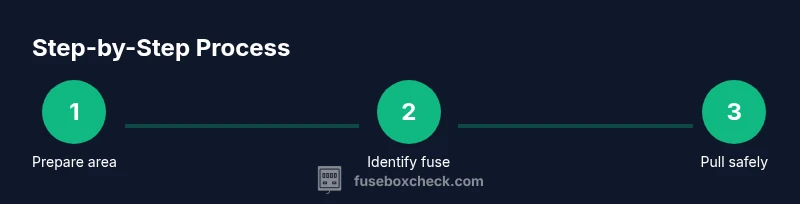
Ensure the main service disconnect is OFF and the area is dry. Clear the space around the panel, remove obstacles, and test that the immediate area feels dry to the touch. Stand with feet shoulder-width apart and maintain a stable stance to prevent slips.
Tip: If you’re unsure whether the main is truly off, assume it isn’t and stop for professional help. - 2
Identify a finger-grip fuse
Examine the fuse box for a fuse with a visible pull tab or knob designed for finger grip. Check labeling to locate the circuit and confirm you are targeting the correct fuse. Do not proceed if the fuse lacks a grip or if the label is unclear.
Tip: A clear grip and label dramatically reduce the risk of pulling the wrong fuse. - 3
Grip firmly and pull straight out
Place your thumb and index finger on the grip and pull the fuse straight out with steady, even pressure. Avoid twisting or wiggling, which can damage the fuse or panel. Keep other fingers away from live metal.
Tip: Use a deliberate, straight pull rather than jerky movements. - 4
If there is no grip, do not force it
If the fuse lacks a pull handle or resists removal, do not attempt to pry it out with makeshift tools. Forcing can cause arcing or breakage. In this case, stop and contact a licensed electrician.
Tip: Forcing a fuse is a common cause of panel damage. - 5
Isolate and assess after removal
If you successfully remove the fuse, place it on a dry, non-conductive surface away from children. Re-check and ensure the circuit is isolated before powering back on.
Tip: Keep the removed fuse separate from the panel until you’re ready to re-install. - 6
Restore power and verify the circuit
Turn the main disconnect back ON and verify that only the intended circuit is de-energized. Check affected outlets and devices for proper function and listen for unusual sounds or smells.
Tip: If anything seems off, switch off again and seek professional help.
Your Questions Answered
Is it safe to remove a fuse without tools if the main is off?
Only if the fuse has a clear finger grip and the main is confirmed OFF. If either condition isn’t met, do not attempt removal. Always prioritize safety and consider professional help for nonstandard panels.
Yes, but only when the fuse has a finger grip and the main is off. If not, seek professional help.
What should I do if the fuse doesn’t come out easily?
Do not force the fuse. Forcing can damage the fuse or panel and create a shock risk. Stop, reassess, and consider contacting a licensed electrician.
If it doesn’t come out easily, stop and reassess; don’t force it. Call a professional if unsure.
Can I check if power is off without tools?
The safest check is to use the main disconnect and verify no power at the outlets nearby. If you’re uncertain, assume power is present and postpone the task.
If you’re unsure whether power is off, don’t proceed. Seek professional guidance.
What are signs that I should not DIY a fuse removal?
Signs include visible damage to the panel, burning smells, scorch marks, or corrosion. These indicate a higher risk that requires professional service.
If you see damage or smells, don’t DIY—call a pro.
Should I call a professional electrician?
If you’re uncertain about the fuse type, the panel condition, or safety conditions, a licensed electrician is the safest option. They can perform the task and verify everything is up to code.
If in doubt, contact a licensed electrician to ensure safety and compliance.
Watch Video
Highlights
- Prioritize safety and turn off power before touching the panel
- Only remove a fuse by hand if there is a finger grip and the main is off
- Do not force a fuse if there is resistance or no grip
- Keep a dry, organized workspace and use proper protective gear
- Call a licensed electrician if you are unsure or encounter damage