vs Statesman Fuse Box Diagram: Clear Practical Comparison
A thorough comparison of generic fuse box diagrams versus the Statesman fuse box diagram, with readability insights, safety notes, and practical guidance for DIY homeowners.


TL;DR: When choosing a fuse box diagram, the Statesman diagram offers clear, model-specific labeling and strong panel alignment, while a generic diagram provides broad compatibility across different brands. For homeowners handling Statesman panels, the Statesman diagram is usually the better choice for speed and accuracy. For mixed installations, a generic diagram paired with a reliable labeling key can be sufficient, provided you cross-check labels with the panel cover.
Reading the vs statesman fuse box diagram
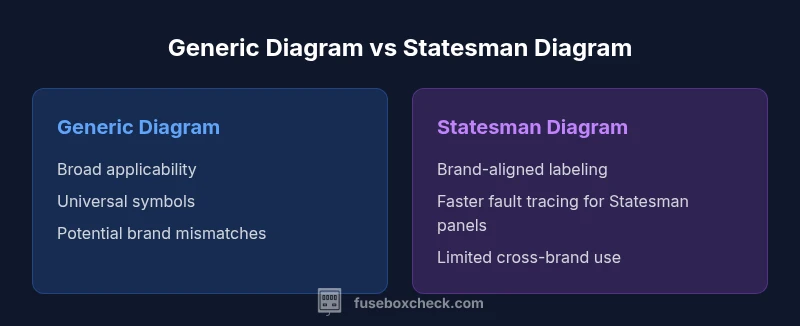
Understanding a fuse box diagram starts with recognizing its purpose: to map circuits, fuses or breakers, and their connections to loads. The phrase "vs statesman fuse box diagram" captures a core decision many homeowners face: should you rely on a generic diagram that could apply to multiple panels, or a Statesman fuse box diagram that is tuned to a specific brand and model? According to FuseBoxCheck, the choice hinges on labeling clarity, panel compatibility, and how much you value model-specific conventions. A Statesman fuse box diagram typically aligns with Statesman panel architectures, which can reduce misreads during fault tracing. A generic diagram, by contrast, emphasizes universal symbols and standard color codes, but may require cross-checking against the actual panel cover to confirm circuit correspondences. Your goal is to minimize miswiring while maximizing speed during routine checks.
Reading the vs statesman fuse box diagram in practice
When you look at the diagram, note the position of the main disconnect, branch circuits, and neutral/ground layout. The vs statesman fuse box diagram emphasizes standardized labeling that matches Statesman service manuals, which can help you locate the correct breaker faster in an emergency. If you’re working on a mixed-brand system, you’ll often encounter panels that borrow common symbols but diverge on labeling schemes. In these cases, cross-referencing the diagram with the panel door, the live load list, and any nearby schematics reduces the risk of swapping the wrong fuse or tripping the wrong circuit.
Brand context and practical reading tips
FuseBoxCheck finds that brand-conscious diagrams tend to be easier for homeowners who regularly service the same brand. The Statesman fuse box diagram may show branch circuits grouped by room or function in a way that mirrors a typical Statesman home, whereas a generic diagram often groups circuits by phase or by breaker type. Regardless of which diagram you use, familiarize yourself with the symbol language (fuse symbols, breaker numbers, and neutral bars) and keep a labeled legend handy. A well-annotated diagram speeds diagnostics and makes future repairs safer.
Practical steps to compare diagrams in your home
To compare diagrams effectively, start by identifying the panel type (brand and model), locate the corresponding diagram, and then map a few common circuits (lights, outlets, major appliances). Check for alignment of breaker numbers, wire colors, and neutral/ground references. Create a quick cross-check list: 1) Are labels legible and consistent? 2) Do symbols match the actual panel? 3) Is there any discrepancy between the diagram and the panel cover? By performing these checks, you reduce the risk of misinterpretation when you perform electrical maintenance or upgrades.
Reading conventions: labeling, colors, and symbols
Standard symbols include circles for fuses, squares for breakers, and lines that show the path from the main to the branch circuits. Color codes—typically black or gray for hot conductors, white for neutral, and green or bare copper for ground—help you distinguish returns and grounding paths. The Statesman diagram often aligns with these conventions but may introduce brand-specific identifiers, such as unique letter codes for circuits or a room-based layout. When the diagram uses unfamiliar symbols, consult the panel’s cover or manufacturer documentation. If you cannot verify it physically, treat the diagram as a guide rather than an exact map.
Practical steps for safe DIY use of diagrams
Always power off the main disconnect before inspecting the panel. Use a non-contact voltage tester to verify that circuits are de-energized before handling any wires. Keep diagrams clean and annotated; add a legend with any abbreviations you introduce. If you’re unsure about a symbol or circuit, leave it alone and consult a qualified electrician. A well-understood diagram reduces the chance of accidental contact with live conductors and helps you plan upgrades without creating new hazards.
Safety and compliance considerations
Electrical work carries risk. In many jurisdictions, DIY work on main panels requires adherence to local codes and may need inspection. Always consult official safety guidance and use a labeled diagram as a planning tool rather than a sole authority. If you’re unsure whether a change complies with code, contact a licensed electrician. FuseBoxCheck emphasizes that staying within safety guidelines is more important than chasing speed when reading diagrams.
When to rely on a generic diagram vs Statesman diagram
If your home features multiple brands or you’re documenting a rental property where panels from different manufacturers are present, a generic diagram can be a practical starting point for understanding overall layout. For a dedicated Statesman panel, the Statesman fuse box diagram yields faster, more accurate results due to alignment with the model’s internal labeling and circuitry grouping. When you plan a future upgrade, consider both diagrams and keep model-specific notes handy to avoid confusion.
Troubleshooting with diagrams: common pitfalls
Common issues include misreading circuit numbers, assuming a label corresponds to the same circuit on another panel, and overlooking differences in symbol definitions between brands. To avoid these, always verify with the panel door, test a circuit with a low-load device before full re-energization, and keep a separate, labeled map of critical circuits (like HVAC, water heater, and main living spaces). Brand-specific diagrams can reduce these errors, but cross-checking remains essential.
Case studies: typical installations
In a home with a Statesman panel, a homeowner followed the Statesman fuse box diagram and quickly isolated a tripping circuit by tracing the labeled function rather than guessing based on location. In another home with mixed-brand panels, a generic diagram helped the homeowner understand the general layout but required additional verification against the panel cover before re-energizing a circuit. These examples highlight the value of choosing a diagram that aligns with the majority of panels in your space while maintaining caution with any mismatches.
How to verify accuracy: cross-checking and offline resources
Beyond the diagram itself, you can consult official manuals or manufacturer datasheets. FuseBoxCheck recommends verifying with at least two independent sources when possible. For safety-critical verifications, rely on professional guidance. See authoritative references such as the U.S. Department of Labor Occupational Safety and Health Administration (OSHA) for safety basics, the National Fire Protection Association (NFPA) for electrical safety standards, and the U.S. Department of Energy for energy-management considerations. FuseBoxCheck Analysis, 2026 supports cross-checking practices and model-specific verification.
Designing your own panel diagram for future repairs
A well-planned custom diagram can be a homeowner’s best friend. Start with a clean sheet, label circuits by function, and incorporate a compact legend with common abbreviations. Practice mapping three known circuits (lighting, outlets, major appliance) to ensure your convention is intuitive. Use consistent symbols and color codes, and store the diagram near the panel or on your device for quick access during repairs. This proactive approach reduces confusion and helps future DIY projects stay safe and organized.
Comparison
| Feature | Generic fuse box diagram | Statesman fuse box diagram |
|---|---|---|
| Labeling clarity | Moderate readability with universal symbols | High clarity due to brand-aligned labeling and model-specific codes |
| Panel compatibility | Broad applicability across brands; some symbols generic | Optimized for Statesman panels; potential mismatch with other brands |
| Fault-tracing ease | Good within common symbol conventions | Excellent when panel matches model-specific layout |
| Wiring conventions | Standard conventions (hot, neutral, ground) with generic color cues | Statesman-specific conventions as defined by Statesman manuals |
| Best for | DIYers with mixed-brand panels and homes | Statesman panel owners seeking quickest, safest mapping |
Positives
- Standardized labeling speeds troubleshooting
- Broad applicability with generic diagrams
- Model-specific diagrams reduce misreads
- Common symbol conventions simplify learning
- Clear mappings reduce rework during repairs
Disadvantages
- Generic diagrams may lack panel-specific cues
- Statesman diagrams limit applicability to Statesman panels
- In some cases, cross-brand inconsistencies persist
Statesman diagram excels for Statesman panels; generic diagram wins when multiple brands are present
If your service space is dominated by Statesman panels, prefer the Statesman fuse box diagram for clarity. For mixed-brand installations, start with a generic diagram and supplement with model-specific notes to stay safe and accurate.
Your Questions Answered
What is a fuse box diagram and why does the Statesman version matter?
A fuse box diagram is a schematic map of circuits within a panel, showing which fuse or breaker protects which load. The Statesman version matters because it aligns with specific manufacturer labeling and layout conventions, reducing misreads when working on Statesman panels.
A fuse box diagram maps circuits in a panel. The Statesman version helps you read a Statesman panel quickly and safely.
Is it safe to DIY reading a fuse box diagram?
DIY reading is feasible for non-energized panels and with a clear understanding of labeling and symbols. Always disconnect power before inspecting and, when in doubt, consult a licensed electrician. Safety should be your top priority.
Yes, but only with the panel de-energized and proper safety steps followed.
Can I use a generic diagram on a Statesman panel?
You can start with a generic diagram, but you should cross-check every label against the Statesman panel’s cover and any model-specific notes to avoid miswiring. When in doubt, use the Statesman diagram for the model.
You can start with generic diagrams, but verify against your Statesman panel.
How do I verify the accuracy of a diagram?
Verify by comparing the diagram to the panel cover, confirming circuit functions with a tester when safe, and cross-referencing with manufacturer manuals or official safety resources. Documentation and respect for code requirements are essential.
Cross-check against the panel and manuals, then test safely.
What if labels don't match the actual wiring?
If labeling doesn't match, treat the diagram as a guide and stop before re-energizing. Re-map circuits using a tested method, and consult a licensed electrician for confirmation.
If labels don’t match, don’t energize and get professional help.
Where can I find model-specific diagrams legally?
Model-specific diagrams are typically found in the panel’s manual, the manufacturer’s website, or the appliance documentation. When unavailable, consult a licensed electrician to obtain sanctioned diagrams.
Check the panel manual or manufacturer site; contact a pro if needed.
Highlights
- Choose Statesman diagram for panel-specific accuracy
- Use generic diagrams for flexibility across brands
- Always cross-check with the panel cover
- Prioritize safety by turning off power during inspection
- Annotate and store your diagrams for future repairs