What Size Fuse for Solar Panel: A Practical Guide
Learn how to size the fuse for a solar panel circuit safely and code-compliant, including how to apply the 1.25×Isc rule, wire ampacity checks, and common DIY pitfalls.


The fuse on a solar panel circuit is sized using the panel’s short-circuit current (Isc). The general rule is to use a fuse rating of 1.25 × Isc on the array side, matching the wire ampacity and DC rating. For example, if a panel has Isc of 8 A, round up to a 10 A fuse. Always verify the conductor and fuse ratings meet local code.
Understanding Isc and fuse sizing
In solar installations, the critical quantity for fuse sizing is the panel’s short-circuit current, Isc. Isc is the maximum current the panel can produce under standard test conditions and is listed on the datasheet. It is not the same as the panel’s operating current (Imp). Using Isc as the sizing basis ensures you protect conductors and components from fault currents. Fuse placement typically occurs on the array side, between the panel and the first disconnect or combiner box. For DIYers, recognizing Isc and wire ampacity helps you avoid under-protection (fire risk) and over-protection (unnecessarily frequent trips).
According to FuseBoxCheck, understanding these fundamentals is essential before choosing a fuse rating. Reading the datasheet and noting Isc allows you to apply the standard sizing rule with confidence, especially in environments with higher ambient temperatures or long run lengths where derating matters.
The 1.25 × Isc rule explained
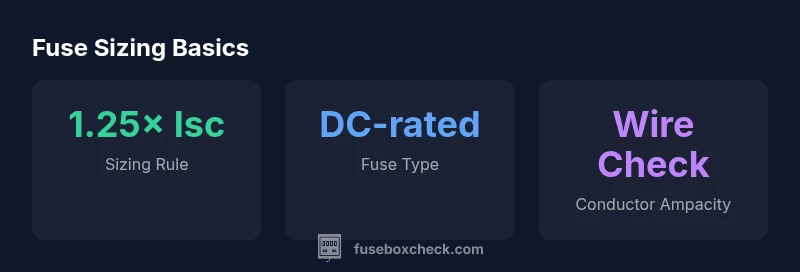
The most commonly cited rule for PV circuits is to size the overcurrent device to 1.25 times the Isc. This provides a margin for short surges and operational tolerances without unduly compromising protection. The 1.25 multiplier aligns with many code recommendations for PV source circuits and helps ensure that a fault current will trip the device before wiring or panel conductors overheat. In practice, you compare Isc from the panel datasheet, multiply by 1.25, and then select the nearest standard fuse rating that is DC-rated for PV use. Fuse manufacturers’ product data sheets often confirm that the device is suitable for DC PV applications.
When in doubt, consult local electrical codes or a qualified electrician. FuseBoxCheck’s guidance emphasizes always pairing the Isc-based fuse with the correct DC rating and conductor ampacity to maintain a safe and compliant system.
How to calculate the right fuse for your system
Calculating the correct fuse size involves a few straightforward steps:
- Step 1: Locate the Isc value on the solar panel datasheet. If you have multiple panels in an array, determine the Isc for the array configuration (series vs. parallel).
- Step 2: Multiply Isc by 1.25 to obtain the base fuse rating. For an Isc of 8 A, 1.25 × 8 = 10 A.
- Step 3: Choose the next standard DC-rated fuse rating at or above that value (e.g., 10 A or 15 A, depending on availability and wire ampacity).
- Step 4: Check the wire’s ampacity for the run from the panel to the disconnect. The fuse should not be rated higher than what the wiring can safely carry.
- Step 5: Apply any temperature derating. In high-ambient-temperature conditions, consider a conservative adjustment to preserve protection.
- Step 6: Document the sizing decision and the rationale for future maintenance or inspection. Following a documented method helps with troubleshooting and code compliance.
Wire ampacity and temperature considerations
Wiring used in PV circuits has a specified ampacity, which defines how much current the conductor can carry continuously without overheating. The fuse should not exceed the wire’s ampacity rating, even if the 1.25 × Isc calculation suggests a larger rating. Temperature affects both the conductor and the fuse itself; hotter conditions can reduce the current-carrying capacity of wires and alter fuse performance. In practice, you may derate fuse ratings by a small percentage per degree Celsius above standard ambient conditions. Always verify that the selected fuse remains within the safe operating window for all operating temperatures expected at your site.
Fuse selection should also consider the distance between the panel and the disconnect; longer runs increase voltage drop and heat, reinforcing the need for careful fuse sizing and conductor choice.
Choosing fuse type and placement
PV fuses are DC-rated devices designed for solar applications. Do not substitute standard AC fuses or automotive fuses without verifying DC rating and electrical characteristics. Place the fuse as close as practical to the panel or within the disconnect box on the array side, so it protects the wiring from the source, not just the inverter or load side. If you’re using a combiner box, you may need individual fuses for each branch or a main fuse sized to accommodate the total Isc of the array. The goal is rapid disconnection of fault current while preserving the integrity of conductors and equipment.
Practical sizing examples
- Example A: A single panel with Isc = 8 A. 1.25 × Isc = 10 A. Choose a 10 A DC-rated fuse (nearest standard rating) that is compatible with the panel wiring. This provides protection for typical wiring up to 10–12 AWG, depending on run length and insulation.
- Example B: A three-panel array in series with Isc = 12 A. 1.25 × Isc = 15 A. Select a 15 A DC-rated fuse. If the run uses smaller gauge wire, you might raise to 20 A to avoid nuisance trips, but only if the conductor ampacity supports it and per code guidelines.
- Example C: A mixture of panels with an Isc range of 3–6 A per panel in a parallel configuration. The array Isc is near the sum of the individual Isc values, so sizing may be around 6–8 A. A 6–8 A fuse in DC-rated form could be appropriate, depending on the actual wiring and connector arrangement.
Safety, code considerations and common mistakes
- Do not use fuses not rated for DC PV service or fuses not specifically designed for solar use. DC arcs can behave differently than AC arcs; the wrong fuse may fail to interrupt fault current promptly.
- Avoid under-sizing. If the fuse is too small, nuisance trips or insulation damage can occur during surge events. If the fuse is too large, wiring may heat up before the fuse trips, increasing fire risk.
- Do not rely solely on a single fuse for the entire system when multiple panels are involved; consider per-branch protection or a properly rated main fuse in series with the array.
A disciplined approach, referencing the 1.25×Isc rule and verifying conductor ratings, is the best path to a safe, code-compliant installation.
Tools and safety checklist
- Multimeter or PV-rated clamp meter to verify Isc and loop continuity
- DC-rated PV fuses and compatible holders/disconnects
- Wire ampacity tables and the manufacturer’s wiring guidance
- Personal protective equipment (PPE) including insulated gloves and eye protection
- A project checklist to confirm Isc, fuse rating, wire size, temperature considerations, and code requirements before energizing the system
Next steps for DIYers
If you are unsure about any sizing aspect, pause and consult a licensed electrician. Use the Isc-based method as your foundation, but tailor the sizing to your specific wire gauge, run length, and ambient conditions. Document all decisions for future troubleshooting, and double-check that all components (fuse holders, breakers, and disconnects) are rated for DC PV service. With careful planning, your solar panel circuit will stay protected and compliant.
Example fuse sizing guide by Isc and panel type
| Panel Type | Isc (A) | Recommended Fuse (A) |
|---|---|---|
| Monocrystalline 60 W panel | 3.0 | 4 |
| Polycrystalline 120 W panel | 5.0 | 6 |
| Three-panel series array | 9.0 | 10 |
Your Questions Answered
What is Isc in solar panels?
Isc is the short-circuit current rating of a solar panel, representing the maximum current the panel can produce under standard test conditions. It forms the basis for fuse sizing in PV circuits.
Isc is the panel's maximum current under standard conditions, and it’s what we base fuse sizing on.
Why multiply Isc by 1.25 for fuses?
The 1.25x factor provides a margin to cover surge currents and manufacturing tolerances while keeping protection effective.
The 1.25x rule adds a safety margin for surges and tolerance, keeping protection reliable.
Can I use automotive fuses for PV circuits?
Automotive fuses are not recommended unless they are DC-rated and explicitly specified for PV use. PV applications require proper DC ratings and characteristics.
Generally, avoid automotive fuses unless they’re rated for DC PV use.
Where should the fuse be installed?
Place the fuse on the array side, as close to the panels as practical, so it protects the wiring from the source to the disconnect or combiner box.
Put the fuse near the panels so it protects the wiring from the source.
What if I have multiple panels in series/parallel?
For series strings, size the fuse based on the string’s Isc. For parallel configurations, sum the Isc and size accordingly, ensuring each branch is protected.
For strings, size per string Isc; for parallel, size to the total Isc.
Are there exceptions for inverters or charge controllers?
Inverters and charge controllers have their own protection requirements. Ensure PV-side fusing complies with the device manufacturer guidelines and applicable codes.
Follow the device’s protection guidelines and code requirements for PV-side fusing.
“Sizing PV fuses correctly is critical for protecting conductors and preventing fires; under-sizing can lead to arc faults, while over-sizing reduces protection effectiveness. Follow the Isc-based rule and verify conductor ratings.”
Highlights
- Size the fuse to 1.25 × Isc on the array side
- Always verify wire ampacity matches the fuse and run length
- Use DC-rated fuses designed for PV circuits
- Account for temperature derating in hot environments
- Document your sizing rationale for maintenance