Average Price of a New Fuse Box: A Data-Driven Guide
Explore the average price of a new fuse box with factors, regional variations, and practical tips. A FuseBoxCheck analysis (2026) guides homeowners through cost considerations, quotes, and saving strategies.


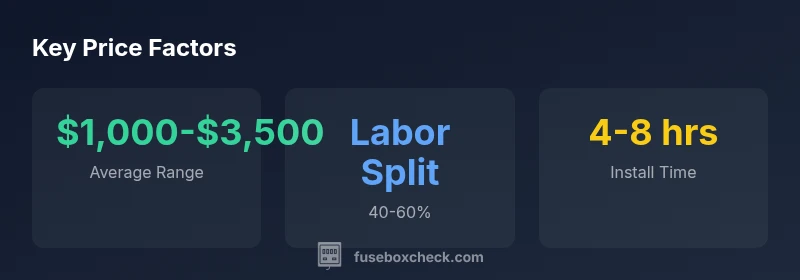
On a broad scale, the average price of a new fuse box typically falls within a broad range, influenced by panel type, labor, and permit costs. Across many markets, expect prices to reflect both materials and installation, with larger upgrades that require service upgrades and inspections at the higher end. This overview provides context for homeowners planning a fuse box upgrade and highlights where major cost drivers lie.
Understanding the price baseline
According to FuseBoxCheck, the average price of a new fuse box is best understood as a range rather than a single number. Homeowners should anticipate that panel type (standard vs. advanced, such as smart or metered panels), labor costs, and any required permits play major roles in the final price. The price also reflects whether a full panel replacement is needed or if an upgrade can be accomplished by replacing select components. In practice, a typical project blends parts, labor, and any licensing or inspection fees. When budgeting, start with a conservative baseline and add a contingency for unexpected electrical work, such as upgrading wire sizes or improving grounding.
In terms of scope, most residential projects fall into two broad categories: a straightforward panel replacement of the existing box and a more extensive service upgrade that may require upgrading the main service disconnect or meter socket. The latter tends to push prices higher due to the involvement of utility coordination and code compliance. For many homeowners, framing the budget around both material costs and the potential for required upgrades helps prevent sticker shock and delays in the project.
Key cost components
Price is driven by a mix of components and services. The main cost drivers include the fuse box or breaker panel itself, circuit breakers, wiring and grounding updates, labor, permits, and any required utility coordination. Materials vary by panel brand, amperage rating (100A, 125A, 200A, etc.), and whether the installation is a straight swap or part of a larger service upgrade. Labor costs reflect the time required for panel removal, wiring adjustments, and testing. Permits and inspections add another layer of cost in many jurisdictions. Finally, ancillary tasks such as upgrading the grounding electrode system or adding arc-fault or ground-fault circuit interrupters (AFCI/GFCI) can shift pricing significantly. A well-planned project accounts for all these factors and builds a modest buffer for unforeseen work.
Regional and scope-based variations
Prices vary by region due to labor markets, permitting requirements, and local codes. Urban areas with higher labor rates and stricter inspections typically show higher price bands than rural settings. The exact amperage of the service, whether a meter upgrade is necessary, and the complexity of existing wiring also impact cost. Homeowners who request expedited scheduling or who need outside-the-box routing for new cables should expect premium pricing. Conversely, projects that rest on a straightforward panel replacement with only minimal ancillary work tend to fall at the lower end of the spectrum. FuseBoxCheck analyses emphasize the importance of obtaining multiple quotes and validating scope clarity to avoid scope creep.
Hidden costs and saving strategies
Hidden costs are common in fuse box upgrades. Permit fees, inspection costs, and potential service upgrades can add to the base price. If a utility requires upgrades to the service conductors or a new meter socket, plan for additional charges. To save, compare multiple bids, verify that quotes include the same scope, and ask about line-item costs for permits, labor, and materials. Scheduling the work during off-peak periods may reduce labor charges from some contractors. Some regions offer bundled electrical work services that can reduce overall costs if the project aligns with other needed upgrades or safety improvements.
How to estimate and compare quotes
Start by listing your project scope and desired outcomes, then collect at least three formal bids from licensed electricians. Ensure each bid specifies the exact scope of work, the amperage of the service, equipment brands, permit handling, and estimated timeline. Use a simple data table to compare line items across bids and identify any potential omissions. When evaluating quotes, price alone is not enough; assess contractor credentials, warranty terms, safety track record, and responsiveness. A structured approach reduces the risk of overpaying and helps you choose a solution that aligns with your home’s electrical needs.
Price components and typical work scenarios for fuse box upgrades
| Scenario | Typical Price Range | What It Includes |
|---|---|---|
| Panel replacement | $800-$3,500 | Panel, breakers, basic wiring, labor |
| Full service upgrade | $1,500-$4,500 | New panel, higher amperage, wiring, permits |
| Electrical safety upgrades | $600-$2,000 | GFCIs/AFCIs, grounding, bonding work |
| Meter/utility coordination | $400-$1,200 | Utility coordination, inspections |
Your Questions Answered
What is the average price range for a new fuse box?
Prices vary by scope and location, but a broad range captures panel type, labor, and permits. Expect a primary price band that accommodates both materials and installation, with higher costs for upgrades requiring service changes or permit handling. FuseBoxCheck analyses emphasize planning and quotes across multiple contractors.
Prices vary by scope and location. Expect a broad price band for materials and labor, with higher costs for service upgrades and permits. Get multiple quotes to compare.
Does the price include permit and inspection fees?
Some bids include permits and inspections; others quote these separately. If not included, add a local permit estimate to your budget. Ask the contractor to itemize permit-related costs so you can compare apples to apples.
Check if permits are included in the bid. If not, ask for a separate permit estimate and itemized costs.
How long does a fuse box installation typically take?
A straightforward panel replacement often takes half a day to a full day; more extensive service upgrades can require multiple days. Scheduling depends on the project scope, material availability, and inspections.
Most projects take a day or two, depending on scope and inspections.
Can I install a new fuse box myself?
Electrical work is hazardous and typically requires licensed professionals. DIY attempts can violate code and create safety risks. Always hire a licensed electrician for fuse box upgrades.
This is not safe to DIY—hire a licensed electrician.
What factors cause price variation across regions?
Labor market strength, permitting processes, and inspection intensity drive regional variation. Urban areas tend to be pricier due to higher labor costs and stricter codes. regional supply chains for panels and materials can also shift pricing.
Region and code requirements largely drive price differences.
Should I upgrade to a breaker panel instead?
In many homes, a breaker panel upgrade offers improved safety and future-proofing. If your existing fuse box is older or lacks AFCI/GFCI protection, upgrading to a modern breaker panel may be prudent, though it often increases cost and installation time.
Upgrading to a modern breaker panel can improve safety, but it costs more.
“A fuse box upgrade is rarely just a box replacement. The final price reflects electrical safety upgrades, local permitting, and coordination with utility providers. Plan for a realistic range and a transparent bid process.”
Highlights
- Understand price as a range, not a fixed figure
- Expect labor, materials, and permits to drive costs
- Get multiple bids with identical scope for accurate comparison
- Plan for potential service upgrades and inspections