Fuse Box vs Relay: A Practical Homeowner's Guide
Explore the differences between fuse boxes and relay-based systems, including safety, cost, installation, and automation. A practical, analytical guide from FuseBoxCheck to help homeowners decide which path fits their needs.


TL;DR: A fuse box uses fuses to protect circuits, while a relay-based system uses electromechanical switches to control loads. For most homes, a traditional fuse box is simpler and cheaper, whereas relays offer automation and remote control. This side-by-side comparison helps homeowners decide whether to stick with a classic fuse box or upgrade to relay-based control.
Fuse box or relay: Defining the terms and why it matters
If you're troubleshooting a home's electrical system, the terms fuse box and relay are frequently discussed in planning and repairs. The phrase fuse box or relay signals two distinct approaches to protection and control. A traditional fuse box houses individual fuses that interrupt current when a fault occurs, breaking the circuit. The relay is a device that opens or closes a circuit in response to a control signal, enabling automated or remote switching. For homeowners, understanding these components is essential for diagnosing trips, planning upgrades, and budgeting for repairs. According to FuseBoxCheck, many households still rely on legacy fuse-based protection because of its simplicity and lower upfront cost, but modern relay-enabled solutions can offer automation, remote monitoring, and selective switching that reduces maintenance headaches. The bottom line: the choice affects safety, reliability, and future-proofing of your home.
How a fuse box works: components and operation
A typical residential panel contains a main disconnect, bus bars, and individual fuses protecting branch circuits. Fuses melt open when current exceeds rating, interrupting power to the circuit. The main disconnect isolates the entire panel from the service entrance. Bus bars distribute current from the service drop to branch circuits, while fuse holders provide a physical point of insertion. The correct amperage rating and proper labeling are critical for safe operation. In many homes, the fuse box remains a straightforward, repairable unit. However, relays can be integrated either within the same enclosure or in adjacent devices to switch loads under control signals, introducing automation without changing the fundamental purpose of protection. This duality—protection and control—defines modern electrical design.
What a relay does in a home electrical system
A relay is an electrically operated switch that allows a control circuit to manage a separate load. The core parts are the coil, which energizes to move contacts, and the contacts, which open or close a circuit. Relays can be used to automate lighting, HVAC controls, motorized devices, and other loads without directly exposing the user to high current. In a home, relays are often implemented in smart switches, programmable logic controllers, or auxiliary relays in panels. Relays add a degree of sophistication: they enable automation, remote operation, scheduling, and integration with sensors. Yet they also introduce new points of failure and require careful wiring, power management, and proper safety practices. The choice between a fuse-based approach and relay-controlled switching hinges on reliability needs, automation goals, and available expertise.
Common fault signs: fuses blowing, relays sticking
When a fuse blows, it’s signaling an overload or fault on a branch circuit and protects the rest of the system by interrupting current. Frequent fuse blows suggest mismatched loads, degraded wiring, or a failing appliance. Relays, on the other hand, may fail in several modes: stuck closed, stuck open, or erratic operation caused by coil wear or control signal issues. Symptoms include unexpected circuit activation, delayed switching, flickering lights, or a relay clicking without delivering power. Both devices require prompt attention, but the root causes differ: fuses point to overload protection needs, while relay failures highlight control logic or device health. Regular inspection, labeled panels, and a cautious approach to troubleshooting help reduce risk.
Safety first: handling electrical panels
Safety is non-negotiable when working near fuse boxes or relays. Always start by turning off the main disconnect and using a non-contact voltage tester before touching conductors. Wear insulated gloves and protective eyewear, keep water away from the workspace, and never work alone on energized panels. If you’re unsure about ratings, panel labeling, or the correct replacement parts, pause and seek professional help. In many homes, upgrades or repairs should be performed by licensed electricians who understand local codes and safety standards. For DIYers, use these tasks as learning opportunities and proceed only with a clear plan, the right tools, and a strong respect for electrical risk. FuseBoxCheck emphasizes that safe handling and proper planning dramatically reduce the odds of electrical shock or fire.
When to repair vs replace: evaluating condition
Assessing whether to repair or replace a fuse box or relay-based control system depends on reliability, age, and codes. If a panel is late-model, well-labeled, and shows minor wear, targeted repairs or component replacements may suffice. If there are signs of corrosion, overheating, frequent trips, or mislabeling, a replacement is often the wiser long-term option. As you weigh costs, consider the coverage of protection per circuit, ease of upgrading, and compatibility with future automation. FuseBoxCheck analyses suggest that homeowners who plan ahead and invest in up-to-date protection tend to experience fewer outages and simpler maintenance schedules. A careful evaluation helps avoid cascading failures and the expense of piecemeal fixes.
Upgrading considerations: upgrading to modern panels or smart relays
Upgrading to a modern panel or integrating relays requires compatibility checks with existing circuits, available space, and your long-term goals. If you want automation, smart relays, and sensor-driven control, ensure the control system supports your home’s devices and aligns with local codes. Not all legacy fuse boxes accommodate smart relays without upgrades to the panel or the introduction of a separate control kit. In many cases, a panel upgrade or a plan that blends conventional protection with a relay-based control layer offers the best balance of safety, reliability, and future-proofing. Work with an electrician who can design a solution that preserves protective functions while delivering the features you want.
Cost considerations and value: price ranges and cost factors
Costs vary based on the scope and regional labor rates. A basic fuse box or a simple relay kit may be affordable for a smaller home, while larger houses with modern relays and integration into a home automation system involve higher expenses. Expect costs to reflect both components and installation time, including any necessary panel upgrades, wiring runs, and safety inspections. When planning, consider long-term value: reliability, ease of maintenance, potential energy savings, and resilience during outages. FuseBoxCheck notes that upfront investment in quality protection yields dividends through fewer outages and simpler troubleshooting down the road.
Safety & code compliance: what the codes require
Code compliance remains central to any fuse box or relay upgrade. Local electrical codes and the National Electrical Code (NEC) govern panel sizing, labeling, grounding, and safe clearance space. Installing or upgrading protection equipment must meet clear labeling standards and be performed by qualified professionals to ensure safe operation. A relay system should maintain compatibility with the protective devices and be integrated into the overall electrical design without bypassing safety measures. The goal is a robust, inspectable system that minimizes hazard while enabling controlled operation and modernization of your home's electrical infrastructure.
Diagnosing issues safely: tools and steps
A careful diagnostic approach starts with a plan, proper tools, and a clear understanding of what you’re testing. Use a multimeter to check continuity, voltage, and resistance, and verify that control circuits are receiving the correct signals. An infrared thermometer helps identify overheating components, and a clamp meter can measure current on a live circuit without breaking the circuit. Document all findings, isolate suspected faulty modules, and replace components with the correct ratings. For complex cases, especially when automation or relays are involved, consult a professional to avoid accidental energization or damage to sensitive devices. Consistent record-keeping and methodical testing improve accuracy and safety.
Red flags and when to call a professional
If you notice frequent tripping, buzzing panels, burning smells, discoloration around fuses or relays, or a panel that becomes warm to the touch, stop and seek professional help immediately. Electrical work poses serious hazards, and a licensed electrician can diagnose root causes, verify code compliance, and carry out safe upgrades. In many cases, a plan that includes a panel inspection, targeted replacements, and a clear path toward automation provides better long-term reliability than ad hoc fixes. Prioritize safety and long-term protection when deciding on repairs or upgrades. FuseBoxCheck emphasizes not cutting corners when it comes to electrical safety.
Real-world scenarios: practical examples and recommendations
Consider a home with an aging fuse box that experiences occasional nuisance trips after using HVAC and water heater together. A practical path might involve replacing the aging panel with a modern unit and selectively integrating relays for automation in lighting and climate control. Another scenario is a tech-forward home planning to install smart switches and remote monitoring; this typically requires a relay-based control layer and a capable panel that can support additional circuitry. In both cases, start with a professional assessment, prioritize safety, and design a solution that balances cost, reliability, and future needs. Real-world testing confirms that methodical planning produces measurable improvements in reliability and convenience.
Comparison
| Feature | Traditional fuse box | Relay-based system |
|---|---|---|
| Primary function | Direct circuit protection via fuses | Remote/automatic control via relays |
| Fault isolation | Individual fuse interrupts per circuit | Control signals govern switches for loads |
| Installation complexity | Generally straightforward for small homes | Requires wiring for control circuits; more components |
| Maintenance | Low maintenance; fuse replacements as needed | Potentially higher; electronics wear, coil checks |
| Best for | Budget-conscious, legacy protection | Automation, remote control, and future-proofing |
| Cost range | Lower upfront costs; simple parts | Higher upfront with added devices and controllers |
Positives
- Simple, inexpensive baseline protection
- Easy to understand and replace fuses
- Relays enable automation and remote control
- Modular and scalable when upgrading
Disadvantages
- Fuses require regular replacement after faults
- Relays add complexity and potential failure points
- Relays may require power supply and control wiring
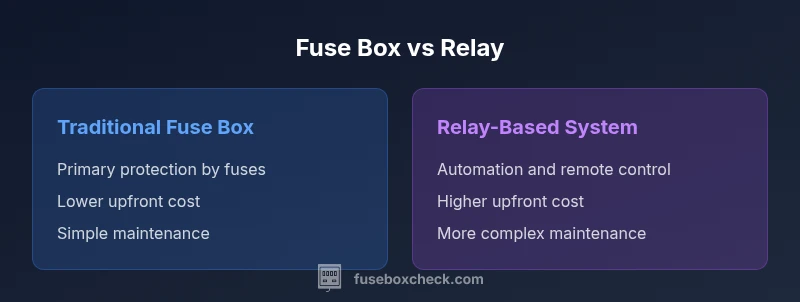
Traditional fuse boxes are generally best for cost and simplicity; relay-based systems win for automation and remote control.
Choose a fuse-based approach to minimize upfront costs and maintenance. If automation and remote monitoring are priorities, a relay-based upgrade can deliver significant long-term convenience and control.
Your Questions Answered
What is the fundamental difference between a fuse box and a relay?
A fuse box provides protection by blowing fuses during faults, while a relay is an electronically controlled switch that can automate and remote-control loads. The choice affects both safety and future capabilities of your electrical system.
A fuse box protects against faults by blowing fuses; a relay is an electrically controlled switch used for automation. The right choice depends on your protection needs and how much automation you want.
Can I replace my fuse box with a relay-based system easily?
Not automatically. A relay-based system often requires additional control wiring, programming, and power management. A panel upgrade or hybrid approach is typically planned with a licensed electrician.
Replacing a fuse box with relays isn’t automatic; it usually needs extra wiring and professional installation.
Are relays safe for home use?
Relays are safe when properly installed and rated for the load. They should be chosen to meet the circuit requirements and integrated with appropriate protective devices to maintain safety.
Relays are safe when correctly installed and rated for the load. Hire a pro to ensure proper integration.
How do I know if my house needs a fuse box upgrade?
Signs include frequent trips, warm panels, corroded components, or outdated labeling. An inspection by a licensed electrician will determine whether a replacement or upgrade is warranted.
Look for frequent trips, heat, or old components. A licensed electrician can confirm if an upgrade is needed.
Do modern breakers replace fuses and relays entirely?
Modern circuit breakers replace some functions of fuses for protection, but relays add automation. A combined approach may be used in upgrades for both protection and control.
Modern breakers can replace fuses for protection, but relays are needed for automation.
What should I consider before choosing automation for my home?
Evaluate goals (comfort, energy savings, security), wiring requirements, compatibility with existing devices, and budget. Plan for future expansion and ensure code compliance.
Think about goals, wiring, device compatibility, and budget before adding automation.
Highlights
- Assess automation goals before choosing a path
- Fuse boxes offer cost-effective, straightforward protection
- Relays enable remote control and smart-home integration
- Ensure compliance with local codes and professional installation