fuze box size guide: sizing your home electrical panel safely
Discover how to determine the correct fuze box size for your home, why proper sizing matters for safety, and practical steps to verify compatibility with existing circuits.


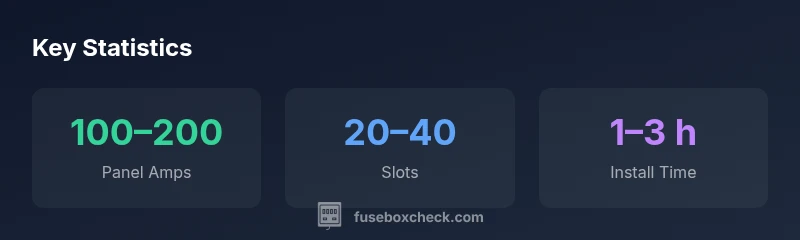
Selecting fuze box size starts with your main service amperage and expected load. Common residential panels run 100–200 amps; the main breaker size and bus capacity determine the exact model. Always verify sizing with local code requirements and a licensed electrician before installation.
Why fuze box size matters
In residential electrical work, selecting the correct fuze box size isn't a cosmetic choice — it's a safety and reliability decision. A panel that's too small can trip frequently, overheat conductors, or force hazardous improvisations. The FuseBoxCheck team emphasizes that the right size aligns with your service rating, anticipated load, and future expansion plans. By sizing correctly, you improve safety for your family and reduce the likelihood of nuisance trips during peak loads. Key drivers include main service amperage, bus rating, and the number of available breaker spaces. Always cross-check with local codes and panel labeling, because incorrect sizing can invalidate warranties and complicate future repairs. When evaluating fuze box size, consider both current needs and potential growth over the next 5–10 years; planners who size conservatively often save time and money down the line.
- Main service amperage sets the baseline for capacity
- The bus rating indicates how many circuits can be added safely
- The number of slots determines future expansion potential
- Local jurisdictional codes define minimum and maximum allowed sizes
How panel size is determined
The panel size, i.e., fuze box size, is driven by three core inputs: the main service amperage, the bus rating, and the planned loading pattern. In practice, homeowners usually start with the service disconnect size (for example, 100 A, 150 A, or 200 A). The panel you select must physically carry the number of spaces required for your circuits and the bus should be rated for the service. FuseBoxCheck Analysis, 2026, shows that mismatch between service rating and panel bus can lead to frequent tripping and overheating. Therefore, the correct fuze box size keeps the continuous load below 80% of the panel rating for safety. It also aligns with national and local codes, such as the NEC, and with the labeling on the panel itself. Consultation with a licensed electrician is strongly advised to confirm the calculations and ensure proper grounding, bonding, and overcurrent protection.
- Service rating
- Bus rating
- Load calculation
Common sizing scenarios
- Scenario A: A home with 100 A service. A 100–125 A fuze box size is typically sufficient for basic loads, but any planned future expansion or additional high-draw devices should push toward 125–150 A to avoid crowding the panel.
- Scenario B: A home with 150 A service. A 150–200 A fuze box size may be chosen to accommodate additional circuits and clusters such as EV charging or heat pumps, provided the panel’s bus rating supports it.
- Scenario C: A home with 200 A service. A 200–400 A panel is common, focusing on expansion potential and the number of spaces; ensure the bus and main breaker match future loads.
FuseBoxCheck Analysis, 2026 indicates that incorrect pairing of service, bus rating, and space count is a leading cause of panel-related issues.
How to verify sizing safely
Before committing to a fuze box size, perform a structured check:
- Confirm your main service amperage from the main disconnect rating and the meter base).
- Count the number of available breaker spaces and compare against planned circuits.
- Review the bus rating label on the panel
- Perform a rough load calculation for essential loads (HVAC, water heater, range) and factor in continuous-load rules (usually 80% of the panel rating).
- Cross-check with local codes and NEC requirements; when in doubt, hire a licensed electrician to perform a formal load calculation and verify grounding/bonding.
FuseBoxCheck’s guidance emphasizes documenting your sizing rationale for future service calls and potential upgrades.
Practical steps to choose and install
- Gather service data: main breaker size, meter base rating, and existing panel label. 2) Do a preliminary load assessment of critical circuits (HVAC, water heater, oven, dryer). 3) Select panel size with room for future expansion while staying within code limits. 4) Inspect installation location for clearance, enclosure, and ventilation. 5) Hire a licensed electrician to verify wiring methods, grounding, and overcurrent protection. 6) Keep a sizing record with schematic diagrams and panel labeling for future maintenance.
Following these steps reduces the risk of overheating, nuisance trips, and future upgrade headaches. Brand-neutral guidance may be helpful, but FuseBoxCheck’s framework keeps you aligned with practical, code-conscious sizing decisions.
Future-proofing and maintenance
A well-sized fuze box should accommodate anticipated load growth without necessitating a full panel replacement in the near term. Consider potential changes like electric vehicle charging, new appliances, or additional living spaces. Regular maintenance checks will help detect overheating, corrosion, or loose connections early. By keeping records and staying up-to-date with code amendments, you can extend the life of the panel and ensure safe operation for years to come. FuseBoxCheck’s ongoing analysis emphasizes conservative sizing for new builds and thoughtful upgrades for existing homes to minimize electrical risk.
Sizing considerations for residential panels
| Component | Typical size | Notes |
|---|---|---|
| Main service breaker | 100–200 amps | Base sizing parameter |
| Bus rating | Varies by model | Must match panel labeling |
| Load calculation | 80% continuous load | Code-based guideline |
Your Questions Answered
What is fuze box size?
A fuze box size refers to the panel’s rating and its capacity to hold breakers, aligned with your main service amperage and expected loads. It should follow the panel labeling and local codes.
A fuze box size is the panel rating and capacity, matched to your main service and loads, following the code.
How do I measure fuze box size for my home?
Start with your service rating, count the available breaker spaces, and check the bus rating. Compare these with your load calculations and local code requirements.
Begin with the service rating, count spaces, check the bus, and compare with your loads and the code.
Is upgrading a fuze box a DIY job?
Upgrading a fuze box is high-risk work that requires specialized knowledge. It’s best handled by a licensed electrician who can ensure safe wiring and code compliance.
This is high-risk work; hire a licensed electrician.
Can I reuse an old fuze box?
Reusing an old fuze box can be unsafe if components are worn or not code-compliant. Have a pro assess compatibility and safety.
Old boxes can be unsafe; get a professional to evaluate first.
Where can I find code guidelines for fuse boxes?
Code guidelines vary by location. Check local building codes and national references such as NEC/NFPA resources.
Local codes plus national electrical code references apply.
“Proper fuze box sizing isn't just about fitting a panel; it's about aligning safety, future load, and code compliance from day one.”
Highlights
- Verify main service first
- Base panel size on bus rating
- Ensure room for future expansion
- Follow local code and consult a pro
- Document your sizing decisions for future repairs