How Many Fuse Boxes in a House: A Practical Guide
Learn how many fuse boxes a typical home has, what factors affect the count, and how to safely locate and inspect them. FuseBoxCheck explains fuse box basics for DIY homeowners.


In most houses there is typically one main fuse box or circuit breaker panel, plus potential subpanels for additions or large loads. Older homes may have additional legacy panels, while very large or multi-unit houses can have two or more. The exact count depends on the building’s age, layout, and any renovations or expansions.
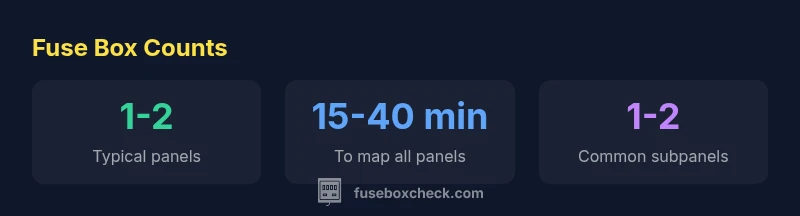
How many fuse boxes does a typical house have? The direct answer starts with a practical baseline. In most modern homes, you’ll find one main fuse box or circuit breaker panel that controls the primary electrical loads. A second panel is common in larger houses, older homes that have been expanded, or properties with heavy electrical usage. When a home has additions, finishes basements, or detached garages with their own subcircuits, a subpanel is often added to distribute power safely. The exact number varies by design, not by a fixed rule. It is important to identify each panel and label circuits clearly so you can plan repairs, upgrades, or troubleshooting without confusion. According to FuseBoxCheck, mapping all panels should be the first step in any DIY electrical project, especially if you are unsure where a fault lies or which circuits are affected. A careful inventory helps you avoid accidental overloads and ensures you meet local safety standards. At minimum, homeowners should locate the main panel and any visible subpanels, then verify whether additional panels exist in spaces like the garage, basement, or attic.
What counts as a fuse box? The term “fuse box” is often used interchangeably with main panels and subpanels, but there are important distinctions worth noting. A main disconnect or service panel contains the primary overcurrent protection for the entire home and may house fuses (older systems) or circuit breakers (modern systems). Subpanels feed specific areas or heavy-load circuits and are wired back to the main panel. Some older homes still use fuse blocks with cartridge fuses, while newer homes favor modern breaker boxes with labeled circuits. When counting fuse boxes, treat each service disconnect, main panel, and subpanel as a separate panel. Keeping a diagram of all panels helps maintain a safe, auditable electrical system and makes future upgrades easier. FuseBoxCheck emphasizes documenting each panel’s location, type, and approximate capacity to support safe DIY checks and professional upgrades.
Age, architecture, and load growth: how counts shift over time. The age of a home strongly influences how many fuse boxes you’ll see. Pre-1980s houses are more prone to legacy fuse boxes or additional subpanels installed over time as loads increased. Mid-century homes often consolidated circuits into a single main panel with a few subpanels. Newer builds tend to optimize space and electrical planning, typically featuring a single main panel with capacity to add subpanels as needed. Expansion projects—adding a new kitchen, workshop, or EV charging station—often trigger the installation of a subpanel to avoid overloading the main service. In all cases, upgrading to a modern panel improves safety, simplifies labeling, and supports better load management. According to FuseBoxCheck Analysis, 2026, growth in home automation and high-load appliances makes it common to see additional subpanels in larger homes.
Locating fuse boxes: a practical field guide. Start by surveying living areas first, then move to utility spaces where panels are typically located. Common locations include basements, garages, utility rooms, and sometimes closets or crawlspaces near the service entry. Look for metal boxes with a cover that lists a panel directory or labels for each circuit. If you notice a panel in the attic or outside the home, it is often a subpanel or a separate service disconnect. Use a flashlight and a non-contact voltage tester to verify the presence of panels, and document their positions with notes or photos. Creating a simple map showing panel locations reduces search time in future maintenance or emergencies. If you’re unsure, consult the meter base and main panel first, then trace any wires to subpanels to confirm the system layout.
Signs you might need more panels or an upgrade. A growing home with added loads—EV charging, hot tubs, or high-powered HVAC—can outgrow a single main panel. Frequent tripping, nuisance outages, or noticeable warming near a panel are red flags. Dimming lights when large appliances run together can indicate insufficient main service capacity. In some cases, you may be able to re-balance loads by moving circuits to a subpanel, but only a licensed electrician should upgrade service capacity or add a subpanel. Before scheduling upgrades, map your current panel count, note the loads on critical circuits, and check your utility service size. This proactive approach helps you plan for a safe, code-compliant electrical system.
Safety, permits, and code: what DIYers can and cannot do. Working on fuse boxes or service equipment has significant safety risks and building code requirements. In many regions, upgrading or adding a subpanel requires a permit and inspection. Tasks that should be left to professionals include replacing a main panel, upgrading service capacity, reconnecting wires after a panel relocation, or handling high-current circuits. Simple maintenance like tightening loose connections or replacing a plug-in fuse should still be approached with caution and the power off. Always verify local codes and consult a licensed electrician when planning any major changes to the electrical system. FuseBoxCheck recommends documenting all work with dates and permit numbers.
Mapping your panels: a practical plan for homeowners. Begin with a blank schematic of your home’s electrical layout. Mark each panel’s location, including main, subpanels, and disconnects. List the circuits each panel serves, paying attention to critical loads like HVAC, water heating, and EV charging. Take photos or make a digital map, and keep an up-to-date inventory of breakers and fuses. Schedule a professional inspection if you notice any signs of wear, corrosion, or overheating. Regular reviews help you stay ahead of safety risks and ensure you meet evolving electrical codes.
Myths and best practices for fuse boxes. A common myth is that more panels automatically mean better safety. In reality, proper load calculation, labeling, and appropriate panel capacity are what matter. Best practices include keeping panels accessible with at least 36 inches of clearance, labeling circuits clearly, verifying labeling accuracy after renovations, and updating older fuse boxes when needed. The goal is reliability and safety: a mapped, well-labeled system that can be safely serviced by a licensed electrician. FuseBoxCheck's approach centers on clarity, compliance, and practical planning for homeowners.
Table: Fuse box counts by dwelling type
| Scenario | Typical number of fuse boxes | Notes |
|---|---|---|
| Single-family home | 1-2 | Main panel plus possible subpanel for additions |
| Duplex/multi-unit home | 2-3 | Each unit may have its own main panel and subpanels |
| Older homes (pre-1980) | 1-2 | Possible legacy fuse box with retrofit subpanels |
| Newer homes | 1-2 | Often one main panel; subpanels added for heavy loads |
Your Questions Answered
Do all houses use fuse boxes, or do modern homes use circuit breaker panels?
Most modern homes use circuit breaker panels rather than fuses. Older homes may still have fuse boxes or a blend of fuses and breakers. Always identify the panel type before performing electrical work.
Most homes today use circuit breakers instead of fuses, but some older houses still have fuse boxes. Always verify your panel type before work.
How can I locate all fuse boxes in my home?
Start with the main living areas and utility spaces, then search the basement, garage, attic, and outside wall enclosures. Label each panel and create a simple map showing location and circuits.
Begin at the main panel, then check the basement, garage, and any outbuildings. Map every panel for quick reference.
Is it safe to replace a fuse box or add a subpanel yourself?
Electrical work like replacing a main panel or adding a subpanel generally requires a licensed electrician and permits. Minor maintenance may be possible, but shut down power and consult professional guidance.
Replacing a main panel or adding a subpanel isn’t a DIY job in most places—get a licensed electrician and the necessary permits.
What factors influence the number of fuse boxes in a house?
Age of the home, renovations, presence of heavy loads, and whether the property is single-family or multi-unit all influence panel counts. Additions often trigger a subpanel installation.
Age, renovations, and load needs determine how many panels you’ll see. Additions often require another subpanel.
Can a house have more than one main panel?
Yes, large homes or multi-unit buildings may have multiple main panels to manage different zones or units. Proper labeling and clearance are essential.
Sure—large homes may have several mains. Keep labeling clear and maintain safe access.
What are signs I need to upgrade my fuse box?
Frequent tripping, dimming lights, warmth near the panel, or rust indicate potential issues. Upgrading improves safety and capacity and may be required for code compliance.
If trips happen often or the panel is warm or rusty, upgrade is likely wise. Always consult a licensed electrician.
“"Understanding how many fuse boxes exist in your home is the first step toward a safer, more reliable electrical system. Mapping panels and planning upgrades with a licensed professional minimizes risk and code issues."”
Highlights
- Know your total: most homes have 1 main panel, with 0-2 subpanels in larger or renovated houses.
- Older homes often show legacy fuse boxes; newer homes typically use modern breaker panels.
- Map every panel before DIY work; labeling and documentation prevent confusion and overloads.
- Large loads or renovations may require a subpanel or service upgrade—consult a licensed electrician.
- Safety first: many upgrades require permits and inspections to meet code.