Relay with Fuse: Safe DIY Wiring Guide
Learn to choose, install, and test a relay with fuse in home circuits. This FuseBoxCheck guide covers coil voltage, fuse sizing, wiring diagrams, and essential safety practices for DIYers.


You will learn how to select, install, and test a relay with fuse in a low-voltage control circuit. This includes choosing coil voltage and contact rating, wiring safely, and verifying operation with a multimeter. By following the steps, you reduce risk and ensure reliable control. This quick guide links to a full step-by-step tutorial for safe home electrical work.
What is a relay with fuse and why it matters
A relay with fuse is a compact device that couples a switching relay with an inline protective fuse to safeguard a circuit. In many DIY and professional setups the fuse protects the power supply side and the load, while the relay provides isolation and control. This combination reduces clutter and simplifies troubleshooting, especially in low-voltage control circuits such as door openers, lighting controllers, and HVAC relays. According to FuseBoxCheck, properly selecting coil voltage and contact rating is critical to prevent nuisance trips and ensure reliable operation. The core idea is simple: when the coil is energized, the relay closes or opens a set of contacts to switch the load, and the fuse interrupts current if something goes wrong. Using a fused relay also provides a clear maintenance point—a visible fuse that can be checked or replaced without digging through multiple components. For DIYers, a fused relay minimizes wiring complexity and enhances safety by consolidating protection and switching in a single module.
How it protects circuits and typical applications
The protection mechanism is twofold: the fuse stops excessive current from flowing into or through the circuit, and the relay handles the load switching without exposing the control side to the high current. In a typical automotive or home-automation project, you wire the coil to a low-voltage control signal and route the high-current path through the relay contacts. If the load current or a short triggers overcurrent, the fuse melts and interrupts the circuit, preventing damage to wires, devices, and power supplies. FuseBoxCheck's analysis, 2026, emphasizes selecting a fuse with a rating that matches the load's normal operating current and surge characteristics, while leaving a safety margin for startup spikes. The relay's contact rating should also exceed the maximum expected current, otherwise contacts can weld shut or wear prematurely. This arrangement is popular for controlling motors, pumps, heaters, or lighting circuits where a compact, integrated protector is beneficial. Always ensure your wiring path minimizes path length and avoids heat buildup around the fuse and relay. Fuse-bearing modules should be enclosed or mounted to avoid accidental contact and to keep fingers away from live terminals.
Key specifications to check before you buy
When evaluating a relay with fuse, the most important specifications are coil voltage, contact configuration, and contact rating. Coil voltage must match your control circuit (for example 12 V or 24 V DC). Contact configuration (SPST, SPDT, NO/NC) determines how the relay will switch the circuit. The contact rating, typically expressed in amps at a certain voltage, must exceed the load current plus a safety margin. The integrated fuse type (slow-blow vs fast-acting) affects protection in transient conditions; ensure the fuse rating is compatible with startup surges. Another practical factor is the physical footprint and mounting method—some units fit on a common 1- or 2-4" relay board, while others come in sealed enclosures for damp environments. Look for certifications or UL-style listings if the device will power critical loads. For those wiring in a panel, verify clearance and insulation around the fuse holder to avoid arcing. Finally, check that the device supports the environmental temperature range of your installation and that the wiring terminals accept the gauge of wire you plan to use.
Wiring fundamentals: coil voltage, contact rating, and fuse sizing
Coil voltage must match your control signal (12 VDC or 24 VDC are common in home automation; AC variants exist but are less common in DIY). The relay's contact rating should exceed the maximum current and voltage of the load. Fuses come in fast-acting or slow-blow types; for motors or equipment with startup surges, a slow-blow fuse is often preferred. The fuse rating should be slightly above normal operating current but well below the wire's insulation and device limits. When wiring, use appropriate gauge wires (e.g., 14-18 AWG for low-current circuits, larger for higher loads) and keep leads short to minimize voltage drop. The fuse should be placed on the supply side to guard both the load and relay coil. Avoid looping the coil and load wires in a way that creates electromagnetic interference.
Safe installation workflow: planning, wiring, and testing
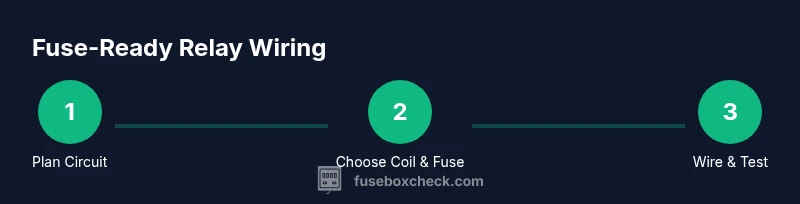
Plan by drawing a simple schematic that shows the control circuit, the relay coil, the load path, and the fuse location. Power down all sources and use proper lockout/tagout if available. Prepare wiring by selecting connectors, stripping insulation, and organizing wires for neat routing. Make connections with the coil to the control signal, and route the load current through the relay contacts with the fuse in series on the supply line. Inspect every connection for oxidation, loose terminals, and insulation damage. Test first with a low-current, power-limited source; energize the coil and observe the load behavior. If everything works as intended, power up fully and monitor for heat or arcing. Finally, document your wiring with a schematic and labels for future maintenance.
Common mistakes and how to avoid them
Common mistakes include using the wrong coil voltage, underestimating the load current, or selecting a fuse rating that is too close to normal operating current. Avoid mounting the fuse in a location prone to vibration or moisture; inappropriate placement can cause intermittent protection. Do not skip insulation or enclosure; exposed terminals pose shock and arc risks. Always test with the power off first, then verify operation with a current-limited source before full power. Keep control and power wiring separate to minimize interference and ensure clear fault isolation. Regularly inspect the fuse and relay for signs of overheating, corrosion, or loose connectors, and replace components that show wear.
Tools & Materials
- Relay with fuse module (12 V or 24 V coil, NO/NC option)(Choose a module with rated current above your load; ensure integrated fuse matches load startup current and wire gauge.)
- Multimeter(Used to verify coil voltage, measure resistance, and test continuity.)
- Insulated screwdrivers (Phillips and flathead)(For safe terminal connections.)
- Wire strippers/crimpers(Prepare control and load wires; keep strips clean and even.)
- Appropriate gauge wire (e.g., 14-18 AWG for low current, larger for higher loads)(Match to fuse rating and terminal size.)
- Fuse (matching rating)(Use a fuse rated for the expected current and surge characteristics.)
- Mounting hardware and enclosure(Keeps components protected and organized.)
- DC power supply or battery (for coil)(Ensure supply matches coil voltage.)
- Protective gloves and safety glasses(Personal protective equipment during wiring.)
Steps
Estimated time: 60-90 minutes
- 1
Identify circuit requirements
Define the load, expected current, voltage, and control method for the relay with fuse. This helps determine coil voltage, contact rating, and fuse size. Create a simple schematic showing the control side, the load side, and fuse placement.
Tip: Document the load’s normal operating current and peak startup current to guide fuse sizing. - 2
Select coil voltage and contact rating
Choose a coil voltage that matches your control signal (commonly 12 V or 24 V DC in home DIY projects). Pick a contact rating that exceeds the load current plus a safety margin. Verify whether SPST, SPDT, or NO/NC configuration suits the circuit.
Tip: Opt for a slightly higher rating than the minimum to extend relay life. - 3
Choose fuse type and rating
Decide between fast-acting and slow-blow fuses based on the load type. Motors and inductive loads benefit from slow-blow fuses; electronics may use fast-acting variants. Match the fuse rating to the load’s startup surge and a safe operating current.
Tip: Avoid overrating; a fuse too large defeats protection, increasing risk. - 4
Plan wiring path and tools
Lay out a clean wiring route with separation between control and power conductors. Gather the tools and materials, and plan strain relief and strain-free connections. Ensure there is an enclosure or shield around live terminals.
Tip: Keep wires short and well-secured to prevent accidental snagging. - 5
Connect the coil, contacts, and fuse
Connect the coil to the control signal with correct polarity. Wire the load through the relay contacts and place the fuse in the supply path. Tighten terminals and check for bare copper exposure.
Tip: Double-check terminal numbers against the schematic before powering. - 6
Test and verify the installation
With power limited, energize the coil and observe load switching. Use the multimeter to verify coil voltage and continuity on the load side. If possible, test under nominal load and record readings.
Tip: If the relay doesn’t switch, recheck connections and verify fuse integrity. - 7
Label, document, and finalize
Label wires, attach a clear diagram to the panel, and store the device’s datasheet. Note fuse rating, coil voltage, and contact configuration for future maintenance.
Tip: Keep a maintenance log for quick troubleshooting later.
Your Questions Answered
What is a relay with fuse and how does it work?
A relay with fuse combines a signal-controlled switch (relay) with an inline protective fuse. The fuse interrupts current if a fault occurs, protecting both the wiring and the load. This setup simplifies protection and switching in one compact module.
A fused relay is a small unit that switches a circuit and protects it with an integrated fuse. If something goes wrong, the fuse blows and stops current flow.
Do I need a fuse on both the relay and the circuit?
Typically, the fuse in a fused relay protects the circuit it powers. You usually do not need an additional fuse on the same circuit unless there are unique risk factors or very long wiring runs.
Usually just one fuse protects the circuit through the relay; additional fuses are only necessary for special cases.
What coil voltages are common for control circuits?
Common control coil voltages are 12 VDC and 24 VDC for low-voltage home projects. Some relays support 120 VAC or 240 VAC coils for mains-powered control, but those require different safety considerations.
Most home DIY projects use 12 or 24 volts DC for the relay coil.
Can a fused relay be used in mains circuits?
Yes, but only with relays and fuses rated for mains voltages and installed following strict electrical safety standards. Use enclosures, proper insulation, and protective gear, and consult a licensed electrician for higher-risk applications.
Mains work is possible, but it’s safer to consult an electrician for high-voltage setups.
How do I verify the fuse sizing is correct?
Compare the load’s normal operating current to the fuse rating, allowing a small safety margin for startup surges. Use the load’s datasheet or measured current, and choose a fuse that protects wire insulation and devices without nuisance blows.
Make sure the fuse is rated a bit above the normal load current but well below what would damage the wiring.
What tests confirm proper operation after install?
Test with the power off to check wiring, then energize the coil and observe that the load switches as intended. Use a multimeter to verify coil voltage and continuity, and check for overheating or arcing after test runs.
Turn everything on slowly and watch for proper switching and any signs of overheating.
Watch Video
Highlights
- Choose the correct coil voltage for the control circuit
- Ensure the fuse rating matches load current with a safe margin
- Verify wiring with a multimeter before applying full power
- Document wiring and keep protective enclosures for safety