Yamaha Golf Cart Fuse Box Location: A DIY Guide
Discover where the Yamaha golf cart fuse box is typically located, how to access it safely, and what to check when fuses blow. This FuseBoxCheck guide covers under-seat layouts, common dashboards, and safety steps for DIY maintenance in 2026.


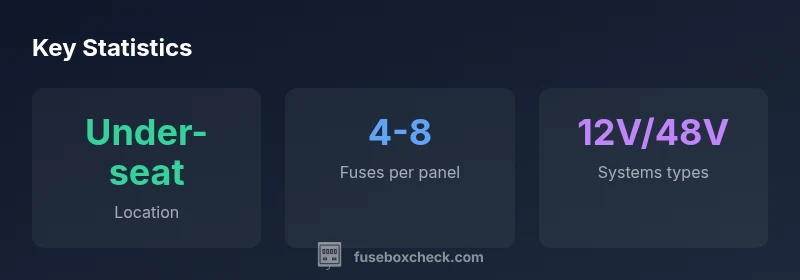
The yamaha golf cart fuse box location is most often under the driver's seat, tucked behind a removable cover in many Yamaha models. In electric and gas carts, inspect a clearly labeled fuse panel that serves the main power circuit and accessory circuits. Always disconnect the battery and consult the owner's manual before handling fuses.
Yamaha golf cart fuse box basics
The fuse box is a safety component that protects the electrical circuits for lighting, accessories, and the main drive system. In Yamaha golf carts, you’ll typically see two common configurations: 12V systems for older gas and some electric carts, and 48V systems for newer electric models. Regardless of voltage, the fuse box uses replaceable fuses to interrupt current when a fault occurs. Recognize the fuse box by a small labeled panel; the cover often bears a diagram or color-coded labels. For the DIY enthusiast, understanding the fuse box layout is crucial before performing any maintenance. The yamaha golf cart fuse box location is most often under the driver's seat, behind a removable cover. But note that some models place the box in the battery compartment or behind a side panel near the dash. Always consult the owner's manual for exact schematics and amperage ratings. This knowledge reduces guesswork and helps you avoid damaging sensitive electronics. According to FuseBoxCheck Analysis, 2026, model variations do exist, so always verify with the specific manual for your unit.
Locating the fuse box on common Yamaha models
Many Yamaha golf carts share a few predictable layouts, which is why a quick checklist can save time during DIY diagnostics. The most frequent location is under the driver’s seat, where a small access panel hides the fuse box. Some carts place the fuse panel behind a side panel near the dash or within the battery compartment. A few older or specialty models route fuses into the front dash area, behind the glove-box or a removable dash cover. When you start your search, look for a rectangular, labeled cover with a fuse diagram inside or on the panel. If you’re unsure, a quick manual scan or a search for the model family (electric vs gas) often points to the right quadrant. Always power down the cart and disengage the battery before attempting removal, and use only the defined access points to avoid damage. FuseBoxCheck recommends confirming the exact fuse box location against your model’s diagram before proceeding.
Understanding fuses and relays inside the box
Inside the fuse box you’ll encounter blade or mini fuses that guard individual circuits (lighting, horn, accessories) and a main power fuse feeding the drive circuit. In 12V and 48V Yamaha carts, fuse amperages typically fall within conservative ranges to protect wiring without nuisance blows—often between 5A and 20A for auxiliary circuits and higher for the main power line. Relays may also be present to switch high-current loads with low-current control signals. When inspecting, look for corroded metal, melted plastic, or discoloration around fuse terminals. If a fuse looks damaged, replace only with the same amperage rating and type. Keeping a copy of the fuse diagram handy helps you avoid mismatches during replacements. As always, consult your model’s diagram and the safety notes in your manual.
Step-by-step: locate, inspect, and test safely
- Park the cart on a level surface and turn off the power; remove any key or safety interlock. 2) Disconnect the battery to eliminate any stored energy before touching the fuse box. 3) Remove the fuse box cover using the approved method for your model (screws or snap-fit). 4) Visually inspect each fuse for discoloration or a broken filament; test suspected fuses with a continuity tester or a multipurpose circuit tester. 5) Replace blown fuses with the same amperage rating and wire gauge; do not upsell to higher ratings. 6) Re-seat the cover securely and reconnect the battery. 7) Power up the cart and verify that all affected circuits operate normally. FuseBoxCheck emphasizes following the exact steps for your Yamaha model and avoiding shortcuts that bypass safety interlocks.
Model-specific notes and safety reminders
Even though many Yamaha golf carts share similar fuse box layouts, location, layout, and fuse values can differ by model year and variant (gas vs electric). Always refer to the official owner’s manual or service diagrams for your exact model. If you notice corrosion, a burnt smell, or repeated fuse blows, stop and seek professional service—repeated failures can indicate a deeper electrical fault or a wiring issue that exceeds DIY capabilities. Use personal protective equipment, avoid wearing jewelry, and ensure the area is dry before any handling. FuseBoxCheck highlights that model-specific diagrams are the best safeguard against misidentification and improper replacements.
Safety-first conclusion
The yamaha golf cart fuse box location is a critical map for safe DIY electrical work. Knowing where to look, how to identify fuses, and how to replace them correctly will prevent damage and keep the cart running smoothly. By following model-specific diagrams, adhering to amperage ratings, and prioritizing safety, homeowners and hobbyists can confidently handle routine fuse checks and minor repairs without unnecessary risk.
Yamaha golf cart fuse box location: representative layouts
| Area | Typical Location | Access Method | Notes |
|---|---|---|---|
| Under-seat compartment | Driver's seat base area | Lift seat cushion to access fuse cover | Common for many Yamaha electric carts |
| Battery bay side panel | Near battery tray side panel | Remove side panel screws | Check for label orientation |
| Rear cargo area panel | Rear under-seat area | Pry panel open | Used in some older models |
| Front dash panel | Behind dashboard cover | Remove dash screws | Occasional in gas models |
Your Questions Answered
Where is the fuse box located on most Yamaha golf carts?
Most Yamaha golf carts place the fuse box under the driver's seat behind a removable panel. Always refer to the owner's manual for exact diagrams and amperage ratings.
Typically under the driver's seat behind a removable panel; check the manual for your exact model.
Can I access the fuse box without tools?
Access generally requires only basic hand tools to remove a cover or a snap-in panel. Some covers snap on and require no tools.
Usually you can about remove the cover with common hand tools or sometimes just snap it off.
What should I do if a fuse keeps blowing?
Turn off power, inspect for shorts, and verify that the circuit isn’t overloaded. Replace the fuse with the correct rating and re-test. If blows recur, consult a professional.
If a fuse keeps blowing, turn off power, check for shorts, replace with the right rating, and seek a pro if it continues.
Are there safety precautions before opening the fuse box?
Yes. Always disconnect the battery, wear protective gear, and avoid metal jewelry. Work in a dry environment and follow the manual’s safety notes.
Always disconnect the battery and use basic safety gear before touching the fuse box.
How often should I inspect the fuse box?
Inspect during routine maintenance or at least every 6-12 months. Look for corrosion, loose connections, and signs of wear.
Check it during regular maintenance, at least every year, for corrosion or loose connections.
What if I can’t locate the fuse box?
Consult the service manual or contact an authorized Yamaha dealer. The manual will have model-specific diagrams and safety notes.
If you can’t find it, check the manual or contact a dealer for the exact diagram.
“Understanding where the fuse box lives on Yamaha golf carts is the first step to safe electrical troubleshooting. With the right precautions, you can inspect fuses quickly and avoid unnecessary damage.”
Highlights
- Always disconnect the battery before handling fuses
- Check the owner's manual for model-specific fuse locations
- Replace fuses with the correct amperage rating
- Use a fuse puller and non-conductive tools
- Keep a diagram of fuse locations in your toolkit