Fuse Box Y16 Error Guide: Urgent Diagnosis and Fixes
Urgent guidance for diagnosing and fixing the fuse box Y16 error. Learn safety steps, common causes, step-by-step fixes, and prevention tips from FuseBoxCheck.


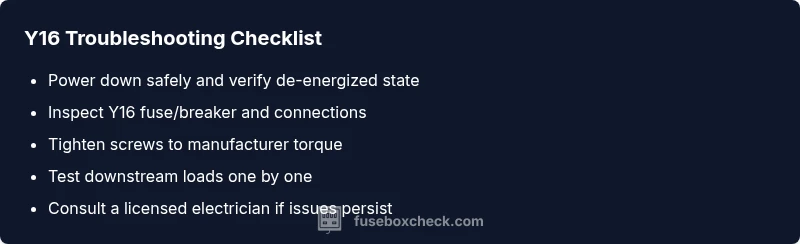
The fuse box y16 error means a fault in the Y16 circuit, often caused by a loose connection, a blown fuse, or a tripped breaker that interrupts power to the affected area. Start with safety steps: reset the main and Y16 breakers, inspect the Y16 fuse and nearby terminals for corrosion, and tighten any loose screws. If the problem persists, shut off power and call a licensed electrician.
What the Fuse Box Y16 Error Means for Your Home
The term fuse box y16 refers to a specific circuit designation within a home’s electrical panel. When the Y16 circuit trips or signals an error, it usually indicates an interruption in power to the zone that feeding that circuit. This could be due to a weak connection, a worn fuse, moisture exposure, or a short in the downstream loads. For homeowners, recognizing the urgency is crucial: a recurring Y16 fault can be a symptom of broader panel health concerns, including aging components or overload risks. Throughout this guide, we’ll reference practical, safety-first steps that align with typical residential configurations while acknowledging that every panel may have unique labeling and components. FuseBoxCheck emphasizes cautious handling, p. 2026 guidelines, and avoiding any improvisations that could jeopardize safety.
What the Fuse Box Y16 Error Means for Your Home (continued)
In many homes, Y16 will be part of a mapping that groups circuits by room or function (kitchen, living area, HVAC, etc.). If Y16 trips frequently, it may point to a specific load pattern or an intermittent connection rather than a continuous fault. Always treat a tripping panel as a safety hazard until proven otherwise. The primary purpose of diagnosing the Y16 fault is to determine whether it’s a simple reset, a repairable connection, or a larger panel issue that warrants expert attention. FuseBoxCheck’s 2026 analysis underscores that many Y16-related problems resolve with careful inspection and tightening, but persistence signals the need for professional evaluation.
What the Fuse Box Y16 Error Means for Your Home (final note)
Knowing the basics helps you act quickly without compromising safety. If you’re unsure at any stage, pause, turn off power to the affected circuit, and call a licensed electrician. The goal is to restore reliable power while preventing fire risk and equipment damage.
Quick Safety Mindset for Y16 Issues
Safety first: never touch live terminals, avoid working on a damp surface, and wear rubber-soled shoes. Use insulated tools if you must intervene and keep a fire extinguisher accessible nearby. If you suspect moisture or signs of burning, evacuate and contact emergency services if needed.
Steps
Estimated time: 60-90 minutes
- 1
Power down safely
Stand on a dry surface, shut off the main disconnect, and switch off the Y16 breaker. Verify there is no residual power by testing a nearby outlet with a non-contact tester. This prevents shock while you inspect the panel.
Tip: Keep a flashlight handy and avoid touching metal components with bare hands. - 2
Check for obvious signs
Look for burnt smells, discoloration, or melted insulation around the Y16 area. If you see signs of overheating, do not proceed—call a professional immediately.
Tip: Do not handle damp components; moisture dramatically increases shock risk. - 3
Reset and test the Y16 circuit
With power still off, reset the main and Y16 breakers by fully cycling them off and on. Then restore power and observe whether the Y16 indicator clears or returns.
Tip: If the breaker trips again instantly, something is wrong downstream—do not re-energize. - 4
Inspect the Y16 fuse and terminals
Carefully remove the Y16 fuse or the corresponding breaker cover and reseat terminal screws. Look for looseness, corrosion, or signs of arcing and clean or replace as needed following manufacturer guidelines.
Tip: Use a voltage tester to verify terminals are de-energized before touching. - 5
Tighten and secure connections
Using the correct screwdriver, tighten all screws on the Y16 terminal block and any lug connections involved in the path. Loose connections are a common cause of intermittent faults.
Tip: Avoid over-tightening, which can damage threads or strips threads. - 6
Test downstream loads individually
One by one, re-energize circuits on the Y16 path to identify which load triggers the fault. This helps isolate a faulty appliance or wiring in a branch circuit.
Tip: Unplug heavy appliances while testing to reduce load on the circuit. - 7
Replace faulty components
If a fuse, breaker, or terminal shows wear, replace it with an equivalent-rated part. Do not improvise the rating; mismatched parts can create fire or shock hazards.
Tip: Only use components rated for your panel model and label. - 8
Decide on professional help
If the problem persists after the above steps, or you observe overheating signs, stop and contact a licensed electrician for a comprehensive panel inspection.
Tip: Document symptoms and times when the fault occurs to share with the pro.
Diagnosis: Fuse Box Y16 error code appears on the panel, circuits trip, or lights dim in the Y16 zone
Possible Causes
- highLoose or corroded connections around the Y16 circuit
- highBlown fuse or a weakened breaker on the Y16 path
- mediumOverloaded downstream circuits due to added appliances
- lowControl/terminal board wear or short in the Y16 segment
Fixes
- easyReset main and Y16 breakers, then test the circuit
- mediumInspect Y16 fuse and nearby terminals; reseat or replace corroded connectors
- mediumReplace the Y16 fuse or breaker if needed and inspect downstream loads
- hardSchedule a professional panel inspection if issues persist
Your Questions Answered
What does the Y16 error indicate on a fuse box?
Y16 signals a fault in the Y16 circuit. It often points to a loose connection, a blown fuse, or a tripped breaker. A thorough safety-first inspection helps determine whether a reset, tightening, or part replacement is needed.
Y16 means a fault in the Y16 circuit. Start with safety checks, inspect connections, and consider professional help if it keeps happening.
Is it safe to reset the Y16 circuit myself?
Resetting the circuit can be safe if you follow strict safety steps: switch off the main, use a tester, and avoid touching live parts. If the breaker trips again or you see damage, stop and call a pro.
You can reset with caution, but stop if it trips again or if you notice damage.
What are typical costs to fix Y16 electrical faults?
Costs vary by region and issue severity. A typical diagnostic visit plus part replacement can range from a few hundred to higher, depending on panel access and part availability. Always request a written estimate before work begins.
Diagnostic visits and part replacements vary; ask for an estimate before any work.
Can I keep using the house if Y16 trips often?
Frequent Y16 trips indicate a risk to electrical safety. Avoid overloading circuits and call a licensed electrician to diagnose and resolve the root cause before continuing normal use.
Frequent trips are a safety red flag—get a pro to fix it.
When should I consider a full panel inspection instead of a single repair?
If multiple circuits show faults or the panel feels warm, a full inspection is warranted. A pro can assess for aging components, water exposure, or panel ratings that may need updating.
If several circuits act up or the panel is warm, get a full inspection.
What tools are essential for diagnosing Y16 safely?
Essential tools include a voltage tester, insulated screwdriver set, and a clamp meter. Always wear dry footwear and avoid working on wet surfaces.
Use a voltage tester and insulated tools; stay dry and safe.
Watch Video
Highlights
- Inspect and reset carefully, but don’t force components that show damage.
- Loose connections are a frequent Y16 cause—tighten terminals safely.
- If the fault recurs, prioritize a professional panel assessment.
- Document signs to aid the technician and prevent recurrence.