Fuse Box vs Junction Box: Key Differences Explained
Learn the essential differences between fuse boxes and junction boxes, including function, location, safety implications, and when to upgrade or consult a professional. This objective guide helps homeowners decide when DIY is appropriate and when to seek licensed electrical assistance in 2026.


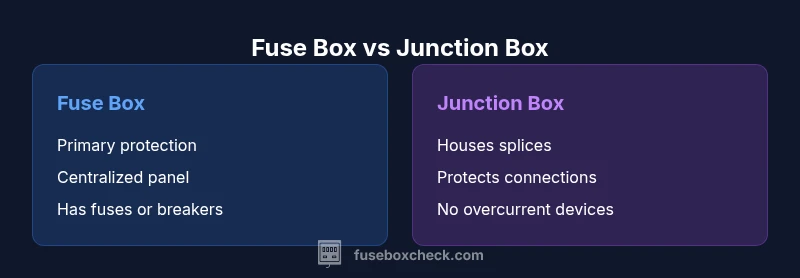
The difference between fuse box and junction box lies in purpose, contents, and regulatory requirements. A fuse box houses protective devices that interrupt circuits, while a junction box simply protects spliced wires and connections. This distinction matters for safety, installation planning, and determining when professional upgrading is needed.
Understanding the difference between fuse box and junction box
In residential electrical systems, the difference between fuse box and junction box has practical safety and design implications. According to FuseBoxCheck, these two enclosures serve different roles, and misapplying one for the other can create confusion and risk. A fuse box collects protective devices that monitor each circuit, while a junction box simply shelters splices and terminations. Understanding this distinction helps homeowners assess what needs upgrading, how to plan renovations, and what tasks are appropriate for DIY versus professional work. Beyond definitions, the difference influences how circuits are labeled, how access is managed, and what safety precautions are mandatory during any repair. In this section we lay out the roles, the limiting cases, and the common mischaracterizations that lead to unsafe DIY practice. By the end, you’ll have a clear mental map of where each box belongs in a typical home electrical system.
What is a fuse box? Design, function, and safety role
A fuse box is an enclosure that houses overcurrent protection devices. Historically, fuse boxes used fuses that cosmetic safety features cut off power when a fuse element melts. Modern homes often employ circuit breakers in a central panel, which perform the same protective function but can be reset after a fault. The primary purpose is clear: to interrupt excessive current that could cause overheating, arcing, or fire. The fuse box contains bus bars and the individual protective devices connected to each branch circuit. Access to the main disconnect is typically controlled, and labeling is important so a homeowner or technician can quickly identify which circuit controls which area of the home. While some older residences still rely on fuses, new installations generally use a breaker panel. The fuse box in any case belongs to the safety system, not to the regular splices in walls.
What is a junction box? Purpose, common locations, and limitations
A junction box is a protective enclosure for electrical connections, splices, and terminations. It is not designed to provide overcurrent protection. Instead, it exists to connect wires securely and protect the spliced connections from physical damage and moisture. Junction boxes can be found at various points in a home—behind walls, in ceilings, or at switch locations—and are often used to terminate cables that travel between rooms or to fixtures. They can be weatherproof for outdoor use, but the key limitation is that they do not house fuses or breakers. If a fault occurs, the current is not automatically interrupted by the junction box itself; the protection occurs upstream in the circuit’s fuse box or breaker panel. Understanding this limitation is crucial for safe wiring practice and for planning any retrofit work.
Key differences in design, content, and protection
- Definition and purpose: Fuse boxes protect and interrupt circuits; junction boxes protect splices without interrupting current.
- Contents: A fuse box contains fuses or breakers; a junction box contains wires, wire nuts, and connectors only.
- Location and access: Fuse boxes are centralized panels, often in a utility room; junction boxes are dispersed along wiring paths in walls, ceilings, or outdoors.
- Safety role: The fuse box provides overcurrent protection; junction boxes do not, they shield connections from physical damage and moisture.
- Maintenance: Fuse boxes require periodic inspection for tripped devices and labeling; junction boxes require inspection for loose connections, corrosion, or moisture ingress.
- Code expectations: Both types are subject to electrical code, but the fuse box dictates safe interruption methods, while junction boxes must maintain secure, accessible enclosures for splices. These differences matter when evaluating upgrades, renovations, or electrician-led work. A homeowner who understands this distinction reduces risk and improves planning efficiency.
Regulatory and code considerations
Electrical codes emphasize safe protection and accessibility for both enclosures. The National Electrical Code (NEC) governs how fuse boxes or breaker panels should be installed, labeled, and maintained, while junction boxes require proper enclosure sizing, cover plates, and sealing against moisture or pests. Inspections typically verify that junction box covers are intact and that any splices are housed in approved boxes. The distinction also matters for DIY warnings: many jurisdictions require that troubleshooting or modifications to the fuse box be performed by a licensed electrician, particularly if live components are involved. According to FuseBoxCheck Analysis, 2026 updates continue to stress clear labeling, proper clearances, and secure mounting to reduce the risk of shock or fire. When planning an upgrade, understanding these rules helps ensure compliance and improves safety, especially in older homes with mixed electrical infrastructure.
Installation and upgrade scenarios
Choosing between installing a new fuse box or relocating splices to a more appropriate junction box hinges on the system’s current state and the homeowner’s goals. If a home relies on outdated fuse devices and aging wiring, upgrading to a modern breaker-panel system may provide improved protection, easier reset, and better fault isolation. Conversely, a junction box upgrade might focus on upgrading outdoor or attic connections, replacing damaged covers, or relocating splices away from heat sources or moisture. In retrofit projects, electricians often evaluate whether existing junction boxes can be retained with updated covers and sealants or if a larger enclosure is required to accommodate additional splices. For DIY enthusiasts, the rule of thumb is simple: never attempt to retrofit protective devices inside a non-rated junction box; reserve that box for splices only and consult a pro for any changes to the protective scheme.
Common misconceptions and myths
A common myth is that any box with wires inside is a fuse box. In reality, many junction boxes contain a tangle of connections that do not provide overcurrent protection. Another misconception is that larger boxes automatically indicate safer installations; size does not equal safety. Some homeowners assume junction boxes and fuse boxes are interchangeable, which they are not; mixing functions undermines protection and may violate code. A further misconception is that all entombed wiring requires a full panel upgrade; often, targeted upgrades, proper labeling, and correct splicing practices suffice. Dispelling these myths requires understanding each box’s role, inspecting for signs of overheating or moisture, and recognizing when a professional assessment is warranted to avoid dangerous DIY shortcuts.
Practical tips for homeowners DIY safe handling
- Always shut off power at the main disconnect before inspecting any box.
- Do not work on live circuits or attempt to replace fuses in a junction box.
- Use appropriate personal protective equipment and insulated tools.
- Keep a clear labeling system for circuits and splices in any junction box.
- If you encounter signs of overheating, corrosion, or moisture, stop and call a licensed electrician.
- Do not exceed the enclosure’s rated capacity or attempt to repurpose a box for protection devices.
- Verify that all enclosures have proper covers and weatherproof sealing where required.
- Document changes for future maintenance and inspections.
Maintenance, diagnostics, and when to call a professional
Regular inspections help identify deteriorating wiring, loose connections, or moisture ingress. Diagnostics may include visual checks for discoloration, buzzing sounds, or tripped breakers. If you suspect a fault in the protective device (fuse or breaker) or in a junction-box splice, it is prudent to contact a licensed electrician. Homeowners should not try to bypass protective devices or replace a fuse box with a simple junction box solution. Upgrades or rewiring should be performed by professionals who can assess connections, ensure proper clearances, and verify code compliance. A proactive, safety-first approach minimizes risk and increases the resilience of the home’s electrical system.
Quick-start checklist for homeowners
- Identify all fuse boxes or breaker panels and map circuits.
- Inspect junction box covers for cracks or loose fittings.
- Ensure outdoor boxes are weatherproof and properly sealed.
- Label each circuit or splice clearly.
- Schedule a professional inspection if you notice heat or corrosion.
- Keep a record of changes and upgrades for future maintenance.
- Confirm local code requirements and permit needs before any major work.
- Do not modify protective devices without professional guidance.
Real-world scenarios: quick case studies
Scenario A: A 1970s home with older fuse holders discovers frequent tripping; an electrician recommends upgrading to a modern breaker-panel system to improve safety and reset convenience while relocating some splices to more accessible junction boxes. Scenario B: An outdoor light circuit shows moisture in the junction box during spring rains; replacing the weatherproof box and sealing gaskets reduces risk of short circuits. Scenario C: A homeowner attempts to install a new receptacle and mistakenly places the junction box behind a drywall panel without proper access; a pro reworks the wiring and installs a surface-mounted box with a proper cover. These examples illustrate why understanding each box’s role matters for safety and code compliance.
Comparison
| Feature | Fuse Box | Junction Box |
|---|---|---|
| Definition and primary purpose | Houses overcurrent protection devices (fuses or breakers) to interrupt faults | Encloses and protects splices/terminations; does not provide overcurrent protection |
| Typical contents | Fuses or circuit breakers, bus bars, main disconnect | Wires, wire nuts/connectors, and terminations; often no active protective devices |
| Location and accessibility | Centralized panel, often in a utility area | Distributed along wiring paths; found in walls, ceilings, basements, or outdoors |
| Safety role | Provides automatic interruption during faults | Provides protection of connections, not fault interruption |
| Code and labeling | Requires precise labeling of circuits and clear access | Requires proper enclosure, cover plates, and labeling of splices |
| Maintenance needs | Regular checks for tripped devices; panel inspection | Inspect connections for looseness or moisture; enclosure integrity matters |
| Upgrade considerations | Often involves panel replacement or upgrade to breakers | Often involves improving cover/ seals or relocating splices without changing protection |
Positives
- Clarifies safety responsibilities and reduces risk when correctly installed
- Provides centralized control and easier fault isolation in modern systems
- Supports code-compliant upgrades and easier future enhancements
- Clear labeling improves troubleshooting and maintenance timing
Disadvantages
- Mixing fuse box and junction box functions creates safety hazards and potential code violations
- Upgrading panels can be costly and may require permits
- DIY attempts can void warranties or create dangerous conditions if not approached carefully
Fuse boxes and junction boxes serve distinct, non-interchangeable roles in home electrical systems; upgrading toward a safe, code-compliant panel while ensuring proper junction-box practices offers the best long-term safety.
A fuse box (or breaker panel) provides overcurrent protection and should be upgraded only with proper planning and professional help when needed. Junction boxes protect splices but do not interrupt faults. The right approach mixes professional panel upgrades with meticulous splice protection and sealant practices to maintain safety and code compliance.
Your Questions Answered
Are fuse boxes the same as breaker boxes?
No. A fuse box houses fuses; a breaker box houses circuit breakers. Both serve overcurrent protection, but breakers can be reset after trips, while fuses must be replaced. Understanding this distinction helps determine whether an upgrade is needed and ensures you maintain proper protection for each circuit.
No—fuse boxes use fuses, breaker boxes use breakers. Breakers reset after trips, fuses must be replaced. This matters for safety and maintenance.
Do junction boxes include fuses?
No. Junction boxes are designed to enclose splices and terminations, not to provide overcurrent protection. They are integral to safe wiring connections but rely on upstream protection devices in the fuse box or breaker panel.
Junction boxes do not contain fuses. They simply protect wire connections and rely on the main protection upstream.
Can I replace a junction box with a fuse box?
You cannot substitute a junction box for a fuse box. Junction boxes do not provide overcurrent protection, which is essential for safety. A licensed electrician should assess whether a full panel upgrade is warranted and how to relocate splices to appropriate enclosures.
No, you can’t replace a junction box with a fuse box. It wouldn’t provide protection, so consult a pro for a safe upgrade.
What code governs fuse boxes and junction boxes?
Electrical code governs both: fuse boxes must be installed to ensure safe protection and accessibility, and junction boxes must enclose splices with proper covers. Local amendments may apply, so a licensed electrician can ensure compliance for your home.
Codes govern both boxes; a pro ensures compliance and safe installation according to local rules.
Is it safe to DIY fuse box work?
DIY work on fuse boxes or panels is not advised unless you are trained and experienced. Working with live circuits poses severe shock and fire risks. When in doubt, hire a licensed electrician to perform upgrades or repairs.
DIY fuse box work is risky. If unsure, hire a licensed electrician to avoid shocks or fires.
Highlights
- Identify which box protects circuits versus which houses splices
- Upgrade panels when protective devices are outdated or unsafe
- Keep junction boxes sealed, accessible, and properly labeled
- Avoid DIY changes to protection devices without professional guidance
- Follow local codes to ensure compliance and safety