Fuse Board vs Fuse Box: Practical Home Guide
Compare fuse boards and fuse boxes to understand safety, maintenance, and upgrade considerations for modern homes. Learn key differences, regional nuances, and practical guidance.


In most homes, a modern fuse box (distribution board with circuit breakers) is the safer, more future-proof option compared to an older fuse board that uses cartridge fuses. The debate between fuse board vs fuse box centers on safety, fault isolation speed, and upgrade readiness, all of which influence long-term reliability and code compliance. For new builds or major renovations, a distribution board with breakers is typically recommended by professionals.
Fuse Board vs Fuse Box: Definitions and Core Concepts
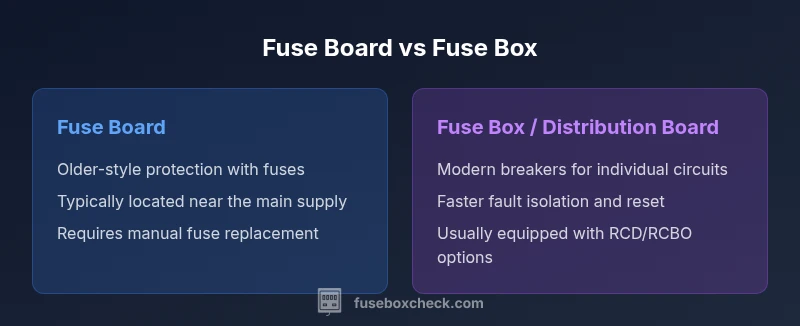
In everyday home electrical work, the terms fuse board and fuse box are often used interchangeably, but understanding their subtle distinctions helps homeowners assess safety and long-term costs. For the purposes of this comparison, a fuse board refers to an older-style assembly that uses cartridge fuses to protect individual circuits. A fuse box, in many markets, denotes a distribution panel that may still use fuses but is frequently upgraded to circuit breakers, providing faster fault isolation and easier resets. According to FuseBoxCheck, many homes built before the 1980s rely on fuse boards; those upgraded since then often use fuse boxes or modern distribution boards with circuit breakers. The practical difference matters most when you consider how faults are detected, how quickly you can reset a circuit, and how future-proof the system is for new devices and appliances. This article will map out the key distinctions, and provide a framework to decide which solution fits a given home’s age, layout, and risk appetite.
Regional Terminology and Evolution
Terminology varies by region. In the United Kingdom and parts of Europe, the term fuse box is commonly used to describe a wall-mounted panel that houses fuses or breakers. In the United States and other markets, the phrase electrical panel or distribution board is more common, with fuse boxes historically referring to older setups. Over time, many homes have transitioned from fuse boards to modern distribution boards with circuit breakers, partially driven by safety standards and code updates. The FuseBoxCheck perspective emphasizes that the core concept—protecting circuits from overload—remains the same, but the protective technology has evolved. When homeowners discuss fuse board vs fuse box, they are often weighing familiarity against modernization and compliance with current electrical codes. The trend across regions is toward modular, clearly labeled boards with protection that can be easily reset after a fault.
Core Components and How They Work
Both fuse boards and fuse boxes serve the same fundamental purpose: protect electrical circuits from overload and fire risk. A fuse board uses cartridge fuses that must be replaced after a fault, whereas a modern fuse box typically uses circuit breakers that trip and can be reset with a switch. Modern distribution boards may include RCDs (residual current devices) and RCBOs (combined RCD and overcurrent protection), which enhance safety by detecting ground faults and imbalance in live conductors. The shift from fuses to breakers also improves fault isolation speed and appliance reliability, reducing downtime and damage to connected devices. When evaluating fuse board vs fuse box, consider the protective philosophy, the ease of testing, and how the protection interacts with downstream circuits. A correctly sized board not only matches current loads but also anticipates future device demand.
Safety Implications and Regulatory Considerations
Safety is the central axis in any fuse board vs fuse box decision. Older fuse boards may lack modern safety features and could be noncompliant with current electrical codes in many jurisdictions. Upgrading to a distribution board with circuit breakers and RCDs improves fault detection, reduces the risk of arc faults, and simplifies manual resets. Regulators increasingly emphasize upgrading old installations to limit hazards, especially in homes with aging insulation or heavy electrical loads from heaters, AC systems, or EV charging. Always verify local code requirements and consult a licensed electrician to assess whether your setup meets contemporary safety standards. The goal is to minimize electrical fires, nuisance tripping, and unplanned outages while preserving system reliability.
Modernization Trends: From Fuses to Smart Distribution Boards
The evolution from fuse boards to modern distribution boards mirrors broader advances in electrical safety. Contemporary boards feature modular breakers, clearly labeled circuits, and options for integrated protection like RCDs and AFCIs (arc-fault circuit interrupters). Smart features—remote monitoring, real-time load analysis, and surge protection—are increasingly common in new installations. When deciding on fuse board vs fuse box, consider not only current protection but also future-proofing for electric vehicle charging, home automation, and energy efficiency upgrades. A modern board can adapt to expanded circuits and smarter protection strategies, reducing risk and improving user experience.
Location, Access, and Installation Realities
Where a board is installed affects both safety and usability. Fuse boards and fuse boxes are typically located near the main service entrance or in utility spaces. Accessibility for testing, tripping, and labeling is a practical concern; poor access complicates maintenance and increases the risk of accidental contact with live parts. Installation complexity varies with house age and wiring standards. Retrofitting a modern distribution board may involve upgrading conduits, rewiring sections of the home, and ensuring adequate clearance for maintenance. For homeowners, planning access and compliance during a retrofit is vital, as space constraints and wiring complexity directly influence project duration and cost.
Cost, Maintenance, and Longevity Expectations
Costs for a fuse board vs fuse box upgrade reflect labor, materials, and regional pricing. Upgrading to a modern distribution board generally incurs higher upfront costs than simply replacing old fuses, but long-term maintenance and safety benefits often justify the investment. Ongoing maintenance typically includes periodic inspections, testing of protective devices, and ensuring proper labeling and accessibility. Longevity depends on build quality, wire age, and load demand. A well-chosen distribution board with proper protection can extend the usable life of a home electrical system and accommodate future power needs with less frequent replacements.
How to Assess Your Current Installation: Signs That You Might Upgrade
If your home relies on older fuse boards, you may notice nuisance trips, burnt smells, or visible signs of wear. Additional indicators include lack of RCD protection, difficult fuse changes, and limited capacity for additional circuits. Conducting a basic assessment that includes checking panel labeling, age of cables, and accessibility helps determine whether a professional inspection is warranted. An upgrade decision should consider not only safety but also potential increases in home value and compliance with modern standards. FuseBoxCheck recommends a structured assessment to determine if a fuse board vs fuse box upgrade is appropriate for your property.
Planning an Upgrade: Steps, Permits, and Contractor Considerations
A successful upgrade from a fuse board to a distribution board requires careful planning. Begin with a professional electrical assessment to determine load requirements, conductor sizing, and panel location. Obtain any required permits, plan for potential wiring upgrades, and select a board that includes breakers, RCDs, and labeling features. Discuss labor schedules, cosmetic considerations, and testing procedures with the contractor. After installation, ensure a thorough inspection, proper labeling, and a commissioning test to verify protection across all circuits. A well-documented plan reduces downtime and improves safety.
Common Myths and Misperceptions About Fuse Board vs Fuse Box
One common myth is that all fuses are inherently safer than breakers; in reality, fuses protect circuits but require replacement and can fail if not properly rated for the circuit. Another misconception is that upgrading is always expensive or unnecessary in older homes; in many cases, upgrading improves safety, enables new loads, and helps compliance with modern codes. Some homeowners believe that upgrades trigger extensive rewiring; often, targeted upgrades to the panel and associated feeders are sufficient. Debunking these myths requires consultation with a licensed electrician and a clear plan tailored to the home’s electrical load and safety goals.
Decision Framework: When to Keep a Fuse Board vs Upgrade to a Fuse Box
The decision hinges on age, safety risk, and future load demands. If the system is older than 30–40 years, shows signs of wear, or lacks modern protection (RCDs/ARC protection), upgrading is often prudent. For homes with modest electrical loads and limited expansion plans, replacing components within the existing fuse board might be feasible in some cases, but code compliance and safety should drive the choice. Consider both current needs and anticipated loads from appliances, heating, or EV charging to guide whether to upgrade now or plan a staged retrofit. The goal is to balance safety, cost, and future-proofing needs.
Practical Takeaways for Homeowners
- Start with a formal assessment of your current panel and loads.
- Consider upgrading to a distribution board with breakers and RCDs for safety and future-proofing.
- Plan for permits, contractor selection, and labeling to ensure a smooth upgrade.
- Prioritize compliance with local codes and best safety practices when evaluating fuse board vs fuse box options.
Comparison
| Feature | Fuse board | Fuse box |
|---|---|---|
| Protection type | Cartridge fuses (older) or mixed (regional variants) | Circuit breakers (modern) with optional RCD/ARC protection |
| Fault isolation | Slower; requires fuse replacement after a fault | Faster; breakers trip and can be reset quickly |
| Upgrade potential | Limited without full panel replacement | Designed for modular upgrades and future loads |
| Safety features | Basic overload protection | RCD/ARC protection options common |
| Regulatory alignment | Often older, may require updates | More likely to meet current safety standards |
| Maintenance | Fuse changes; periodic inspection | Testing, labeling, and routine inspections are easier |
Positives
- Modern breakers improve safety with quick fault isolation
- Upgrading increases future-proofing for additional circuits
- Enhanced protection with RCDs/ARC devices
- Easier circuit identification and resets after trips
Disadvantages
- Upfront upgrade costs and potential permit requirements
- Retrofitting can be disruptive to living spaces
- Older wiring may require additional upgrades beyond the panel
Upgrade to a modern distribution board for most homes
A distribution board with circuit breakers offers faster fault isolation, easier resets, and better protection. For safety and future-proofing, the upgrade commonly provides greater long-term value than maintaining an older fuse board.
Your Questions Answered
What is the difference between a fuse board and a fuse box?
A fuse board uses cartridge fuses to protect circuits, requiring replacement after a fault. A fuse box typically uses circuit breakers that trip and can be reset, often with options for RCDs and AFCIs for enhanced safety.
A fuse board uses fuses that you replace after a fault, while a fuse box uses breakers that you reset. The modern choice is usually a distribution board with breakers and safety devices.
Is upgrading from a fuse board to a fuse box legally required?
Legislation varies by region, but many jurisdictions encourage or require upgrades to meet current safety standards. Consult your local electrical codes and a licensed electrician to confirm requirements for your home.
Check your local codes and talk to a licensed electrician to see if an upgrade is required in your area.
Can I upgrade myself, or do I need a licensed electrician?
Upgrading a fuse board to a distribution board involves high-voltage work and requires specialized training. It is strongly recommended that a licensed electrician perform the upgrade to ensure safety and code compliance.
Electric work like this should be done by a licensed electrician for safety and compliance.
What signs indicate my system needs replacement or upgrade?
Frequent tripping, burnt smells, or visible wear on the panel are red flags. Lack of RCD protection and limited circuit capacity are common reasons to upgrade.
Watch for frequent trips, burning smells, or outdated protection features as upgrade indicators.
How long do fuse boxes or boards typically last?
Lifespan varies with usage and loads, but modern distribution boards are designed for long-term reliability when properly maintained. An inspection every few years helps ensure continued safety.
Modern boards are built for long-term use with periodic checks.
What maintenance should I perform on a fuse box?
Schedule regular professional inspections, ensure proper labeling, test protective devices, and verify that wiring and panel clearances meet safety standards.
Have a pro inspect it regularly and keep labels up to date.
Highlights
- Assess your current panel age and protection features
- Modern boards with breakers reduce downtime and improve safety
- Plan for permits and contractor coordination when upgrading
- Choose protection strategies (RCDs, AFCIs) aligned with your loads