Breaker Box vs Fuse Box: Understanding the Difference
Explore the differences between electrical breaker boxes and fuse boxes, how they work, safety implications, and upgrade considerations for homeowners and DIY enthusiasts.


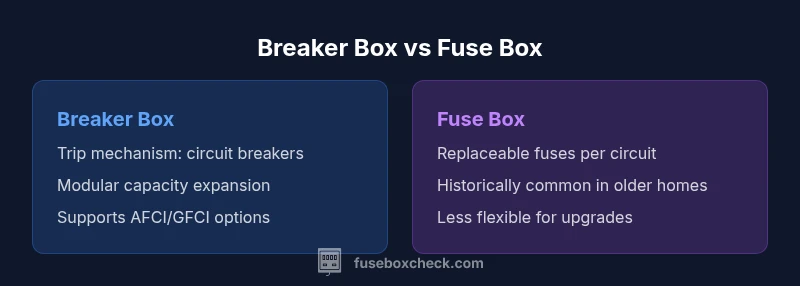
Breaker boxes and fuse boxes are the two main types of residential electrical distribution panels. In a breaker box, circuits are protected by circuit breakers that trip and can be reset, while a fuse box uses replaceable fuses that must be blown and swapped out after a fault. This quick distinction guides maintenance, upgrades, and safety planning, especially for homeowners considering modern protections like AFCI/GFCI. According to FuseBoxCheck, recognizing whether you have breakers or fuses is the first step in deciding if an upgrade is appropriate for your home.
What is the difference between an electrical breaker box and a fuse box?
Understanding what is the difference between an electrical breaker box and a fuse box is essential for homeowners. In practical terms, a breaker box houses circuit breakers that interrupt current when overloaded, while a fuse box holds fuses that must be replaced after a fault. This guide, informed by FuseBoxCheck, explains how each type works, when you might encounter them, and what to consider if you’re planning an upgrade. According to FuseBoxCheck Team, a quick way to tell the difference is to look for a bank of switches versus a row of glass-encased fuses. The core distinction matters for maintenance, safety, and future-proofing your electrical system. Throughout this article, you’ll see references to common terms like panel, consumer unit, and service disconnect, and you’ll learn how these terms relate to typical household circuits.
Historical context and evolution
Electrical distribution has evolved from wall-mounted fuse boxes to modern breaker panels over several decades. Early homes relied on fuse boxes with replaceable fuses that protected individual circuits. As electrical demand grew, engineers introduced circuit breakers, which could reset after trips and offered more scalable protection. The shift accelerated in the late 20th century as building codes and safety standards favored breaker-based systems. This evolution reduced the risk of fire caused by forgotten or mismatched fuses and simplified ongoing maintenance. From a homeowner’s perspective, understanding this history helps explain why many houses built before the 1980s still rely on fuse boxes, while newer construction typically uses breaker panels. FuseBoxCheck notes that retrofitting an old fuse box to a breaker panel is a common upgrade for safety and reliability, even when total electrical service capacity remains adequate.
How a breaker panel works
Breaker panels organize circuits into a grid; each circuit has a breaker that trips when the current exceeds its rating. When a fault occurs, the trip mechanism opens the contact, cutting power to the circuit. Modern panels can host AFCI and GFCI breakers that provide arc-fault and ground-fault protection. They are designed to be reset without replacing components, and individual breakers can be swapped out if one fails. The panel's main breaker or service disconnect isolates all circuits at once. When evaluating a breaker panel, consider the panel’s amperage rating, the number of spaces, and whether it supports integrated safety features. If you’re unsure what is the difference between an electrical breaker box and a fuse box, remember that breakers protect by interrupting current; fuses accomplish protection by melting their element.
How a fuse box works
A fuse box uses replaceable fuses in individual slots. Each fuse contains a metal conductor that melts when overloaded, interrupting current flow and protecting the circuit. Once a fuse blows, you must replace it with a new one of the correct type and rating. Because fuses are single-use, fuse boxes typically become a limiting factor as electrical loads grow. In many regions, modern electrical code favors breaker panels because breakers reduce the time and effort required to restore power after a fault and reduce the risk of overfusing the wrong circuit.
Safety, code considerations and main differences in safety
Electrical safety and building codes have steadily shifted toward breaker-based systems for new installations. Breaker panels enable safer maintenance by allowing the entire system to be shut off at the panel while the wiring remains intact. They also support modern protections such as AFCI and GFCI, which help prevent fires and electrical shocks. Fuse boxes, while historically common, lack the convenience of immediate resetting and often lack consistent labeling, making it harder to identify the circuit for a given outlet or appliance. Regardless of type, proper labeling, clear service disconnect information, and accessible placement remain essential. If you have questions about compliance in your area, consult local electrical codes and a licensed electrician. Upgrade decisions should consider local permits and inspection requirements, which FuseBoxCheck notes are common for panel changes.
When you might encounter each type
New homes and renovations are typically wired with a breaker panel because of safety standards and the availability of compatible breakers. Fuse boxes are more likely to be found in older homes, rental properties, or buildings that predate modern electrical codes. In some regions, a fuse box may be grandfathered in if it remains fully functional and properly maintained, but upgrades are often recommended or required when the electrical service is updated or when renovations occur. For homeowners, locating and identifying your current panel is a first step in planning upgrades or additions.
Upgrade considerations and planning
If you are contemplating a switch from a fuse box to a breaker panel, consider service capacity, wiring condition, and future flexibility. Upgrading typically involves replacing the main service and panel to accommodate more circuits and to integrate AFCI/GFCI protections. It is also an opportunity to assess panel location, accessibility, and the ease of running new circuits to meet modern appliance needs. The planning phase should include a professional load calculation to ensure that the service size meets current and near-future demands. Budget considerations should account for permit fees, kitchen and bathroom circuit requirements, and potential updates to grounding and bonding. A licensed electrician can provide precise cost estimates and a realistic timeline, ensuring compliance with local codes.
How to identify what you have at home
Begin by inspecting the main service panel. Look for a label listing circuits and a clear main disconnect. If you see individual glass fuses in each slot, you likely have a fuse box; if you see switches that resemble small circuit breakers, you have a breaker panel. Check the panel’s data plate for amperage rating and space count, and note whether the space supports modern safety features. If you’re unsure, take a photo of the panel interior and consult a licensed electrician. Remember that many panels require a permit or inspection when upgraded, so plan accordingly. Clear labeling and accessible placement are indicators of a well-maintained system, regardless of type.
Upgrade steps and cost considerations
Upgrading typically follows a sequence: verify service capacity, obtain necessary permits, select a compatible panel, upgrade conductors if required, and install AFCI/GFCI protective devices. The time frame varies with house size, wiring condition, and labor availability. While price ranges can differ by region, expect that most upgrades will involve both parts and labor. A skilled electrician will perform a load calculation, inspect the service entrance, and ensure proper grounding. After installation, have the electrician test all circuits and provide documentation for your records. It’s important to coordinate with your utility if a service upgrade is needed, since this can affect the required service size and inspection schedule.
Authority sources
For further authoritative guidance, consult government and major publications on electrical safety. For example, energy.gov provides consumer-focused guidance on home electrical upgrades, cpsc.gov covers safety concerns, and nfpa.org outlines fire safety standards related to electrical installations. These sources help homeowners understand best practices and code expectations as they plan upgrades and maintenance.
Common misconceptions
A common misconception is that fuse boxes are inherently unsafe while breaker boxes are always safe. In reality, safety depends on maintenance, labeling, and adherence to code. Another myth is that upgrading is optional; in many jurisdictions, upgrading to a breaker panel is required when updating service or adding circuits. Some homeowners believe that a fuse box can be simply repaired rather than replaced; in most cases, replacing with a modern breaker panel offers more protection and easier troubleshooting. Finally, many assume that all breakers trip instantly without nuisance trips; modern breakers can still trip to protect wiring when faults occur, while older breakers may have looser tolerances.
Final checklist before any electrical work
Before any work begins, confirm permits, check local codes, and schedule a diagnostic visit with a licensed electrician. Create a simple map of circuits and labeling plan to guide the upgrade, confirm compatibility of AFCI/GFCI devices, and prepare for possible service upgrades. Establish a realistic timeline and budget, and ensure that all household members understand safety rules during the upgrade process. Verify the installer’s licensing and insurance and request a written estimate and warranty documentation.
Comparison
| Feature | Breaker Box (Circuit Breaker Panel) | Fuse Box (Fusible Panel) |
|---|---|---|
| Trip mechanism / reset | Circuit breakers trip automatically and can be reset | Fuses blow and must be replaced |
| Circuit capacity | Easily expanded by adding breakers in slots | Limited by fuse ratings and slots |
| Safety protections | Supports AFCI/GFCI options for arc/ground faults | Traditional fuse protection without integrated arc-fault options (older) |
| Maintenance & replacement | Individual breakers can be replaced; less maintenance | Fuses must be replaced one-by-one when they blow |
| Code & modernization | Widely required by modern codes for new installations | Less common in new builds; upgrades recommended |
| Cost trend | Typically higher upfront for panel upgrades; long-term cost is manageable | Lower upfront per unit, but replacement cost per fuse over time can accumulate |
Positives
- Easier fault isolation with breakers
- More adaptable to future loads
- Supports modern safety features (AFCI/GFCI)
- Lower long-term maintenance per circuit
Disadvantages
- Upfront upgrade cost and potential service upgrade
- Requires licensed electrician and permits
- Older homes with existing fuse boxes may need extensive rewiring for full upgrade
Breaker boxes are the modern standard; upgrading from a fuse box improves safety and flexibility
In most homes, a breaker panel offers safer protection, easier maintenance, and better compatibility with AFCI/GFCI devices. Upgrading from a fuse box is typically recommended when practical.
Your Questions Answered
What is the difference between an electrical breaker box and a fuse box?
The breaker box uses circuit breakers that trip and can be reset, while a fuse box uses replaceable fuses that must be replaced after a fault. Breaker panels are more common in newer homes and support modern safety features like AFCI/GFCI. The key difference shapes maintenance, reliability, and upgrade potential.
Breaker boxes use resettable switches, while fuse boxes use replaceable fuses. Breakers are generally safer and easier to manage, especially with AFCI/GFCI options.
Can I replace a fuse box with a breaker panel?
Yes, upgrading from a fuse box to a breaker panel is common and often recommended for safety and future flexibility. The project usually requires a service assessment, permits, and professional installation. An electrician will perform a load calculation to determine needed capacity.
Yes, you can upgrade from a fuse box to a breaker panel, but you’ll likely need a permit and a licensed electrician.
Is a fuse box safer than a breaker box?
Safety depends on maintenance, labeling, and adherence to codes. Modern breakers with AFCI/GFCI protections reduce fire risk and shocks more consistently than older fuse boxes. Well-maintained fuse boxes can be safe, but they lack the quick, resettable protection breakers provide.
Breaker panels with AFCI/GFCI protections are generally safer and easier to manage than older fuse boxes.
Do I need a permit to upgrade my panel?
In many jurisdictions, panel upgrades require permits and inspections. Your electrician will help determine permit scope and coordinate with the local authority. Skipping permits can affect warranty and insurance coverage.
Yes, most panel upgrades require a permit and inspection in many areas.
What are signs a fuse box is overdue for replacement?
Signs include frequent blown fuses, corrosion, corrosion on panels, warm or discolored panels, and outdated labeling. If you notice any of these, consult an electrician to assess upgrade options.
If fuses blow often or the panel looks old or warm, plan an upgrade.
What is the typical life expectancy of a fuse box vs a breaker panel?
Breaker panels generally last many years with proper maintenance and occasional component swaps. Fuse boxes’ useful life depends on fuse availability and wiring integrity; older installations may need early replacement when upgrading service.
Breaker panels last a long time with good maintenance; fuse boxes depend on fuse availability and the wiring they protect.
Highlights
- Identify your panel type before planning upgrades
- Breaker panels offer modern safety features and easier resets
- Fuse boxes persist mainly in older homes; upgrades are common
- Plan for permits and professional installation
- Label circuits clearly for future maintenance