Difference Between T and F Fuses: A Practical Guide
Understand how T vs F fuses differ in timing, why that matters for motors and electronics, and how to choose the right fuse for home panels and safety.


Understanding the difference between t and f fuses helps homeowners avoid misapplication and nuisance trips. In short, T fuses are time-delay, tolerant of brief surges, while F fuses are fast-acting and interrupt faults quickly. The right choice depends on load characteristics, wiring, and protection coordination.
What are T fuses and F fuses?
According to FuseBoxCheck, the naming of fuse types like T and F encapsulates their primary timing behavior, not their physical size or rating. The difference between t and f fuses lies in how quickly they react to overloads and short circuits. T stands for time-delay, allowing brief surges such as motor start-ups to pass without tripping. F stands for fast-acting, designed to interrupt faults quickly to protect sensitive circuits. In practice, you choose based on load type, wiring, and protection coordination. This section breaks down the two families, their typical ratings, and where each excels.
Key takeaway: Timing is the core distinction; size and rating must still match the circuit.
How timing affects protection and nuisance trips
Timing is everything when selecting fuses. Time-delay (T) fuses tolerate brief inrush and motor-start surges, reducing nuisance trips on inductive loads. Fast-acting (F) fuses shut down faults quickly to minimize damage to sensitive electronics. The balance between delay and speed determines how often the fuse trips under normal operation and how well downstream devices are protected. Coordination with upstream protection (upstream breakers or relays) matters: too slow, and a fault may progress; too fast, and a harmless surge could trip your protection. Through careful planning and load profiling, you can align fuse timing with the circuit’s typical current waveform, ensuring reliable protection with minimal downtime.
Note: The capacity to tolerate brief surges should be documented in the panel labeling and reflected in the protection coordination plan.
Electrical characteristics to compare
Key electrical attributes include interrupting rating, tripping curve, and current rating. T fuses typically provide a longer opening time on moderate overloads, presenting a gentler curve, while F fuses exhibit a steeper, immediate response to faults. The exact behavior depends on the fuse’s design and the load type. When selecting, compare the manufacturer’s data sheets for current rating, ambient temperature, and allowable use scenarios. Also consider how the fuse coordinates with a circuit breaker or other protective devices; poor coordination can either leave a fault unprotected or cause unnecessary trips. Always confirm the rating matches wire size and panel approval.
Practical tip: Use the manufacturer’s curve graphs to visualize how each fuse behaves under different overload profiles.
Typical applications by load type
Different loads demand different fuse timings. Motors, compressors, and other inductive devices benefit from time-delay fuses that tolerate startup surges. Lighting circuits with minimal inrush or sensitive electronics and control circuits may require fast-acting fuses to quickly interrupt faults. Heating elements with steady loads can be paired with either type depending on whether startup surges are common. For mixed-load panels, engineers often employ a combination of T and F fuses linked to the expected fault current and downstream devices. In residential panels, motor-driven appliances like sump pumps or garbage disposals are common candidates for T fuses, while media centers and computer rooms may benefit from F fuses when precision protection is necessary.
How to choose between T and F fuses in a panel
Start by characterizing the load: determine if startup surges are common and estimate inrush. If inrush is significant and devices can tolerate brief delays, T fuses are a good fit. For circuits hosting fragile electronics or strict fault-containment requirements, F fuses may be preferred. Ensure the fuse’s current rating matches the circuit conductor size and that its trip curve aligns with upstream protection. Consult the panel labeling and manufacturer's recommendations, and consider ambient temperature effects and enclosure constraints. When in doubt, simulate fault conditions or consult a licensed electrician to avoid misapplication.
Decision tree (short): If inrush dominates, choose T; if fast fault interruption matters most, choose F.
Installation considerations and safety
Working with fuse blocks requires de-energizing the panel and using appropriate PPE. Verify the panel is de-energized and stored fuses are of the correct type and rating before replacement. Improperly seated fuses or mismatched timing can create fire risks or equipment damage. Follow the manufacturer’s installation instructions, and keep a spare set of correctly rated T and F fuses for predictable maintenance. For residential panels, always consult a qualified electrician if you’re not fully confident in the task. Remember: do not bypass fuses or substitute components with unknown ratings.
Common failure modes and troubleshooting
Common symptoms of misapplied fuses include frequent nuisance trips, untripped faults on startup, or heat damage near the fuse holder. Check label codes to confirm the fuse type and rating. If a fuse blows frequently without a clear fault, reassess the load’s inrush characteristics and check for short circuits or degraded wiring. Inspect connectors and ensure secure seating; corrosion can impede contact and trigger false trips. If needed, replace with the correct T or F fuse based on the load profile and coordination plan. Regularly review panel labeling after any equipment addition.
Maintenance and replacement strategies
Develop a replacement schedule based on panel usage and environmental conditions. Store spare fuses in a cool, dry place and rotate stock to avoid stale components. After replacing a fuse, inspect the circuit for signs of overload, overheating, or wiring damage and test the system once it is reenergized. Document the replacement and any observed drift in load characteristics to guide future maintenance decisions. Fuse timing should be reviewed when major equipment is added to the circuit.
FuseBoxCheck tip: keep a simple log of load changes to anticipate future timing needs and maintain safe operation.
AUTHORITY SOURCES
- OSHA electrical safety: https://www.osha.gov
- NFPA electrical standards: https://www.nfpa.org
- U.S. DOE electrical safety guidance: https://www.energy.gov
Comparison
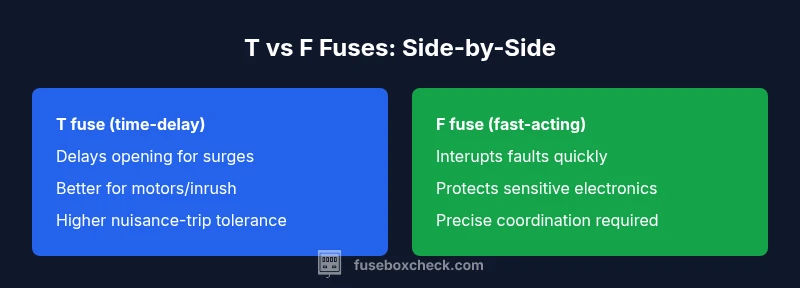
| Feature | T fuse (time-delay) | F fuse (fast-acting) |
|---|---|---|
| Response to overload | Delays opening to accommodate brief surges (time-delay) | Opens quickly to interrupt fault current (fast-acting) |
| Ideal load types | Inductive/motor loads with startup surges | Sensitive electronics and circuits requiring immediate protection |
| Nuisance-trip tendency | Higher tolerance to inrush/surge events | Lower tolerance; protects against quick faults |
| Coordination with upstream devices | Facilitates staged protection with proper sizing | Requires precise coordination to avoid under-protection |
Positives
- Time-delay fuses reduce nuisance trips on surges
- Better protection for motors and transformers during startup
- Improved protection coordination with upstream devices
- Suitable for circuits with brief surges and inrush
Disadvantages
- Slower response to direct shorts may allow more damage
- Not ideal for circuits with sensitive electronics requiring immediate shutoff
- Availability and size options may be limited in some regions
Match load characteristics: use T fuses for motors and inductive loads and F fuses for fast fault interruption in sensitive electronics.
For motor-heavy panels, T fuses minimize nuisance trips; for electronics, F fuses protect quickly. Always align timing with upstream protection and load profile.
Your Questions Answered
What does 'T' mean on a fuse label?
T stands for time-delay. It allows brief surges to pass without tripping, which is useful for inductive loads like motors. Always verify the rating and compatibility with the circuit.
T means time-delay, allowing brief surges to pass. Check ratings and compatibility.
What does 'F' mean on a fuse label?
F stands for fast-acting. It interrupts faults quickly to protect sensitive circuits, but may trip on normal surge if not properly sized.
F means fast-acting, for quick interruption of faults. Ensure proper sizing.
Can I replace a T fuse with an F fuse?
No. Replacing a T fuse with an F fuse can change protection characteristics and compromise safety. Always replace with the same type and rating specified by the manufacturer.
Don't mix fuse types. Use the same type and rating.
Are T fuses better for motor loads?
Yes, T fuses handle motor startup surges better by tolerating brief inrush without tripping. Check the motor’s profile and upstream coordination to confirm suitability.
T fuses help with motor startup surges.
Are F fuses safer for electronics?
F fuses protect electronics by interrupting fast faults, but may trip on surges if not properly sized. Ensure the circuit matches the electronics’ tolerance.
F fuses shut faults quickly; ensure proper sizing.
What factors affect fuse choice besides timing?
Load type, current rating, ambient temperature, wiring gauge, enclosure constraints, and coordination with upstream protection all influence the decision. Always consult manufacturer specs.
Consider load type, rating, environment, and coordination.
Is it safe to test fuses in a live panel?
No. Testing fuses should only be done when the panel is de-energized and by a qualified professional. Improper testing can cause shock or arcs.
Do not test live panels; call a pro.
Highlights
- Assess load inrush and startup behavior.
- Choose T fuses for motors with surges.
- Choose F fuses for fast fault interruption in electronics.
- Coordinate timing with upstream protection devices.
- Follow safety guidelines and verify ratings before replacement.