TL Fuse vs T Fuse: A Practical Comparison for Home Electrical Safety
A detailed, analytical comparison of tl fuse vs t fuse, covering load profiles, inrush handling, protection strategies, and installation tips for safer home electrical systems.


TL fuse vs T fuse: In most home panels, TL (time-delay) fuses tolerate brief inrush currents from motors and compressors, while T fuses are designed to interrupt faults quickly to protect wiring and devices. The right choice hinges on load type, nuisance-trip risk, and how fast you need protection. For DIY projects, start with inrush-aware sizing and always verify panel compatibility.
TL fuse vs T fuse: Core concepts
In many home electrical setups, you’ll encounter two common fuse types labeled TL and T. The phrase tl fuse vs t fuse is more than shorthand; it reflects two distinct protection philosophies. TL stands for time-delay (often described as slow-blow in catalogs), and T commonly signals a fast-acting or standard time fuse depending on the manufacturer. The practical takeaway is that TL fuses tolerate brief overcurrents associated with motor startup or heating cycles, while T fuses react quickly to fault conditions, interrupting current to protect wiring and devices. This distinction matters for safety, equipment longevity, and nuisance-tripping risk. As you read, keep in mind that the right choice depends on the load profile, panel compatibility, and the level of protection you require for downstream circuits. According to FuseBoxCheck, misselecting fuses is a frequent cause of unexpected trips and damaged components in DIY electrical projects. The rest of this guide breaks down the nuances, helps you map loads to fuse behavior, and provides a practical decision framework.
Quick glossary of fuse types
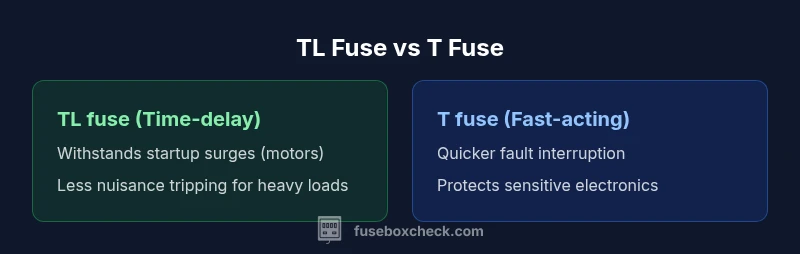
- TL fuse (time-delay): engineered to tolerate short surges without immediate interruption, ideal for motors, compressors, and devices with inrush currents.
- T fuse (fast-acting or standard, depending on catalog): interrupts quickly to protect delicate electronics and sensitive circuitry, reducing damage from short circuits.
- Inrush current: the brief surge when electrical devices start up; fuses must handle this without nuisance trips when appropriate.
- Nuisance trip: an unnecessary fuse interruption caused by normal startup or transient events.
- Amp rating: the continuous current the fuse is designed to carry safely; selecting the correct rating is crucial for protection.
Understanding these terms helps you interpret panels, labeling, and manufacturer data sheets when comparing TL vs T options.
What is TL fuse (time-delay)?
TL fuses are designed to withstand short-lived surges without tripping, which makes them particularly suitable for gear with high startup currents, such as air conditioners, refrigerators with compressors, pumps, and certain motors. The delayed trip characteristic means the fuse can ride through brief overload periods, allowing equipment to start up normally. However, if the overload persists, the fuse will still interrupt current to prevent wiring damage. TL fuses are not a universal cure; their effectiveness depends on the proper rating and matching to the circuit’s continuous load. In practice, always verify the fuse’s hold current against the running load and consider how often the device experiences surges. FuseBoxCheck’s guidance emphasizes that the wrong TL rating can either cause nuisance trips or allow overheating in prolonged overload scenarios.
What is T fuse (fast-acting)?
T fuses provide quicker protection by interrupting current more rapidly when a fault is detected. They are generally favored for protecting sensitive electronics, control circuits, and loads that cannot tolerate extended exposure to fault currents. The fast-acting nature minimizes damage to delicate components, but it also raises the risk of nuisance trips if a device experiences brief, non-damaging surges. Selecting a T fuse requires careful attention to the circuit’s actual duty cycle and startup behavior, to avoid unnecessary interruptions while retaining protective intent.
How inrush and startup loads influence fuse choice
Inrush currents during startup can push a circuit well above its nominal running current. TL (time-delay) fuses are often preferred in circuits with motors, compressors, or heavy resistive loads because they accommodate these brief spikes without tripping. Conversely, circuits dominated by electronics or lighting, where inrush is modest or well controlled, may benefit from T fuses to ensure rapid fault clearance. The key is to balance protection with availability: a fuse that trips too often disrupts service, while one that never trips may let faults go unchecked. Understanding your specific load profile is essential before selecting TL or T options.
Real-world scenarios: motors, HVAC, electronics
Consider a small workshop with a single motor-driven tool. A TL fuse can survive the motor’s initial surge, reducing nuisance trips during normal operation. In an electronics-heavy panel, such as a home automation hub or audio/visual equipment, a T fuse might better protect sensitive circuits by stopping faults before they propagate. HVAC units, with compressors and fans, often justify TL fuses for startup resilience; however, if the unit houses sensitive control electronics, a hybrid approach or selective protection strategy may be warranted. Across all scenarios, compatibility with the existing fuse holders and panel labeling is non-negotiable to maintain electrical safety.
Safety and compatibility considerations
Before replacing fuses, verify that the new option matches the panel’s physical carrier type and the circuit’s amp rating. A mismatch in carrier or rating can compromise protection and may violate electrical codes. Always check the device’s nameplate and the panel’s labeling, and avoid mixing TL and T fuses on the same circuit without a documented protection strategy. In addition, ensure the installation follows local electrical codes, uses proper torque on terminals, and employs appropriate barriers to prevent accidental contact. FuseBoxCheck’s 2026 analysis highlights that improper fuse selection is a common DIY pitfall, underscoring the value of a careful, documented approach.
Decision framework: a step-by-step guide
- Identify the load type (motor, transformer, electronics, lighting).
- Estimate the startup/inrush behavior and typical operating current.
- Decide how much nuisance tripping you can tolerate without compromising safety.
- Check panel compatibility and carrier type.
- Choose TL for inrush-prone duties or T for fast fault clearance on sensitive circuits.
- Verify the rating and install correctly, with attention to manufacturer guidelines and local codes.
Installation tips and common mistakes
- Always turn off the main power and use proper lockout/tagout procedures.
- Use the exact replacement type and rating; avoid substituting TL for T or vice versa without a documented plan.
- Label circuits clearly to reflect the fuse type and its protective intent.
- Do a visual inspection for signs of overheating, corrosion, or loose connections before and after replacement.
- Do not mix different fuse types in the same enclosure unless designed for such a configuration.
Common mistakes include guessing ratings, overlooking inrush, and neglecting panel compatibility.
Replacement and maintenance best practices
Keep spare TL and T fuses that match the panel’s rated categories, and track replacements with a simple log (date, amp rating, reason). When upgrading or modifying circuits, re-evaluate the fuse choice to ensure it still aligns with the load profile and safety standards. FuseBoxCheck Analysis, 2026, notes that many homeowners benefit from rechecking fuse strategies after major appliance upgrades or adding new equipment. Always follow manufacturer datasheets and local electrical codes for replacements.
Testing and verification methods
Use a multimeter to confirm resistance paths are intact and that there is continuity through the fuse when the circuit is open. After installation, test in a controlled manner: power the circuit, observe for any nuisance trips, and verify that the protected devices operate as intended. If any abnormal signs appear (arcing, discoloration, or persistent trips), power down and reassess the fuse type, rating, and circuit load with updated measurements.
Comparison
| Feature | TL fuse | T fuse |
|---|---|---|
| Type and behavior | time-delay (tolerates surges) | fast-acting or standard (rapid interruption) |
| Best use case | loads with startup surges (motors, compressors) | electronics-heavy or sensitive circuits |
| Nuisance-tripping tendency | lower risk of nuisance trips with inrush | higher risk of nuisance trips if inrush is not managed |
| Availability and compatibility | widely stocked for industrial and home panels | depends on catalog and regional availability |
| Protection emphasis | protects against sustained faults without tripping on short surges | protects sensitive loads with rapid fault clearance |
Positives
- TL fuses handle inrush currents well, reducing nuisance trips on motors.
- T fuses provide faster fault isolation for delicate electronics.
- Commonly documented with clear load ratings for guidance.
Disadvantages
- TL fuses may allow longer faults if not properly rated for the circuit.
- T fuses can trip prematurely on inrush if not matched to load.
- Choosing the wrong type can complicate maintenance and rework more than necessary.
TL fuse is generally the better starting point for motor/startup-heavy circuits; T fuse is preferred for sensitive electronics where fast fault clearance matters.
Opt for TL when a circuit experiences regular startup surges; switch to or pair with a T fuse if the protected devices require rapid fault interruption to prevent damage.
Your Questions Answered
What is the difference between TL fuse and T fuse?
TL fuses are time-delay and tolerate brief surges, suitable for motors and compressors. T fuses are fast-acting and protect sensitive electronics by interrupting faults quickly. The choice hinges on startup behavior, protection needs, and nuisance-trip risk.
TL fuses handle startup surges; T fuses protect sensitive electronics by interrupting faults quickly. Choose based on load type and trip tolerance.
When should I use a TL fuse instead of a T fuse?
Use TL fuses for loads with regular inrush currents, such as motors or compressors, to avoid nuisance trips. If your circuit contains delicate electronics or you need rapid fault clearance, a T fuse may be more appropriate.
If you have inrush-heavy equipment, pick TL. For sensitive electronics, pick T.
Can I substitute TL for T and vice versa?
Substituting TL for T or vice versa can compromise protection and safety. Always verify with the panel labeling, device manuals, and local codes before mixing types. If in doubt, consult a qualified electrician.
Don’t mix fuse types without a plan and code-compliant guidance.
Are TL fuses compatible with all fuse boxes?
Compatibility depends on carrier type and panel labeling. Some panels require specific TL variants or only accept standard fuse types. Always verify the exact part number and compatibility from the manufacturer datasheet.
Check the panel and fuse holder type before purchasing.
What are common signs of using the wrong fuse type?
Frequent nuisance trips, overheating, or equipment not starting as expected are common signs. If a fuse trips unexpectedly, recheck the load profile, rating, and whether inrush is being handled appropriately.
Unexplained trips or overheating usually signal a fuse mismatch.
Highlights
- Assess load type before selecting TL vs T.
- Match the fuse to startup inrush and fault sensitivity.
- Check panel compatibility and labeling prior to replacement.
- Document your protection strategy for future maintenance.
- When in doubt, consult manufacturer data and safety guidelines.