F vs T Fuse: Fast vs Time-Delay Fuses for Home Electricals
A practical, objective comparison of fast (F) and time-delay (T) fuses, with actionable guidance for homeowners troubleshooting fuse boxes and improving electrical safety.


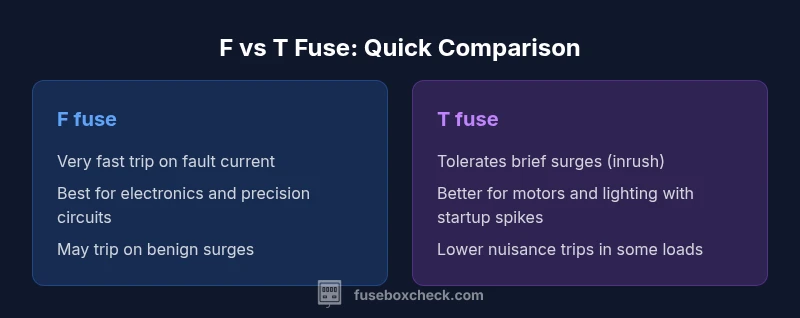
F vs T fuse: In most home circuits, time-delay (T) fuses balance protection and nuisance-tripping by tolerating brief inrush. Fast-acting (F) fuses protect sensitive electronics but can trip on surges. The best choice depends on the circuit load, with a mindful approach to matching rating and application; review labeling and manufacturer guidance. For electronics-heavy panels, start with T fuses and reserve F for delicate components.
Overview of F vs T Fuses
Understanding f vs t fuse types is essential for safe, reliable home electrical work. In short, F stands for fast-acting fuses, designed to interrupt fault currents almost immediately after a fault. T stands for time-delay fuses, which allow brief current surges to pass without tripping, protecting circuits that experience inrush or startup transients. For homeowners troubleshooting fuse boxes, recognizing this distinction helps you interpret panel labels and select appropriate replacements. The f vs t fuse decision influences not only protection but also nuisance trips, compatibility with motor loads, and the overall reliability of branch circuits. Across most residential panels, you will find common ratings and form factors that cover a range of applications. This article presents a balanced, analytical comparison to help you decide when to choose F or T fuses and how to apply best practices to real-world sections of your electrical system. The discussion uses practical examples and emphasizes the importance of correct sizing and consistent safety practices.
How Fuses Protect Circuits and What Sets Them Apart
All fuses operate on a simple principle: they interrupt current when a fault pushes the current above a rated threshold. The difference between F and T fuses lies in trip kinetics and tolerance to surges. Fast-acting (F) fuses respond nearly instantly to overcurrent, severing the circuit before damage spreads. Time-delay (T) fuses incorporate a controlled delay, permitting short peaks that are typical in motor startups or lighting circuits. This distinction matters because it shapes how you protect electronics, appliances, and branch circuits. When choosing between F and T fuses, you must balance rapid fault interruption with the practical reality of normal inrush. Correct labeling, adherence to manufacturer data, and consistent circuit sizing are essential for safe operation and long-term equipment health.
Fast-Acting Fuses (F): Why They Matter
Fast-acting fuses are designed for circuits where a fault current needs immediate interruption to prevent component damage or fire risk. They are particularly effective for protecting sensitive electronics, microcontroller-based control circuits, and small appliances where even brief overcurrents can cause noticeable harm. The upside of F fuses is rapid protection; the downside is a higher likelihood of nuisance trips on circuits that produce brief surges during normal operation. Proper matching of the fuse rating to the circuit and the connected load is crucial; using an over-rated F fuse may defeat protection, while an under-rated one can trip unnecessarily.
Time-Delay Fuses (T): When They Shine
Time-delay fuses provide tolerance to brief surges by delaying the trip. This makes them well-suited for loads with startup inrush, such as motor-driven devices, HVAC components, and some lighting transformers. The benefit is fewer nuisance trips during normal operation, which preserves convenience and reduces wear on breakers and disconnects. However, the trade-off is a slightly longer response to a true fault, which means you must ensure the fault current exceeds the lower-bound threshold enough to trip in an acceptable time frame. For mixed loads or circuits with inrush profiles, a T fuse is often a sensible default.
Inrush Currents, Motors, and Lighting: Real-World Scenarios
Home electrical systems frequently experience brief surges when devices start or when motors engage. In such cases, a T fuse can spare you from repeated trips while still offering protection against sustained faults. Conversely, electronic modules, audio/video gear, and control panels with precise timing requirements may benefit from F fuses to minimize exposure to fault currents. When evaluating a panel or a branch circuit, compare the load profile to the fuse’s characteristic curve. If the circuit routinely experiences surges without sustained overcurrent, a T fuse is likely preferable; if the circuit hosts sensitive electronics with strict current limits, an F fuse may be the safer choice.
Safety Coordination with Breakers and Panels
Fuses do not operate in isolation; they must coordinate with the corresponding circuit breakers and the overall panel design. Mismatched fuse types to a given circuit can create confusing protection behavior and risk. When upgrading or replacing fuses, ensure compatibility with the panel labeling and the branch circuit rating. Always power down the panel and use properly rated equipment when performing any replacement. Keeping spare fuses of the correct rating on hand and labeling circuits clearly reduces downtime and promotes safer maintenance. Fuse coordination remains a cornerstone of electrical safety.
Practical Selection Guidelines for F vs T
There is no one-size-fits-all answer for f vs t fuse selection. Start by identifying the circuit’s primary load characteristics: is there delicate electronics, or are there motors and inrush-prone devices? If electronics dominate, lean toward F fuses; for inrush-heavy loads, T fuses tend to be better. Review the equipment’s nameplate, the panel’s labeling, and any manufacturer guidance. Consider a stepwise approach: select a fuse type based on load profile, then validate by testing the circuit’s performance under normal operation and during fault conditions. In some cases, a combined approach with a mixed protection strategy yields the best balance of safety and reliability.
Sizing, Rating, and Replacement Considerations
Sizing a fuse involves matching the current rating to the maximum continuous current of the circuit, with a margin for startup surges. Never oversize the fuse to avoid risking damage during faults. Replacement should use the same type (F or T) and the exact rating recommended by the manufacturer or label. If a panel has no clear guidance, consult a licensed electrician or the panel documentation. Regular audits of circuit loads and periodic testing can help ensure that the chosen fuse type continues to align with evolving electrical usage in the home.
Installation Tips and Common Mistakes to Avoid
Install fuses only in properly rated holders and ensure the fuse body is intact and clearly labeled. Avoid mixing fuse types within the same physical slot, as this can confuse protection behavior and lead to safety hazards. Never bypass a fuse or substitute a higher rating; that practice can create dangerous conditions. When in doubt, document circuit loads and seek guidance from a qualified technician. Following the manufacturer’s installation instructions is essential for long-term reliability.
Maintenance, Testing, and Long-Term Care
Routine inspection of fuse holders, panel connections, and labeling helps prevent unexpected trips and improves safety. Schedule periodic checks, especially after electrical work or renovations that may alter load profiles. Use a multimeter or a suitable testing method to verify that fuses still interrupt at rated currents and that there are no signs of overheating or corrosion. Keeping records of measured loads and fuse performance supports proactive maintenance and reduces the likelihood of unplanned outages.
Comparison
| Feature | F fuse | T fuse |
|---|---|---|
| Operating principle | Fast-acting response to overcurrent | Time-delay response tolerating brief surges |
| Typical applications | Electronics-sensitive circuits and devices | Motors, transformers, and inrush-prone loads |
| Response time | Very fast trip on fault | Moderate delay to accommodate surges |
| Inrush tolerance | Low tolerance; aims to minimize each fault instantly | High tolerance for startup surges |
| Physical size/form factor | Comparable form factors across common ratings | Comparable form factors across common ratings |
| Best for | Electronics-heavy circuits requiring strict protection | Inrush-prone or motor-driven circuits |
| Replacement considerations | Match rating and type to device labeling | Match rating and type to device labeling |
Positives
- Balances protection with tolerance to surges
- Widely available across ratings
- Reduces nuisance trips in inrush scenarios
- Clear labeling and standard ratings
Disadvantages
- Fast-acting fuses can trip on harmless surges in sensitive circuits
- Time-delay fuses may allow brief faults if the surge is prolonged
- Not every panel supports every fuse type without adapters or guides
Choose the fuse type based on load characteristics; use T for inrush-prone or motor loads, and F for electronics-heavy circuits.
The right choice depends on the circuit’s load profile. T fuses are typically better for inrush-prone circuits, while F fuses protect sensitive electronics. Always verify labeling and ratings, and consult a licensed electrician for complex panels.
Your Questions Answered
What does F mean in fuse labeling?
F stands for fast-acting fuse type; it responds quickly to overcurrent, protecting sensitive loads. This makes it ideal for electronics-rich circuits where sudden surges could cause damage.
F means fast-acting; it trips quickly to protect sensitive electronics.
What does T mean in fuse labeling?
T stands for time-delay fuse; it tolerates brief surges, reducing nuisance trips in inrush-prone circuits such as motors and lighting transformers.
T means time-delay; it tolerates brief surges.
Can I replace a fuse with the other type?
Swapping types is not always safe. Check the circuit load, device labeling, and panel compatibility before replacing, and consult a professional if unsure.
Swapping fuse types isn’t always safe—check labeling and loads first.
How do I identify which fuse type I have in my panel?
Look at the fuse body markings and panel labeling; consult manufacturer documentation if needed. If in doubt, ask a licensed electrician to verify.
Check the fuse body and panel labeling; when in doubt, ask a pro.
Are F fuses always safer than T fuses?
Safety depends on the load. F fuses protect sensitive electronics efficiently but may trip on surges, while T fuses reduce nuisance trips but may allow brief faults if not chosen carefully.
F isn’t inherently safer; it depends on the load and usage.
What signs indicate a fuse needs replacement?
Frequent trips, visible damage, or excessive warmth at the fuse holder suggest replacement is due. Always replace with the same rating and type.
Look for frequent trips, damage, or warmth; replace with the same rating.
Highlights
- Assess load profile before choosing fuse type
- Prefer time-delay fuses for inrush-prone circuits
- Use fast-acting fuses for sensitive electronics
- Coordinate protection with panel labeling
- Keep properly rated spares and document circuit loads