Distance Between Meter and Fuse Box: Safe Spacing Guidelines
Discover safe spacing guidelines between your electrical meter and fuse box. Learn why proper clearance matters, practical distance ranges, and how to verify compliance for home safety and easy maintenance.


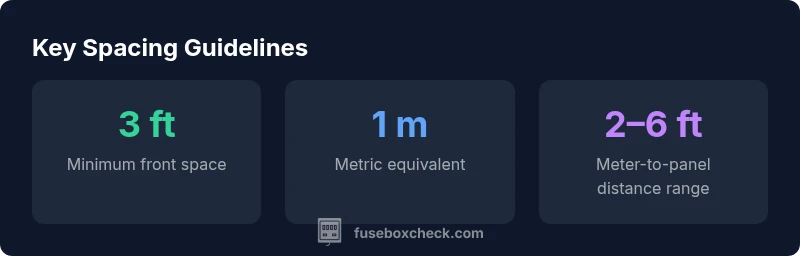
There is no universal fixed distance between a meter and a fuse box; local electrical codes and the layout of your home determine spacing. The key rule is to maintain clear, unobstructed access to both devices, with a minimum working space in front of the fuse panel (commonly about 3 feet / 1 meter) to ensure safe operation and serviceability.
Safety foundations: why spacing matters
The distance between the meter and fuse box is more than just a measurement on a drawing; it is a core safety and maintenance consideration. Adequate spacing ensures that technicians can reach the service disconnect, read meters, and perform routine tests without risking accidental contact with energized components. For homeowners, a clear zone around both devices reduces the risk of tripping breakers or accidentally bumping a live terminal during household chores. When planning or evaluating a layout, remember that the metric distance between meter and fuse box is less important than the practical requirement: unobstructed access and safe working space. In many homes, you will see the distance between meter and fuse box expressed as a range rather than a fixed figure, reflecting variations in house size, wall depth, and existing electrical gear. Maintain a conservative approach to clearance and prioritize safety first. The phrase distance between meter and fuse box is a helpful anchor for actionable planning.
How electrical codes shape layout decisions
Electrical codes are the governing rulebook for clearances and accessibility. They translate safety principles into measurable requirements that differ by country, state, and even local jurisdiction. When addressing the distance between meter and fuse box, most code regimes emphasize a few core ideas: keep the area in front of the fuse box (and the meter’s working face) free from obstructions, provide enough space to replace breakers or service connections, and ensure adequate headroom for safe operation. For example, many regions require a minimum working space in front of service panels—often several feet—to permit safe maintenance. While the exact distances vary, the underlying goal is consistent: prevent crowding that could impede emergency access or routine servicing. If you’re renovating, consult your local electrical code or a licensed professional to confirm the precise front clearance and any restrictions around meter enclosures. The distance between meter and fuse box should be evaluated within the broader framework of code-compliant clearances.
Typical layouts and how to measure your space
Understanding common layouts can help you anticipate the distance between meter and fuse box in your home. In modern houses, installers typically position the meter near the main service panel to minimize run length of conductors, while allowing clear access at both devices. To assess your own space, take precise measurements from the front face of the fuse box to nearby walls or obstacles, and verify that the path to the disconnect remains unobstructed for at least the standard working space. If you have wall-mounted meters, ensure there is enough room to swing open the panel cover without hitting furniture or cabinetry. In some installations, the meter and panel are separated by a short corridor or utility closet, which emphasizes the practical importance of keeping a clear corridor rather than chasing a fixed distance. The distance between meter and fuse box should reflect both safety margins and practical access needs rather than a single fixed number.
Practical steps to verify clearance in your home
Use these steps to verify your spacing without unnecessary risk:
- Visualize a straight access path from the meter to the fuse box, noting any potential obstructions.
- Measure the front clearance of the fuse box; ensure no storage, shelving, or decorative items intrude into this zone.
- Check that there is at least a 3-foot (1-meter) working space in front of the panel for knee room and tool access, and that doors or covers can open fully.
- Inspect the area on both sides of the devices to confirm no wiring or components restrict movement or pose snag risks.
- If you have a meter-closet or shared passage, confirm that the route to the disconnect remains unobstructed and that lighting is adequate.
- Document measurements for future renovations and reference during service calls, so the distance between meter and fuse box remains compliant over time.
If you’re unsure at any step, stop and consult a licensed electrician. They can verify code compliance, assess unique architecture, and suggest compliant rearrangements if needed.
Alternatives when space is tight: relocation and rerouting options
Some homes have tight built environments that challenge standard clearances. In such cases, options include repositioning one device (where permitted), rerouting feeders, or consolidating gear within a compliant cabinet or enclosure. Any relocation requires careful planning, permits, and coordination with your utility provider and local inspectors. In some jurisdictions, the meter location is fixed by the utility, limiting relocation options; in others, modest adjustments may be possible with a formal service upgrade. The key is to maintain safe working space and accessibility while adhering to local codes. If movement is necessary, work with a licensed electrician to design a compliant solution that preserves the integrity of the service and minimizes disruption to daily use.
Documentation and planning for home renovation
Before you start any remodeling that touches the meter or fuse box, create a simple schematic that marks the meter, main service panel, and any intervening hardware. Include notes on clearances, cover panel openings, and any potential obstacles. This documentation helps with future inspections and ensures that the distance between meter and fuse box remains within code as your home evolves. Keep a copy with your project files and share it with your electrician so everyone understands access requirements from day one. In practice, proactive planning reduces the risk of code violations and simplifies maintenance tasks down the line.
Safety reminders and next steps
Always treat electrical spaces with respect for safety. If you notice stiff covers, corroded bus bars, loose connections, or signs of moisture near the meter or fuse box, stop work and call a professional. The distance between meter and fuse box is not just a measurement; it embodies accessibility, emergency response readiness, and long-term reliability of your home’s electrical system. By maintaining proper spacing and staying aligned with local codes, you improve safety, speed up future service calls, and protect your household from avoidable hazards.
Distance considerations across common installation scenarios
| Scenario | Typical distance (feet) | Notes |
|---|---|---|
| New residential installations | 2–6 | Distance varies by layout; ensure inspection clearance |
| Older homes with compact spaces | 1–3 | May be constrained by building structure; plan alternative access |
| Commercial/industrial panels | 3–8 | Code-specific; higher safety margins |
Your Questions Answered
Is there a fixed distance required between the meter and fuse box?
No universal fixed distance exists. Spacing is governed by local codes and the specific layout of your home. The goal is clear access and safe working space.
There isn't a single fixed distance; check your local codes for the required clearances and ensure you have safe access to both devices.
What is the minimum clearance in front of a fuse box?
Most codes require a minimum front working space of about 3 feet (1 meter) in front of the fuse box to allow safe servicing and panel operation.
Typically, plan for at least 3 feet of front clearance for safe panel access.
Can I have the meter far from the fuse box?
Distance can vary, but the layout must still provide unobstructed access and meet clearance requirements. Relocation is sometimes possible with permits and expert guidance.
Distances vary, but ensure accessibility and check with an electrician if considering relocation.
What common mistakes reduce clearance around the meter and panel?
Storing items, shelving, or furniture in the required clearance zone; installing tight cabinets or aesthetic panels that block access; poor lighting in the service area.
Avoid stacking shelves or furniture where technicians need to reach the panel; keep it well-lit and clear.
Who should verify spacing during renovations?
A licensed electrician should verify clearance and code compliance, often with a local inspector if a permit is involved.
Have a licensed electrician check spacing and compliance, especially during remodels.
“Clear access to the meter and fuse box is a fundamental safety requirement, not an optional convenience. Proper spacing protects you during maintenance and emergencies.”
Highlights
- Ensure unobstructed access to both meter and fuse box.
- Follow local codes for minimum working space in front of the panel.
- Measure and document distances before renovations.
- Know that meter-to-panel spacing varies by layout, not a fixed rule.
- Consult a licensed electrician for any relocation or layout changes.