How Far Can a Fuse Box Be From the Meter? A Practical Guide
Explore how far a fuse box can be from the meter, what governs distance, and how to plan or relocate safely with expert guidance from FuseBoxCheck.


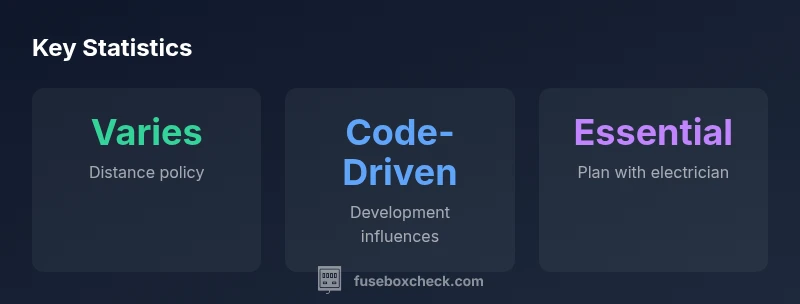
Definition: There is no universal distance allowed between the main fuse box and the utility meter. The allowable distance depends on local electrical codes (such as NEC/NFPA 70 in the United States), utility policies, conductor sizes, and practical considerations like voltage drop and ease of service. To determine a compliant distance, check your jurisdiction's code, contact your utility, and consult a licensed electrician.
How far can fuse box be from meter: Key factors
The distance between your service meter and the main fuse box (service panel) is not dictated by a single universal rule. Instead, it is shaped by a mix of code requirements, utility policies, equipment ratings, and practical considerations. The most important driver is safety and reliability: a longer run can introduce voltage drop, potential accessibility issues, and complications for future upgrades. In practice, many homes position the panel within a reasonable reach of the meter for serviceability, but location choices must comply with local code editions (often the latest NEC/NFPA 70 and any municipal amendments) and the utility’s service policies. For homeowners, the takeaway is simple: plan distances with a licensed electrician who understands both local rules and your home’s electrical layout.
How far can fuse box be from meter: Planning the current layout
To assess your current layout, start with a simple sketch of your property’s electrical path. Identify the meter location, the service disconnect, and the path feeding the main fuse box. Measure approximate distances and note any constraints: finished walls, crawl spaces, or outdoor exposure. If the panel is far from the meter, consider whether the current routing minimizes excessive conduit length, protects conductors from physical damage, and maintains a feasible route for future upgrades. Remember that separate structures (garages, sheds) may introduce additional rules or require metering considerations. Always verify distances against local codes rather than relying on memory or informal guidance.
Code and utility considerations you should know
Code references (NEC/NFPA 70) set the framework for where service equipment can be located, but they also defer to utility requirements and local amendments. Utilities may require meters on exterior walls or in dedicated meter rooms, and some jurisdictions restrict panel distance to minimize voltage drop and ensure reliable service. Permitting, inspection, and utility coordination are common parts of any relocation project. In short, there is no universal maximum distance—the key is ensuring that the route from meter to panel meets code intent and remains safe, accessible, and adaptable to future upgrades.
Practical pathways for relocation or adjustment
If your current layout doesn’t meet safety or code expectations, several practical paths exist. First, consult with a licensed electrician to explore rerouting feeders, adding conduit, or relocating the panel (often closer to the meter or to a central location with better accessibility). Obtain necessary permits and, if required, a utility sign-off. If relocation is not feasible, address safety concerns with protective enclosures, protective covers for outdoor runs, and proper labeling. The aim is to create a compliant, maintainable system that doesn’t compromise service reliability.
Common scenarios and best practices
Residential services vary widely: attached single-family homes, multi-unit buildings, and outbuildings each have unique considerations. In many cases, panel relocation is simplest during a broader remodeling project, but never attempt a relocation without a permit and professional oversight. For garages or basements that place the panel farther from the meter, ensure adequate clearance, temperature control, and protection from moisture and physical damage. In all scenarios, plan ahead for future upgrades, such as solar, EV charging, or generator interconnects, which may affect routing and sizing.
Guidance framework for fuse box distance from meter
| Aspect | Guidance | Notes |
|---|---|---|
| Code references | NEC/NFPA 70 and local amendments | Distance varies by jurisdiction |
| Utility requirements | Meter location influences panel routing | Coordinate with utility if relocation involved |
| Practical design | Keep feeder length reasonable and accessible | Consider future upgrades and safety |
| Permitting | Permits and inspections are typically required | Follow local processes |
Your Questions Answered
Is there a universal maximum distance between the fuse box and the meter?
No. Distance limits vary by jurisdiction and utility policy. Always check current local codes and confirm with your utility before planning relocations.
There isn’t a universal maximum distance; it depends on local rules and utility requirements.
Why does distance matter for safety and reliability?
Longer runs can increase voltage drop, heating, and exposure risk, and they may complicate future upgrades. Keeping the distance reasonable helps maintain safe, reliable service.
Distance affects safety and reliability; shorter, code-compliant runs are typically safer and easier to upgrade.
Who enforces distance requirements—the utility, the code, or the installer?
All three play a role. The code sets the framework, the utility defines service requirements, and the installer implements the practical routing and compliance.
It's a joint process among code, utility, and installer.
Can I relocate a fuse box near the meter myself?
Relocation should be performed by a licensed electrician with utility coordination. Permits and inspections are typically required to ensure safety and compliance.
Only a licensed electrician should relocate the fuse box, with proper permits.
What should I do if relocation isn’t feasible but safety is a concern?
Discuss protective enclosures, proper shielding, and accessibility improvements with a professional to address safety without moving the panel.
Talk to an electrician about safety upgrades if relocation isn’t possible.
“Distance between the meter and the main service panel isn't dictated by a single universal rule; it's determined by local codes, utility requirements, and practical safety considerations.”
Highlights
- Verify there is no universal distance rule; codes and policies vary by location
- Plan with an electrician to ensure safety, accessibility, and compliance
- Coordinate with your utility before any relocation or significant change
- Consider future needs (EV charging, solar) when routing cables