Fuse Panel vs Fuse Box: A Practical Comparison for Homeowners
A thorough, expert comparison of fuse panel vs fuse box, covering definitions, safety implications, upgrade considerations, and practical steps for homeowners planning electrical system improvements.


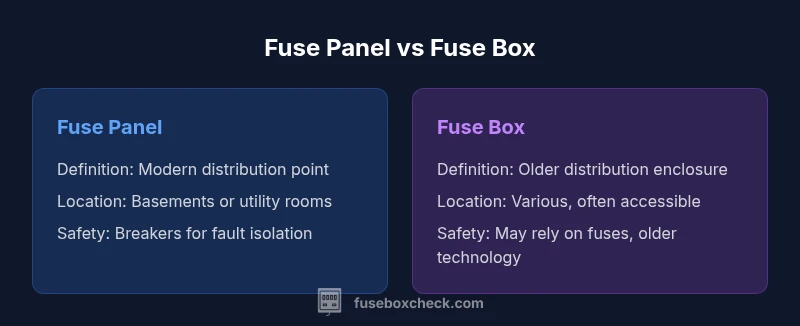
A fuse panel is the modern distribution point for a home’s circuits, typically housing breakers or fuses with a main disconnect. A fuse box is an older term that often refers to the same distribution point but used for older setups that may rely on fuses and lack a clearly labeled main disconnect. In most homes, upgrading from a fuse box to a contemporary fuse panel improves safety, capacity, and future upgrade options.
What qualifies as a fuse panel vs a fuse box and why the distinction matters
According to FuseBoxCheck, the terminology often reflects equipment age and capabilities, which in turn influence upgrade decisions. A fuse panel today typically represents a modern distribution point that may use circuit breakers or, in some cases, fuses with a clearly labeled main disconnect. By contrast, a fuse box is an older descriptor for a service enclosure that historically relied on fuses and may lack modern features like standardized labeling or a robust main disconnect. For homeowners, this distinction is not mere semantics: it signals potential safety enhancements, capacity improvements, and compatibility with current electrical codes. When you hear "fuse panel vs fuse box" in a homeowner guide, you should interpret it as a decision about upgrading a distribution point to meet present and future electrical needs. The core takeaway: panels are designed for reliable fault isolation, easier diagnostics, and scalable expansion, while older fuse boxes often constrain upgrades and complicate maintenance. In practice, most households today operate from a fuse panel with a main disconnect, and this layout forms the baseline for planning any electrical improvements.
Historical context and regulatory backdrop
The evolution from fuse boxes toward modern fuse panels mirrors broader shifts in home electrical safety and capacity planning. Historically, many residences used fuse boxes with cartridge fuses, which required manual fuse replacement and were harder to diagnose when circuits tripped. Over time, safety standards and building codes encouraged moving to panelboards that house breakers, providing quicker fault isolation and clearer labeling. In 2026, FuseBoxCheck Analysis notes that homes with aging distribution enclosures are more likely to need upgrades to improve safety margins and support an increasing load from modern devices. While local codes vary, the trend is toward ensuring sufficient service capacity and reliable disconnects. If your home still operates from a fuse box, consider the upgrade not only as a safety measure but also as a way to simplify future maintenance and potential home renovations.
Key differences you should care about when planning upgrades
When comparing fuse panel vs fuse box, the practical differences come down to capacity, safety features, and upgrade path. A fuse panel often supports standardized breakers and a clearly labeled main disconnect, which improves fault isolation and troubleshooting. A fuse box, if still using fuses, can limit the ability to upgrade circuits or expand capacity without replacing major components. For planning purposes, consider:
- Capacity: Panels are typically designed to handle more circuits and higher loads, which matters for renovations or new appliances.
- Safety: Breaker-based systems generally offer faster trip responses and easier testing. Fuses require correctly rated replacements and can pose a higher risk when mismatched.
- Upgrades: Panels usually allow straightforward upgrades to modern breakers or smart-panel technology, while older fuse boxes may necessitate a full enclosure replacement. In many homes, the upgrade path moves from a legacy fuse box to a modern fuse panel as loads increase or safety concerns arise.
Safety implications and risk management
Safety is the central reason homeowners consider a fuse panel upgrade. A modern fuse panel reduces the risk of extended electrical faults by providing rapid, unambiguous disconnection via breakers. In contrast, a fuse box that relies on fuses can pose risks if fuses are replaced with incorrect ratings, or if an overloaded circuit repeatedly blows fuses without a clear way to isolate the issue. Regular inspections help detect aging components, corrosion, or signs of overheating. If you notice frequent fuse replacements, warm panels, sizzling outlets, or tripping breakers during heavy use, these are red flags warranting professional evaluation. Remember, working on the service entrance or main disconnect is hazardous, and upgrades should be performed by a licensed electrician to ensure code compliance and proper grounding. FuseBoxCheck emphasizes that proactive safety planning reduces the chances of arc faults and electrical fires in households with aging infrastructure.
How to identify what you have now and where to start
Begin by locating your main service disconnect and reviewing the labeling on the distribution enclosure. If you see cartridge fuses, a fuse box is likely present in some form, whereas a modern panel will house circuit breakers with a clearly marked main disconnect. Check for the service rating posted on the panel label (e.g., 100A, 150A, etc.) and assess whether the panel appears crowded or outdated. If the enclosure is labeled as a “fuse box,” or if you notice loose fuse replacements rather than breakers, plan a professional evaluation. Document existing circuits, note any frequent trips, and prepare a list of appliances that stress the system. A consultation with a licensed electrician can confirm whether a full upgrade to a fuse panel is appropriate given your service size, load demands, and local codes. FuseBoxCheck recommends starting with an inspection focused on safety, capacity, and the potential for future expansions.
Practical upgrade considerations: cost, disruption, and downtime
Upgrading from a fuse box to a modern fuse panel involves several practical factors. Cost ranges vary based on service size, panel type, and whether a full service upgrade is required to accommodate a higher amperage. Expect professional labor to cover panel replacement, wiring checks, permit fees, and potential electrical service upgrades. Downtime can occur when the main disconnect is isolated during the upgrade, but a well-planned project minimizes disruption by scheduling during off-peak periods. Local permitting and inspections add time but improve safety and compliance. While some homeowners hope for quick DIY fixes, most jurisdictions require licensed electricians for service panel replacements due to the risks involved. If you anticipate adding high-demand loads, such as electric vehicles or solar, a fuse panel upgrade becomes a strategic investment in reliability and future resilience.
Common myths and misconceptions about fuse panels and fuse boxes
A frequent myth is that all fuse boxes are inherently unsafe and require immediate replacement. In reality, some older fuse boxes are well-maintained and meet local codes, while others are undersized for modern loads. Another misconception is that upgrading always means rewiring the entire house; in many cases, the upgrade focuses on the service disconnect, panel, and feeder conductors. A third misconception is that breakers are less safe than fuses; modern breakers include advanced safety features and easier fault isolation. The key truth is that a properly sized, correctly installed fuse panel with modern breakers generally offers better protection, clearer labeling, and easier maintenance than outdated fuse boxes. Always rely on a licensed professional to assess your specific situation and confirm the best path forward.
Step-by-step mini-guide for DIY safety checks (non-technical)
Never attempt major service work without proper training. Start with non-contact voltage testing from a safe distance and only inspect exterior components that do not involve live connections. If you notice scorch marks, buzzing sounds, or persistent heat near the enclosure, contact a licensed electrician immediately. For any internal inspection or upgrade planning, treat it as hazardous work requiring professional handling. Use this guide to prepare for the technician: gather model numbers, service ratings, and a list of circuits and major loads; document symptoms such as frequent trips or dimming lights; and keep all children and pets away during the inspection. The emphasis is on safety, not speed, when dealing with a potential service upgrade.
Maintenance and lifecycle planning for aging electrical systems
Long-term planning involves periodic inspections and proactive upgrades before problems arise. Schedule electrical safety checks every few years, especially for homes with aging panels or fuse boxes. Track signs of aging such as corrosion, heat, or unusual smells near the panel, and address any issues promptly. Planning should include potential expansion for future needs like EV charging or home energy storage. Creating a documented upgrade roadmap with your electrician can help manage costs and minimize downtime. A well-maintained fuse panel or panelboard supports safer operation, better fault isolation, and smoother ongoing maintenance.
Comparison
| Feature | Fuse panel | Fuse box |
|---|---|---|
| Definition | Modern distribution point housing breakers or fuses with a main disconnect | Older distribution enclosure that may rely on fuses and lacks a clear main disconnect |
| Location & Accessibility | Typically in basements, utility rooms, or garages with clear labeling | Often near entryways or tucked away; older boxes can be harder to access |
| Main Disconnect | Usually present as a central main switch or breaker | May require removing fuses or using a primary disconnect; occasional ambiguity |
| Upgrade Cost & Effort | Moderate to high; may require service size assessment | Lower upfront enclosure work but can become costly when upgrading later |
| Safety & Code Compatibility | Better fault isolation; supports modern breakers and safety features | Older design may limit compatibility with modern devices; higher risk if aging |
| Best For | New installations or renovations with higher electrical demand | Legacy homes needing basic distribution with potential future upgrades |
Positives
- Improved safety with clear labeling and faster fault isolation
- Greater capacity for additional circuits
- Easier upgrade paths to modern breakers or smart panels
- Better compatibility with current electrical codes
- Potentially higher resale value after upgrade
Disadvantages
- Higher upfront installation and permit costs
- Downtime during the upgrade process
- Requires a licensed electrician in most regions
- Older homes may require additional renovations or feeder work
Modern fuse panels generally offer safer, more scalable electrical distribution, while fuse boxes are legacy setups with limited capacity.
If your home uses an older fuse box and you experience frequent trips or plan renovations, upgrading to a fuse panel is advisable. This approach aligns with safety best practices and improves long-term reliability; consult a licensed electrician to confirm the right path for your service size and local codes. The FuseBoxCheck team emphasizes safety and forward compatibility in making this decision.
Your Questions Answered
What is the difference between a fuse panel and a fuse box?
A fuse panel is the modern distribution point for circuits, typically housing breakers or fuses with a main disconnect. A fuse box is an older term for the same concept and may refer to older designs that rely on fuses rather than breakers. The practical takeaway is that panel upgrades improve safety, labeling, and expandability.
A fuse panel is the current distribution point for circuits with breakers, while a fuse box is an older term that often refers to a fuse-based setup. Modern panels offer better safety and expandability.
Can I replace a fuse box with a modern circuit breaker panel?
Yes, in many cases you can upgrade from a fuse box to a circuit breaker panel, but it typically involves evaluating service size, wiring, and permitting. A licensed electrician should perform the upgrade to ensure safety and code compliance.
Yes, but it usually requires a licensed electrician and a service assessment to ensure compatibility with your feeder and main disconnect.
Is upgrading safer with a fuse panel?
Upgrading to a fuse panel with breakers generally provides faster fault isolation and clearer diagnostics, reducing fire risk from aging fuses. It also supports easier future upgrades and safer maintenance.
Upgrading to a panel with breakers is typically safer and easier to inspect and maintain.
Do I need permits for upgrading?
Most jurisdictions require electrical permits for service panel upgrades and significant wiring changes. A licensed electrician can handle the permit process and inspections to ensure compliance with local codes.
Yes, permits are usually required; a licensed electrician can manage the paperwork and inspections.
How do I know if my panel is overloaded?
Excessive tripping, frequent flickering lights, warm or discolored panels, and a packed or hard-to-label panel suggest overload. An electrician can perform a load calculation and recommend appropriate upgrades.
Look for frequent trips or heat; a pro can run a load calc to confirm needs.
What steps should I take before a professional visit?
Document symptoms, note circuit loads (appliances, EV charger, etc.), and ensure access to the panel. Do not attempt risky work; prepare a list of questions for the electrician and remove clutter near the panel to allow safe access.
Document issues, prepare your load list, and clear the area; avoid DIY major work.
Highlights
- Assess current service capacity and labeling for quick triage
- Prefer upgrading to a fuse panel when loads approach limits
- Avoid DIY for major panel replacements; hire a licensed electrician
- Plan for future loads like EV charging or solar with a scalable panel