How to Turn On a Fuse Box Safely: A Homeowner's Guide
A comprehensive, safety-first guide for homeowners on turning on a fuse box after maintenance, with step-by-step actions, tools, and when to call a professional. FuseBoxCheck delivers expert guidance for reliable electrical care.


Following this guide, you’ll safely bring the fuse box on after maintenance, verify circuits, and restore power without risk of shock. You’ll need insulated tools, a voltage tester, and a partner for safety. If you’re unsure, stop and call a licensed electrician.
Understanding the phrase "fuse box on" in home electrical work
When homeowners say they need the fuse box on, they’re usually referring to restoring power to circuits after a safety check, maintenance, or a fuse replacement. The phrase highlights the moment when the panel transitions from a safe, isolated state to an energized state where individual circuits can be tested and used again. This is a high-responsibility moment: every action should prioritize personal safety, correct labeling, and maintaining code-compliant practices. Throughout this guide, you will see practical steps to manage the process without rushing. The goal is to return power only to circuits that are ready and safe, while preventing accidental re-energization of unsafe connections. FuseBoxCheck emphasizes careful planning and adherence to safety standards when the fuse box on becomes live again.
Safety prerequisites before handling the fuse box
Before any work, establish a safe environment. Clear the area, ensure lighting is adequate, and remove any standing water or conductive surfaces nearby. Use insulated gloves and eye protection whenever you handle or inspect the fuse panel. Verify the area is dry, and confirm that pets and children are kept away. If at any point you feel uncertain, pause and consult a professional. FuseBoxCheck consistently stresses that personal safety and a calm, deliberate approach are essential when the fuse box on is involved.
Reading the panel labeling and understanding fuse vs breaker terminology
Panels label each circuit with a description of what it powers. Understanding whether you have fuses or breakers is critical because the re-energization process differs slightly for each type. Look for the rating information printed on each fuse or breaker, and compare it to the loads connected to that circuit. Mislabeling can lead to overloading a circuit once the fuse box on, which creates a fire hazard. Take time to familiarize yourself with the labeling before attempting to restore power.
Tools and safety gear you should gather
Prepare a dedicated, insulated workspace and assemble essential tools: a non-contact voltage tester to verify dead circuits, insulated screwdrivers, a flashlight, and appropriate safety gloves. Have spare fuses of the correct amperage on hand or a tested replacement breaker if applicable. Gather a battery-powered tester for quick resistance checks, and keep a fire extinguisher rated for electrical fires nearby. Having these ready reduces the risk when the fuse box on takes place.
A careful, phased approach to turning the fuse box on
Plan your steps to minimize simultaneous loads and avoid overloading circuits. Start by confirming the main disconnect is on a safe setting, then re-energize individual circuits one at a time. This phased approach helps identify any problematic circuits that could trip or blow fuses. Move slowly, listen for unusual arcing sounds, and watch for warm components. If anything feels off, discontinue and call a professional. FuseBoxCheck notes that patient, methodical power restoration is safer than rushing the process.
Testing and validating circuits after re-energization
After turning the fuse box on, test each circuit with a basic load to ensure it’s operating correctly. Use a simple appliance or a lamp to verify power delivery without exceeding the circuit’s rating. If a circuit trips again or a fuse blows, do not retry the same configuration; instead, re-check connections and consult a professional if there is any sign of a fault. The goal is to confirm stable operation while avoiding overload, overheating, or electrical hazards.
Common signs that something is wrong after restoring power
If you hear buzzing, see discoloration, or smell burnt insulation after turning the fuse box on, stop immediately. These indicators suggest wiring or component damage that warrants professional assessment. Do not continue testing or using affected outlets or appliances—shut off the main and seek help. Early detection of faults can prevent more serious electrical issues and potential fires.
Best practices for ongoing fuse box maintenance
Schedule periodic inspections, keep a clear area around the panel, and label any changes you make. Small, proactive checks reduce the risk when the fuse box on routine maintenance is performed. Use a multimeter to test voltage safely and keep a log of any observed anomalies. Regular upkeep with documented notes improves both safety and reliability over time.
When to call a licensed electrician
If you encounter persistent tripping, burnt smells, melted components, or if you’re uncomfortable with any step, stop and call a licensed electrician. Electrical work carries inherent risks, and a pro can diagnose issues that DIY steps may miss. FuseBoxCheck consistently recommends professional support in ambiguous situations to protect your home and loved ones.
Tools & Materials
- Non-contact voltage tester(to verify dead circuits without touching conductors)
- Insulated screwdriver set(for panel screws and terminals)
- Flashlight or headlamp(for working inside the panel in dim areas)
- Electrical safety gloves(electrically rated if possible)
- Replacement fuses or breakers(of the correct amperage as labeled on the panel)
- Voltage tester or multimeter(for additional voltage checks)
- Safety goggles(protect eyes from sparks)
- Dry cloth and alcohol wipes(clean components if corrosion is present)
- Fire extinguisher (Class C)(electrical fires only)
Steps
Estimated time: 30-60 minutes
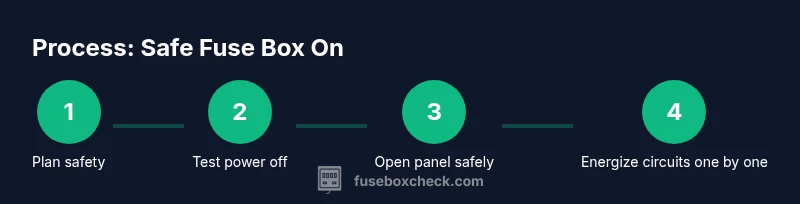
- 1
Prepare and plan safety
Before touching the fuse box on, clear the area, gather all tools, and inform others nearby of the activity. Establish a safe, dry workspace and confirm the main disconnect is accessible. Planning reduces confusion and keeps the task controlled.
Tip: Double-check the area for water or damp surfaces; moisture dramatically increases risk. - 2
Verify power is off to the panel
Use a non-contact tester to confirm the panel and circuits you’ll touch are de-energized. Do not rely on memory of recent work; always verify with a tester. This ensures you won’t experience a shock when opening the fuse box on.
Tip: Test the tester on a known live source first to ensure it’s functioning. - 3
Open the panel and inspect visually
Carefully remove the panel cover with insulated tools. Look for signs of wear, loose terminals, or scorch marks. Do not touch exposed conductors; use only insulated tools for any adjustments.
Tip: Keep a clear labelling system for circuits to prevent mis-wiring when you energize the panel. - 4
Plan which circuit to energize first
Identify a low-load circuit to energize first if you’re testing after maintenance. This limits the risk of overload. A controlled re-energization reduces chances of immediate tripping of a branch circuit.
Tip: Avoid turning on high-power appliances in the same sequence as the first energizations. - 5
Re-energize circuits one at a time
Turn on the main disconnect, then restore individual circuits sequentially. Monitor for any warm components or unusual noises as you go. If anything seems off, stop immediately and reassess.
Tip: If a circuit trips, leave it off for a while and investigate the fault rather than repeatedly tripping. - 6
Test and verify all circuits
With power restored, test outlets and devices on energized circuits. Confirm lights and appliances operate normally and within their rated loads. Document any anomalies for future maintenance.
Tip: Keep a simple log of which circuits were energized and any unusual observations.
Your Questions Answered
Is it safe to turn on a fuse box by myself?
DIY can be safe if you follow the steps above and use proper PPE. If you’re uncertain at any point, stop and call a licensed electrician.
You can do it safely if you follow the steps and use proper protections, but if you're unsure, call a professional.
What is the difference between fuses and breakers?
Fuses are sacrificial devices that melt to interrupt a fault, while breakers trip and can be reset. Both serve to protect circuits but operate differently.
Fuses melt when overloaded, breakers trip and can be reset.
How do I know a fuse is blown or a breaker tripped?
A blown fuse shows a broken element inside; a tripped breaker sits in a middle position and may require flipping back to on. Always verify with a tester.
Look for a broken fuse element or a breaker in the off/middle position and test the circuit.
When should I replace a fuse box?
Replacement is advised when the panel shows signs of wear, corrosion, overheating, or outdated safety ratings. Consult a licensed electrician for evaluation.
If the panel is worn or unsafe, have it evaluated by a pro.
Do I need permits or codes to work on a fuse box?
Electrical work typically requires adherence to local codes and may require a permit. Check with your local building department or a licensed electrician.
Often permits are needed; local codes vary, so check with authorities or a pro.
Watch Video
Highlights
- Plan safety first before touching the fuse box on.
- Verify power-off with a tester to prevent shocks.
- Energize circuits one by one to avoid overload.
- If in doubt, call a licensed electrician.