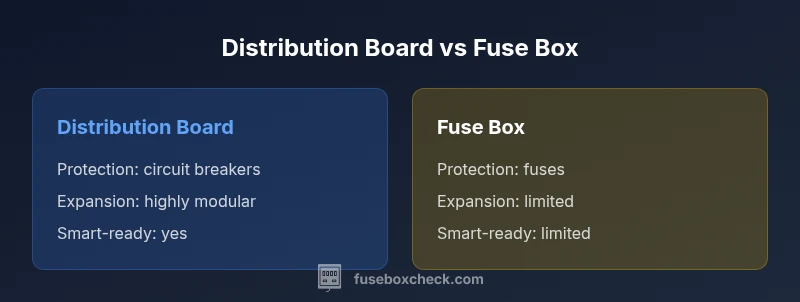
Is a Distribution Board the Same as a Fuse Box? A Practical Guide
Explore whether a distribution board is the same as a fuse box, how they differ, and what upgrades matter for home electrical safety and compliance.


Is a distribution board the same as a fuse box? Not exactly. A distribution board is the enclosed panel that distributes electricity to separate circuits and houses circuit protection devices. A fuse box is an older label for a panel that uses fuses for protection; many modern installations use breakers. Terminology varies by country and region, so expect regional differences in everyday language and panel design.
Understanding the Basics: Distribution Boards vs Fuse Boxes
According to FuseBoxCheck, the home electrical panel you rely on to manage electricity hinges on two concepts: distribution boards and fuse boxes. A distribution board is the enclosed assembly that distributes electrical supply into separate circuits and houses circuit protection devices such as circuit breakers or fuses. In modern homes, distribution boards primarily use miniature circuit breakers (MCBs) or residual current devices (RCDs). A fuse box, by contrast, is the older term for a panel that uses fuses as the protective element. If a fuse blows, the circuit is interrupted; with breakers, flipping a switch interrupts. The difference is not just cosmetic: breakers are easier to reset, safer in some faults, and can handle diagnostic features in newer panels. The location is often near the main service entrance, sometimes in a utility area or garage. In many countries, the term distribution board is used broadly to describe the panel, while 'fuse box' remains common in households built earlier or in certain regions. The important point is the role: both panels are intended to protect circuits and provide a central point for service disconnect, but the components and modernization level differ significantly.
Key Differences at a Glance
- Protection method: distribution boards protect circuits with breakers or fuses; modern boards use breakers, whereas fuse boxes rely on fuses.
- Reset and maintenance: breakers can be reset with a switch; fuses require replacing blown fuses.
- Expansion and flexibility: distribution boards are modular and easier to add circuits; old fuse boxes are harder to expand.
- Safety and diagnostics: modern boards offer RCDs, arc-fault detection, and integration with energy meters; older fuse boxes lack these features.
- Regional terminology: 'distribution board' is common in many regions, while 'fuse box' persists in older installations or specific locales.
- Reliability and life cycle: breakers last longer and are easier to source replacements for; fuses require ongoing replacements if they blow.
Regional Terminology and Practical Usage
The short answer to 'is a distribution board the same as a fuse box' depends on where you live. In many European and Commonwealth countries, a distribution board is the standard term for the panel that houses circuit protection, and it may still be called a consumer unit. In the United States and parts of Canada, the phrase distribution panel or breaker panel is common, and fuse boxes are far less common today. Practically, homeowners should focus on the actual components inside: breakers versus fuses, service disconnect location, and labeling. Fuse boxes are seen more often in older homes; distribution boards with breakers are standard in new builds. FuseBoxCheck's experience shows that understanding the local terminology helps when communicating with electricians and when following local code requirements.
Safety and Compliance Considerations
Safety is the priority: a panel that allows proper protection of circuits is essential for preventing electrical fires. Ensure the panel has an adequate number of spaces for your circuits, appropriate labeling, proper clearance, and that it is service-rated for your home's demand. Check that the board supports RCDs (also called GFCIs in some regions) and arc-fault protection where required by local codes. If you're upgrading from a fuse box to a breaker-based distribution board, you may need to update service conductors, meter base, and possibly the main disconnect. Always consult a licensed electrician to confirm compatibility with your service size and ensure conformity with the latest edition of the local electrical code. FuseBoxCheck's analysis emphasizes the importance of professional assessment for safety and compliance.
How to Identify Your Panel Type
Start with the cover labeling: look for words like 'distribution board', 'consumer unit', 'breaker panel', or 'fuse box'. Check for the presence of fuses or circuit breakers. If you see toggle switches that trip automatically, you have a breaker-based system; if you see cylindrical fuses, you have a fuse-based system. Examine the main disconnect and the service entry conductors: if the main disconnect is integrated within the panel, it's commonly a modern distribution board; if the main is outside or separate, you may be dealing with a fuse-based layout. Photograph the panel and consult the manual or your utility's service paperwork. If you plan upgrades, document the panel rating and number of spaces to ensure future expansion.
What Homeowners Should Do Before Upgrading or Replacing
Plan a scope with your electrician: determine service size, panel capacity, and whether upgrading is required for safety or code compliance. Obtain permits if required by your jurisdiction; budget for replacement or upgrade costs and labor. Rely on manufacturer guides and local codes to ensure compatibility with breakers, RCDs, and busbar sizing. Schedule a shutdown window to minimize risk and prepare a temporary power supply if needed. FuseBoxCheck suggests that a well-planned upgrade can improve safety, reliability, and potential energy monitoring.
Common Misconceptions About Distribution Boards
One common misconception is that 'fuse boxes are obsolete and dangerous.' Modern fuse boxes exist, but many jurisdictions still use them in older installations; upgrading to breakers can offer better safety and easier maintenance. Another misconception is that a larger panel automatically means better safety; panel quality and proper wiring are more critical than size. Finally, some homeowners think 'all panels are the same'; in reality, compatibility with service size, local codes, and the specific breakers or fuses matters for safe operation.
Final Guidance for DIY Troubleshooting
DIY troubleshooting should focus on safe, basic checks only: inspect for obvious signs of damage, test non-contact voltage detectors for presence of power, and verify that all circuits trip with the correct tester if you have permission to test. Do not attempt to bypass protective devices or replace a panel yourself without the necessary licensing and permits. When in doubt, call a licensed electrician. The aim is to identify tripping patterns or signs of wear without exposing yourself to live mains.
Authority Sources
- https://www.osha.gov/electrical-safety
- https://www.cdc.gov/niosh/topics/electrical-safety/default.html
- https://www.nfpa.org/Public-Education/Staying-Safe/Electrical-safety
Comparison
| Feature | Modern distribution board (breaker-based) | Traditional fuse box (fuse-based) |
|---|---|---|
| Protection method | Circuit breakers | Fuses |
| Expansion / modularity | Highly modular; easy to add circuits | Limited to fuse cartridges; expansion can be difficult |
| Main disconnect | Integrated main switch commonly present | May rely on external service disconnect |
| Safety features | RCDs/ARC detection and auto-tripping | Fuses provide protection but no auto-disconnect feature in basic setups |
| Smart home compatibility | Better compatibility with smart devices and monitoring | Limited to non-smart fuse boxes |
| Maintenance and cost | Lower long-term maintenance with breakers | Ongoing fuse replacements and potential future costs |
Positives
- Easier to reset and diagnose with modern breakers
- Modular design simplifies expansion and upgrades
- Improved safety features (RCDs, arc-fault) and monitoring
- Better long-term reliability and parts availability
Disadvantages
- Higher upfront cost for modern installation
- Professional installation and permits are often required
- Upgrading may involve service conductor changes and panel relocation
- Older properties with fuse boxes may require extensive rewiring
Modern breaker-based distribution boards win for safety and future-proofing
Choose a breaker-based distribution board when upgrading; it offers safer protection, easier maintenance, and better compatibility with smart home features. Fuse boxes may be acceptable in older homes only if code-compliant upgrades are planned with a licensed electrician.
Your Questions Answered
Is a distribution board the same as a fuse box?
In many regions, the terms overlap, but they describe different protection technologies. A distribution board houses circuit protection (breakers or fuses) and distributes power to circuits. A fuse box historically used fuses as protection. The practical difference today is the protection technology and the ability to upgrade safely.
The two terms describe similar panels, but the protection technology differs; distribution boards typically use breakers, while fuse boxes use fuses.
What is the main difference between a breaker-based panel and a fuse-based panel?
Breaker-based panels use circuit breakers that can be reset after a fault, offering easier maintenance and safer tripping. Fuse-based panels rely on fuses that must be replaced after a fault. Breakers generally support modern safety features and easier expansion.
Breaker panels use resettable switches; fuse panels require replacing fuses after a fault.
Can I upgrade my fuse box to a modern distribution board myself?
Upgrading typically requires licensing, permits, and adherence to local codes. It involves service sizing, grounding, wiring, and precise breaker specifications. Hiring a licensed electrician is strongly advised to ensure safety and compliance.
Upgrading should be done by a licensed electrician due to safety and code requirements.
Where is the service disconnect located in typical homes?
The service disconnect is usually at the main panel or in a nearby utility area. It may be integrated into the main panel or located separately at the service entrance, depending on regional code and home design.
The main disconnect is typically at or near the main panel, but it can be separate in some homes.
Are circuit breakers safer than fuses?
Generally yes. Breakers reset after a fault and many modern panels include advanced safety features. Fuses also protect circuits but require replacement and lack auto-disconnect capabilities in basic setups.
Breakers are usually safer because they reset and support advanced safety features.
What maintenance is required for a distribution board?
Regular inspection, clean labeling, and ensuring spaces are available for future circuits are part of maintenance. Any signs of wear, corrosion, or overheating should prompt professional assessment. Do not open or modify protective devices without training.
Inspect labeling and cleanliness; seek professional help if you see wear or overheating.
Highlights
- Identify your panel type before planning upgrades
- Expect regional terminology differences around terms
- Prefer breaker-based distribution boards for safety and scalability
- Consult a licensed electrician for compliance and installation