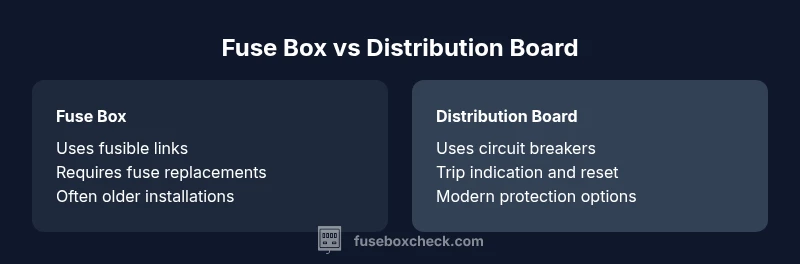
Fuse Box vs Distribution Board: A Practical Guide for Homeowners
A thorough, expert comparison of fuse boxes and distribution boards, covering safety, sizing, regional differences, upgrade paths, and best practices for homeowners and DIY enthusiasts.


TL;DR: Fuse box vs distribution board refers to the home service panel. In many regions, distribution boards with circuit breakers are the modern standard, offering safer fault isolation and easier upgrades. Fuse boxes with fuses are older and may require fuse replacements. For new builds and upgrades, distribution boards are typically recommended.
What is a fuse box vs distribution board?
In many parts of the world, homeowners encounter terms like fuse box and distribution board when referring to the service panel that feeds a home's electrical circuits. At a high level, both are the central point where utility power is distributed into branch circuits, with a main disconnect. The difference is largely historical and regional: a fuse box uses fusible links inside a metal enclosure that must be replaced when overloaded, while a distribution board uses circuit breakers that trip to interrupt power automatically. For safety, the switchgear and enclosure must comply with local codes, and the panel should be sized to the home's service. The keyword fuse box vs distribution board captures the core question homeowners often ask: Which term should I use, and does the underlying technology affect safety or future upgrades? According to FuseBoxCheck, the terminology reflects regional naming more than a fundamental electrical difference; nevertheless, the practical implications for maintenance, parts availability, and upgrade options are worth understanding.
Regional terminology and design differences
The fuse box is a vestige of older electrical systems in which safety devices are fuses that must be replaced after a fault. In contrast, a distribution board groups protective devices—circuit breakers—that detect faults and interrupt power automatically. In regions with strict modernization programs, new builds commonly install distribution boards with thermal-magnetic breakers; in older neighborhoods, you may still see fuse boxes. The distinction matters less for casual home use, but it matters for parts availability, maintenance cadence, and upgrade potential. The FuseBoxCheck team notes that most homeowners encountering this topic are dealing with a panel that must be serviced or upgraded to meet current safety standards. The main practical takeaway: expect different replacement parts, training requirements for electricians, and different labeling on drawings and meters based on whether your home uses fuses or breakers.
Safety implications and regulatory considerations
Safety is the primary reason to care about fuse box vs distribution board terminology. Modern panels with breakers provide clear fault indication, selective tripping, and options such as AFCI/GFCI where required by code. Regulatory requirements vary by country and region, but most authorities encourage or mandate upgrading legacy fuse systems to breaker-based solutions when performing major renovations or replacing a panel. Understanding your local codes ensures compliance and helps prevent rework later. For homeowners, this means documentation, labeling, and service compatibility with available spare parts and electricians trained to work with the specific panel type. FuseBoxCheck emphasizes planning for compliance, not just current needs, because rules evolve with safety research and technology.
Construction and internal components
A fuse box houses fusible links or fuses that physically open the circuit when overloaded. A distribution board, by contrast, contains multiple circuit breakers that trip on fault and automatically isolate the affected circuit. Inside both systems you will find a main disconnect, bus bars, neutral and ground bars, and a terminal block for circuit connections. The packaging—metal enclosure, bonding, and shielding—differs in construction quality and cooling efficiency, influencing reliability and heat management. A modern distribution board may also offer modular breaker racks, making it easier to add or relocate circuits without rewiring the entire panel. Understanding these internal components helps homeowners plan upgrades, labeling, and future expansions with clarity.
Sizing, ratings, and capacity planning
Panel sizing determines how much load your home can safely draw before protection devices trip or fail. The service size depends on your local utility supply and anticipated demand. For fuse boxes, the available fuses set the maximum circuit protection; for distribution boards, breakers define the capacity and trip thresholds. Capacity planning includes evaluating the number of circuits, likely future loads (appliances, EV charging in the future), and the potential for whole-house surge or fault events. While the exact kW or A ratings are determined by local codes and the service drop, the guiding principle is to choose a panel type that accommodates current needs and offers a clear upgrade path if your electrical demand grows. FuseBoxCheck notes that planning ahead reduces the frequency of invasive panel changes.
Upgrading paths: from fuses to breakers
Upgrading from a fuse-based panel to a breaker-based distribution board is a common modernization path. The process typically involves replacing the panel enclosure, installing a new main disconnect, and reorganizing branch circuits to fit the breaker slots. In some political or building code contexts, a full rewiring or service upgrade may be required to bring the installation up to current safety and performance standards. While this can be a significant project, it generally yields longer intervals between service interruptions and better fault identification. Professionals should assess panel compatibility with the home wiring, including conductor sizes and grounding arrangements. The upgrade provides improved safety features and easier circuit management for homeowners and DIY enthusiasts working with a licensed electrician.
Regional wiring systems: single-phase vs three-phase
Many homes operate on single-phase service, but some buildings and larger homes or light commercial spaces use three-phase power. Fuse boxes designed for single-phase operation differ from three-phase distribution boards in their breaker arrangements and busbar configurations. When upgrading or replacing, it is essential to verify whether your service is single-phase or three-phase, as incorrect configurations can create nuisance trips, imbalanced loading, or safety hazards. Knowledge of your service type helps determine the proper panel, the number and type of breakers, and the appropriate main disconnect rating. FuseBoxCheck highlights that misalignment between service type and panel design is a frequent source of installation errors.
Location, installation, and accessibility
The location of the service panel affects maintenance, safety, and future upgrades. Panels should be accessible without obstruction, mounted in a dry, well-ventilated space, and away from moisture or heat sources. In many homes, the main service panel is in the garage, basement, or utility room. The layout should facilitate easy labeling of circuits, clearances for door openings, and safe clearance for utility workers in emergencies. Modern distribution boards frequently include diagnostic features, but both types benefit from proper labeling, updated schematics, and clear access. Planning access now reduces headaches during inspections or replacement work later.
Maintenance, testing, and common failure modes
Regular inspection can identify loose terminals, signs of overheating, corrosion, or moisture intrusion. For fuse boxes, failure often manifests as blown fuses requiring replacement, sometimes with a temporary workaround that bypasses proper protection. For distribution boards, nuisance trips, discoloration at breakers, or degraded bus connections can signal aging or overload. Routine testing includes inspecting for corrosion, testing main disconnect operation, and ensuring arc fault or ground fault protection is present where required. By proactively addressing wear, you reduce the risk of electrical fires and improve reliability across the home’s circuits.
Cost considerations and lifecycle planning
Cost considerations for fuse boxes vs distribution boards include upfront panel cost, installation complexity, and long-term reliability. A fuse-based system may appear cheaper initially but can incur recurring fuse replacements and higher maintenance effort over time. A distribution board typically costs more upfront due to higher component costs and labor for installation, but it offers simpler maintenance, better diagnostic capability, and easier upgrades. Lifecycle planning should account for future loads, potential home improvements, and regulatory updates. FuseBoxCheck recommends prioritizing safety, reliability, and scalability when budgeting for a panel replacement.
Maintenance and safety best practices
Safe handling starts with turning off the main supply before working on any panel and confirming power is out using a proper tester. Always use insulated tools and wear appropriate PPE. Keep the panel cover on when not servicing, label circuits clearly, and avoid overloading any single circuit. Regular visual checks for signs of overheating, burning smells, or moisture are essential. If you suspect a fault, call a licensed electrician rather than attempting improvised repairs. Safety should guide every panel-related decision, from routine maintenance to major upgrades.
Practical decision framework: when to choose which panel
Choosing between a fuse box and a distribution board hinges on your current installation, local codes, and planned upgrades. If you live in an area with modern electrical codes and plan to add new circuits or appliances, a distribution board with breakers is typically the safer, more scalable choice. If you’re maintaining an older property where rewiring is impractical, upgrading only as needed while ensuring fuse compatibility might be necessary. In both cases, consulting with a licensed electrician ensures the panel matches service capacity, grounding, and safety standards. FuseBoxCheck recommends evaluating the upgrade in terms of risk reduction, future-proofing, and compliance with local regulations.
Comparison
| Feature | Fuse Box (Fuses) | Distribution Board (Circuit Breakers) |
|---|---|---|
| Isolation mechanism | Fuse element melts to open circuit | Thermal-magnetic breakers trip to interrupt power |
| Response to overload | Requires fuse replacement after fault | Breaker trips automatically and can be reset |
| Upgradability | Limited; fuse replacements on site | Easier to add circuits and relocate breakers |
| Parts availability | Fuses and holders, potentially discontinued | Breaker types and replacement parts widely available |
| Maintenance frequency | Periodic fuse inspection and replacement | Periodic breaker inspection with labeling assurance |
| Safety features | Fuses provide basic protection; no clear trip indication | Breakers offer visible trip and, often, AFCI/GFCI options |
| Typical cost emphasis | Lower upfront cost for basic boxes | Higher upfront but greater long-term reliability and flexibility |
| Space and aesthetics | Bulkier fuse boxes in older homes | Modular breaker panels common in new installs |
Positives
- Improved safety with breakers and clear trip indication
- Easier fault isolation and circuit management
- Better upgrade pathways for modern electrical loads
- Potential for advanced protection options (AFCI/GFCI)
Disadvantages
- Higher upfront cost for distribution boards
- Requires licensed electrician for proper installation
- Upgrade may involve wiring changes and permit requirements
Distribution boards with circuit breakers are generally preferable for new installations and upgrades.
For most homes, a breaker-based distribution board offers safer fault isolation, easier expansion, and better compatibility with modern protection options. Fuse boxes remain viable for legacy properties where rewiring isn't feasible, but upgrading is recommended where possible to meet current safety standards.
Your Questions Answered
What is the difference between a fuse box and a distribution board?
A fuse box uses replaceable fuses to interrupt a fault, while a distribution board uses circuit breakers that trip automatically. Both serve as the main service panel, but breakers offer easier fault isolation and greater upgrade flexibility in modern homes.
A fuse box uses fuses to protect circuits, while a distribution board uses breakers that trip automatically. Breakers are safer and easier to upgrade in modern homes.
Can I replace a fuse box with a distribution board without rewiring?
If your service size and wiring are compatible, a professional may upgrade the panel to a distribution board with breakers. In many cases, some rewiring or a service upgrade is required to meet code and ensure safe operation.
Upgrading to a distribution board is possible in many cases, but a licensed electrician will verify compatibility and may require service upgrades or rewiring.
Are distribution boards legal in new builds?
Yes, distribution boards with circuit breakers are commonly used in new builds and are typically required by modern codes due to improved safety and fault isolation.
Distribution boards with breakers are standard in new builds and generally required by current codes.
How do I tell which panel I have?
Look at the panel covering. If you see fuses, it's a fuse box; if you see breakers, it's a distribution board. Labels on the door or inside the panel often indicate the type and rating.
Open the panel door and check for fuses or breakers; labels inside will confirm the type.
Are fuse boxes common today?
Fuse boxes are less common in new installations but may still exist in older buildings. They require fuse replacements and can be harder to upgrade to meet current safety standards.
Fuse boxes are more common in older properties and may be harder to upgrade to current safety standards.
What maintenance is required for panels?
Regular visual inspections for signs of overheating, moisture, or corrosion are important. Ensure labeling remains accurate and consult a licensed electrician for any testing or replacements.
Do visual checks for overheating or moisture and have a licensed electrician handle inspections or replacements.
Highlights
- Choose distribution boards for new installs for safety and scalability
- Fuses are legacy technology; expect replacement parts and limited upgrades
- Verify local codes and service type before replacing panels
- Plan for future loads to avoid frequent panel changes
- Label circuits clearly and maintain regular visual inspections