Fuse Box vs Distribution Pillar: Understanding the Difference
Explore the difference between fuse boxes and distribution pillars in home electrical setups. This in-depth guide covers definitions, safety, components, locations, maintenance, and practical decisions for homeowners and DIY enthusiasts.


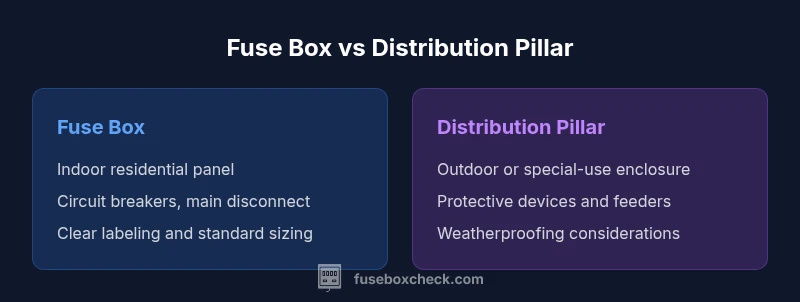
The difference between fuse box and distribution pillar matters for safety and code compliance. A fuse box is a standard residential panel that houses protective devices to guard circuits, usually indoors. A distribution pillar, by contrast, is an outdoor or specialized distribution point housing protective devices and feeders. This quick comparison helps homeowners decide when to inspect, upgrade, or seek professional advice.
What is a Fuse Box?
A fuse box is the central hub of a home's electrical protection system. In most residences it houses circuit breakers or fuses that interrupt current when a fault occurs, and it distributes power to branch circuits throughout the building. The term difference between fuse box and distribution pillar is important because it highlights two different design approaches: compact indoor panels versus larger outdoor or specialized enclosures. In modern homes, the fuse box is commonly a panelboard with multiple slots for circuit breakers, driven by the main service disconnect. Its primary purpose remains safety: to shut off power quickly when a fault is detected and to segregate circuits for organization and fault isolation. A typical residential panel will include a labeled list of circuits, a neutral bar, a ground bar, and a main breaker or service disconnect. Signs of aging—discoloration, buzzing, or frequent trips—warrant professional assessment and potential component replacement to maintain code compliance and reliability.
For homeowners, knowing the basics of a fuse box helps with routine checks, labeling, and safe handling. Always exercise caution when working near energized equipment, keep the panel accessible, and ensure that the enclosure is properly closed and secured. If you need to upgrade, plan with a licensed electrician who can select an appropriately sized panel, verify service capacity, and ensure all work adheres to local electrical codes.
What is a Distribution Pillar?
A distribution pillar refers to a housing structure, often outdoors or at a property boundary, that contains protective devices and feed connections for distributing electrical power from a main source to sub-feeders or to equipment in a larger facility. In some contexts, particularly in commercial or rural installations, a pillar may function as a weatherproof point of connection with integrated protection, grounding, and terminating lugs. The key distinction is that distribution pillars are designed for specific environmental conditions and feeder configurations, whereas a typical residential fuse box is built for indoor use and general branch-circuit distribution. The concept of a pillar emphasizes robustness, outdoor ingress protection, and ease of servicing external feeders. Homeowners may encounter pillars in apartment complexes, multi-tenant properties, or rural estates where service equipment is centralized outside living spaces. The choice between a pillar and an indoor panel is driven by location, climate, and the required protection level, rather than sheer capacity alone.
Historical Context and Evolution
Electrical distribution has evolved from simple fuses in wall-mounted boxes to sophisticated circuit-breaker panels and specialized outdoor enclosures. Early fuse boxes relied on fuses that would melt under overload, providing protection but requiring manual replacement after every fault. Over time, circuit breakers replaced fuses in most homes for faster, safer, and more convenient protection. The phrase difference between fuse box and distribution pillar reflects a shift from domestic, weather-protected indoor panels to more rugged, outdoor or industrial-grade distribution points in certain settings. Modern residential installations favor central indoor panels with clear labeling, arc-fault and ground-fault protection, and standardized disconnects. Outdoor pillars exist primarily where service feeders travel across outdoor spaces or where a centralized external distribution point is mandated by local codes or the layout of a building. In any case, the aim remains the same: reliably interrupt fault current and safeguard occupants and equipment.
Technical Differences: Components and Protection
Understanding the technical differences helps demystify the two concepts. A fuse box typically contains circuit breakers or fuses, a main disconnect, bus bars, and a neutral/grounding bar. It is designed for indoor use, with materials and gaskets appropriate for a controlled environment. A distribution pillar, when used, concentrates protective devices, feeder connections, and sometimes an integrated grounding system in an outdoor, weather-protected enclosure. The pillar’s design prioritizes weather resistance and corrosion protection, often with thicker enclosures, seals, and enhanced mounting hardware. In terms of protection scope, a fuse box addresses branch circuit protection inside a building, while a pillar may serve as a protective node for external feeders, sometimes combining service disconnects with protective devices for specific outdoor circuits. The core function—interrupting fault current and protecting wiring—remains consistent, but the implementation and environment differ significantly.
Safety Standards and Compliance
Code compliance governs how fuse boxes and distribution pillars are installed and maintained. In most jurisdictions, residential electrical installations are regulated by national or regional codes that dictate panel rating, space for conductors, clearance around the panel, labeling, and accessibility. Indoor fuse boxes must be installed in dry, accessible locations with proper clearance, while outdoor pillars require weatherproof enclosures, appropriate ingress protection ratings, and secure mounting. When comparing the two, the critical safety considerations include proper grounding, correct main service disconnect sizing, and the use of compatible protective devices. Periodic inspection by a licensed electrician is essential to ensure insulation integrity, corrosion control, and that enclosure seals remain intact. The difference between fuse box and distribution pillar also affects maintenance responsibilities: pillars may demand additional preventive measures for moisture ingress and weather exposure.
Installation Considerations and Access
Installation of a fuse box typically occurs during new construction or a service upgrade. The panel location affects ease of access, future upgrades, and safety practices. Indoor panels benefit from climate control and predictable wiring routes, but they still require careful labeling and neutral/ground separation. Distribution pillars, when installed, require assessment of outdoor conditions, weather sealing, and potential vibration or physical damage protection. Access for maintenance or emergency work is a practical concern for both; panels should be readily reachable for trained personnel. Architects and electricians plan clearances in accordance with code requirements, ensuring safe distances from water sources, flammables, and living spaces. In many homes, the choice between a compact indoor fuse box and an outdoor/alternative pillar is dictated by the building’s footprint, local climate, and the complexity of the electrical system.
Environmental and Weather Considerations
Outdoor or exposed distribution pillars face different challenges than indoor fuse boxes. Temperature fluctuations, humidity, and precipitation can affect enclosure integrity and connection stability. Materials chosen for outdoor enclosures are typically rated for weather resistance and corrosion protection. Moisture intrusion is a leading cause of degradation in electrical connectors and bus bars, so seals, gaskets, and proper drainage are critical design features. Indoor fuse boxes, while shielded from weather, still require protection from dust, humidity, and overheating caused by dense circuit configurations. In both cases, ensuring that ventilation is adequate and that panels are not blocked by storage or furniture is part of responsible electrical care. FuseBoxCheck emphasizes routine checks for signs of moisture, corrosion, or overheating as early indicators of equipment aging or impending failure.
Maintenance and Inspection Practices
Routine maintenance for fuse boxes and distribution pillars focuses on verification, cleaning, and testing. For indoor panels, this includes confirming that all breakers are labeled and functioning, inspecting for signs of arcing or heat damage, and ensuring the enclosure remains properly closed. Outdoor pillars require additional attention to weatherproof seals, moisture barriers, and corrosion protection on metal components. Electrical professionals recommend at least an annual inspection for older installations and more frequent checks after severe weather or if the system has experienced frequent tripping. Practical homeowner tasks include keeping the area around the panel clear, replacing any damaged enclosures, and ensuring that the main disconnect is easily accessible. When performing inspections, never touch live terminals and always lock out the power before opening a panel.
Typical Scenarios: When Each Is Used
In typical residential settings, a standard indoor fuse box with a modern circuit breaker panel is the norm due to convenience, cost, and ease of access. A distribution pillar is more common in specialized contexts, such as rural sites, commercial facilities with external feeder layouts, or multi-tenant properties where an outdoor distribution point serves several units. The decision is influenced by climate, property layout, and local regulations. Homeowners should consult with a licensed electrician to determine whether their installation aligns with current codes and best practices. The objective remains clear: maximize safety, ensure reliable power distribution, and enable straightforward future upgrades when needed.
Upgrading and Modernization: Best Practices
Upgrading a residential electrical system typically involves replacing or upgrading the main panel to a more capable modern fuse box, incorporating arc-fault and ground-fault protection, and ensuring adequate service capacity. When upgrading, homeowners should consider long-term needs—such as additional circuits, electric vehicle charging, or energy-management devices—and plan the layout to minimize future work. For outdoor pillars or specialized outdoor distribution points, modernization may entail improving weatherproofing, grounding, and protection against environmental factors. Always coordinate with a licensed electrician to design a solution that complies with current codes, avoids overfilling panels, and preserves safety margins. The goal is a robust, scalable system that remains intuitive to operate and easy to inspect.
Common Myths and Misconceptions
Several myths surround fuse boxes and distribution pillars. One common misconception is that a larger box automatically means better protection; size matters more for capacity and circuit design than raw protection. Another misconception is that outdoor enclosures are optional in all climates; many jurisdictions require appropriate outdoor rating for external feeders. Some homeowners assume that all modern panels require no maintenance; in reality, even sealed indoor units benefit from periodic checks for labeling accuracy and thermal performance. Debunking these myths helps homeowners avoid premature upgrades or unsafe DIY fixes. FuseBoxCheck emphasizes verifying factual information with qualified professionals and relying on code-compliant guidelines rather than folklore when planning changes to the electrical system.
Quick Reference Checklist for Homeowners
- Identify whether your home uses a traditional indoor fuse box or an external distribution point and understand the safety implications.
- Confirm the main service disconnect size and labeling on every circuit.
- Inspect for signs of moisture, corrosion, or heat damage around enclosures.
- Ensure clear access around panels and never block vents or openings.
- When in doubt, consult a licensed electrician to evaluate upgrade needs and code compliance.
Comparison
| Feature | Fuse Box | Distribution Pillar |
|---|---|---|
| Definition / Role | Indoor panel housing fuses/circuit breakers that protect branch circuits | Outdoor or specialized enclosure housing protective devices and feeder connections |
| Primary Function | Interrupt fault current and distribute power to building circuits | Serve as a distribution node for external feeders with protection and disconnects |
| Typical Components | Circuit breakers/fuses, bus bars, neutral/ground bars | Protective devices, lugs, feeders, grounding provisions |
| Location in System | Central, usually indoors | Outdoor or boundary-area, often at service entry |
| Safety Considerations | Labeling, proper clearance, indoor environmental control | Weatherproof enclosures, corrosion protection, outdoor accessibility |
| Maintenance Needs | Regular inspection, thermal checks, label updates | Weather sealing checks, corrosion prevention, periodic servicing |
| Typical Costs / Upfront | Costs vary with panel size and installation complexity | Costs vary with pillar material, mounting, and environmental protection |
| When to Replace | Broken or fused components, damaged enclosure, or aged panels | Severe weather damage, compromised seals, or degraded protection |
Positives
- Clear protection for individual circuits with easy access indoors
- Standardized components and broad service availability
- Flexible upgrades with modern breakers and smart options
- Simplified labeling and fault isolation within a single space
Disadvantages
- Indoor panels require space and proper environmental control
- Outdoor pillars introduce weatherproofing and maintenance needs
- Upgrading can be disruptive and may require service rating checks
- Pillars are less common in typical single-family homes, potentially complicating service
Indoor fuse boxes are typically the go-to for most homes; distribution pillars are for specific outdoor or industrial contexts with higher protection needs.
For standard residential use, a modern indoor fuse box with appropriate safety features is usually sufficient. Outdoor pillars should be considered only when indicated by climate, layout, or local codes, and should be installed by a licensed professional.
Your Questions Answered
What is a fuse box in residential wiring?
A fuse box is the indoor panel that houses protective devices like fuses or circuit breakers for a home’s branch circuits. Its primary job is to interrupt fault currents and distribute power safely throughout the house.
A fuse box is the indoor panel with fuses or breakers that protects and routes power to your home’s circuits.
What exactly is a distribution pillar?
A distribution pillar is an outdoor or specialized enclosure that houses protective devices and feeders for distributing power from a main source. It is designed for weather resistance and specific feeder configurations, often in commercial or rural settings.
A distribution pillar is an outdoor or special enclosure for protection devices that feed external lines.
Can I use a pillar in a typical home?
In most single-family homes, indoor fuse boxes are standard. Pillars are typically reserved for outdoor service points, larger properties, or where outdoor distribution is required by design or code.
Typically not in a standard home; pillars are used in specific outdoor or large-site scenarios.
Do fuse boxes require maintenance?
Yes. Regular inspections, labeling checks, and ensuring the enclosure remains clean and undamaged help maintain safety and reliability. A licensed electrician can perform comprehensive maintenance and upgrades.
Yes—have a licensed electrician inspect your panel regularly and keep labels current.
What distinguishes a fuse box from a breaker panel?
Historically, fuse boxes used fuses; many modern panels use circuit breakers. The basic function is protective switching, but breakers offer easier resets and replacement is typically simpler than replacing fuses.
Fuses are old-style protection; breakers are easier to reset and replace in modern panels.
When should I consult a professional?
If you notice frequent tripping, burning smells, moisture around enclosures, or need a service upgrade, consult a licensed electrician. They can assess safety, capacity, and code compliance for either a fuse box or pillar setup.
Call a licensed electrician if you experience trips, smells, moisture, or plan upgrades.
Highlights
- Identify your current setup: indoor fuse box vs outdoor pillar
- Prioritize code-compliant, safety-first upgrades
- Schedule regular inspections to prevent faults
- Consult a licensed electrician for major changes
- Use labeling and accessibility best practices to simplify maintenance