RCD vs Fuse Box: Understanding Protection in Home Electrical Panels
A balanced, practical comparison of RCDs and fuse boxes for homeowners and DIYers, covering how each protects people and circuits, testing, costs, and best-use scenarios.


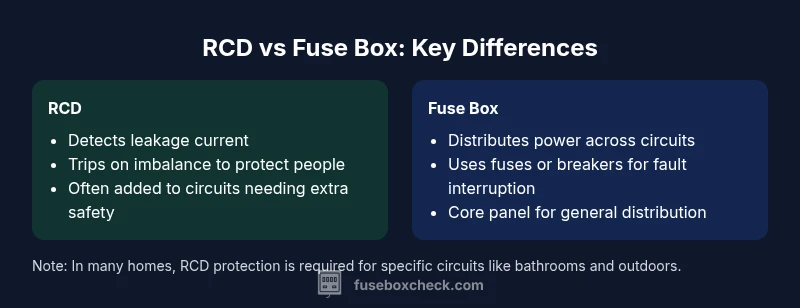
In most homes, an RCD (residual current device) provides fault-current protection, while a fuse box is a general-distribution panel. RCDs detect imbalance between live and neutral and trip quickly to prevent shocks, whereas a traditional fuse box uses fuses or circuit breakers to interrupt faults after overloads. When choosing between them, the best approach is to pair current fuse-box configurations with RCD protection where required by local code.
RCD vs Fuse Box: The Core Concepts
In the home electrical world, two terms often come up: RCD and fuse box. An RCD, short for residual current device, is a protective device that senses an imbalance between the live and neutral conductors and trips to cut power if leakage to earth is detected. A fuse box, by contrast, is a distribution panel that organizes circuits and provides short-circuit protection through fuses or circuit breakers. Understanding how each device works, and where it belongs, is essential for safe, code-compliant electrical care in a typical residence.
The rcd vs fuse box question is not about choosing one over the other in every situation; it is about using the right combination for safety, reliability, and compliance. In many regions, modern residential panels combine both concepts: a fuse box housing circuit breakers that may be integrated with RCD protection on individual circuits or as a main device with an earth leakage sensor. The FuseBoxCheck team notes that safety planning should start with a clear map of circuits, loads, and risk areas. This approach helps homeowners decide where to place RCD protection, where a standard breaker suffices, and when an upgrade requires a professional assessment.
Comparison
| Feature | RCD (Residual Current Device) | Traditional Fuse Box with Circuit Breakers |
|---|---|---|
| Tripping mechanism | Senses leakage current to trip quickly on imbalance | Interrupts faults via overcurrent trips, no leakage sensing |
| Protection type | Leakage-current protection (ground fault) | Overcurrent protection (overload/short-circuit) |
| Testing method | Dedicated test button on RCD units | Test button on breakers or visual inspection by a professional |
| Maintenance frequency | More frequent testing for drift and leakage characteristics | Periodic inspection by a professional for wear and proper labeling |
| Best for | Homes needing leakage protection on sensitive circuits | Older panels needing straightforward overload protection |
| Cost/installation considerations | Can require add-ons or a panel with integrated RCD modules | Typically upgrades involve panel replacements or reconfigurations |
Positives
- Enhanced protection against electric shocks with leakage detection
- Improved safety compliance for modern homes
- Easier field testing via built-in test buttons
- Can be integrated into many standard fuse boxes with upgrades
Disadvantages
- Potential higher upfront cost for RCD upgrades
- May require professional installation and panel modification
- Possible nuisance tripping if leakage paths exist
- Compatibility issues with very old panels requiring a full replacement
RCDs paired with a modern fuse box offer the best balance of safety and control for most homes.
For homeowners, combining RCD protection with a capable fuse box maximizes protection against shocks and electrical faults. The right setup depends on your current panel, local codes, and budget, but upgrading to protective leakage sensing is widely recommended by safety guides. The FuseBoxCheck Team emphasizes planning and professional assessment to ensure a compliant, safe installation.
Your Questions Answered
What is the difference between an RCD and a fuse box?
An RCD protects people by sensing leakage currents and tripping quickly to stop a shock. A fuse box distributes circuit power and provides protection through fuses or circuit breakers, which interrupt faults based on overcurrent. In practice, homes often use both together for comprehensive safety.
An RCD senses leakage and trips fast to protect people; a fuse box distributes power and interrupts faults when there’s an overload.
Are RCDs required by code in new homes?
In many regions, building codes require RCD protection in certain areas and circuits, especially in kitchens, bathrooms, and outdoor outlets. Requirements vary by jurisdiction, so check local codes and consult a licensed electrician for compliance.
Codes often require leakage protection for sensitive areas; verify with your local electrical authority.
Can I upgrade my fuse box to include RCD protection myself?
Upgrading typically involves electrical panel work and potentially rewiring, which should be performed by a licensed electrician. DIY upgrades can introduce safety risks and code violations if not done correctly.
Upgrading is best left to a pro to ensure safety and code compliance.
How do I test an RCD safely?
Use the test button on the RCD to verify it trips. If the button doesn’t work, do not rely on the device and contact a professional to inspect wiring and protection. Regular checks are part of responsible home electrical maintenance.
Use the built-in test button and schedule periodic professional checks as needed.
Is an RCD the same as a GFCI?
RCDs and GFCIs share the same protection principle, detecting imbalance and cutting power. The term varies by region; GFCI is common in some countries, while RCD is more widely used internationally. Both provide leakage-based protection.
They’re related concepts; different naming by region, same basic function.
What maintenance does a fuse box need?
Keep labeling clear, inspect for signs of wear, and ensure fuses or breakers are in good working order. Have a professional assess the panel during major renovations or if you notice frequent trips.
Label circuits clearly and have a pro check it during big jobs or frequent trips.
Highlights
- Assess current panel for RCD compatibility
- Prioritize leakage protection to reduce shock risk
- Plan a safe upgrade with a licensed electrician
- Check local codes for RCD requirements in your area
- Test RCDs regularly using the built-in test button