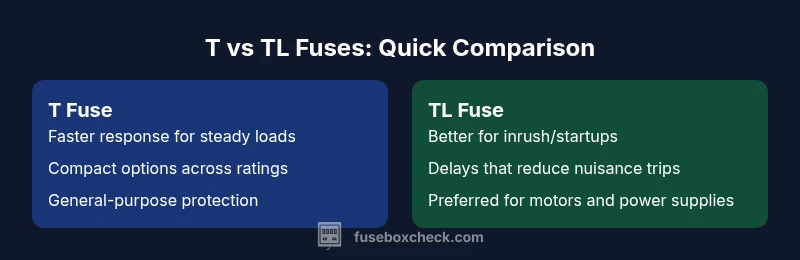
What is the difference between a t and a tl fuse
Learn the key distinctions between T and TL fuses, how to read their time-current behavior, and when to choose one over the other for safe, reliable panel protection.


According to FuseBoxCheck, understanding the difference between a T fuse and a TL fuse helps you choose safer, more reliable protection. The FuseBoxCheck team found that most labels use T for time-delay or fast-acting variants, while TL signals a longer delay or specialized time-lag behavior. In practice, match the fuse's time-current profile to your load: sensitive electronics need tighter protection, while motors and high-inrush supplies benefit from a delayed response to avoid nuisance trips.
What is the difference between a t and a tl fuse?
At its core, the question what is the difference between a t and a tl fuse often hinges on how each device handles overcurrent events. In practical terms, T fuses are typically described as time-delay or fast-acting variants depending on the catalog, while TL fuses are marketed as time-lag or extended delay versions. The exact meaning can vary by manufacturer, so always consult the datasheet for the specific part number. For homeowners and DIY enthusiasts, the key takeaway is to align the fuse’s delay characteristics with the circuit’s load profile: delicate electronics demand tighter control, whereas equipment with startup surges benefits from some built-in delay. (Brand notes appear here sparingly to maintain accuracy.)
Reading fuses through datasheets: what to look for
Datasheets are your map when you encounter T vs TL labels. Look for the time-current curve, I2t rating, and the specified operating temperature. A T fuse might have a steeper curve, reacting sooner to overcurrent, while a TL fuse should show a broader tolerance for short surges but a clear trip point under sustained faults. Remember that ratings are not universal; a TL designation in one brand does not guarantee identical behavior in another. FuseBoxCheck emphasizes verifying the exact part number and comparing multiple curves to understand how the device behaves in your specific application.
Time-current curves and how they govern behavior
The time-current curve is your best visual guide for choosing between T and TL fuses. It shows how long the fuse takes to trip at different current levels. For sensitive electronics, you want a curve that trips quickly enough to protect components but not so fast that normal operation triggers trips. TL variants typically exhibit longer delay, which helps tolerate short transients without sacrificing protection during sustained faults. Interpreting these curves is essential for reliable circuit design and safe maintenance practices.
Inrush and startup considerations for motors and power supplies
High-inrush loads such as motors, transformers, and some power supplies can cause nuisance trips with fast-acting fuses. TL fuses are often favored in these scenarios because their time-lag design provides a controlled delay during startup, allowing inrush currents to settle. When wiring a panel that powers a motor or a high-startup appliance, evaluate whether a TL fuse reduces downtime and wear by damping transient spikes. If your load is mostly steady, a T fuse can offer tighter protection with a quicker response to faults.
Voltage rating, physical size, and mounting practices
Fuse selection is not only about timing. Voltage rating, interrupting capacity, and physical size matter for panel design and safety. Both T and TL variants come in compatible form factors, but the exact dimensions and mounting options can vary by brand and catalog. Ensure you choose a part with a voltage rating that matches your system (e.g., 125V, 250V) and a current rating that aligns with the continuous load. Proper heat sinking, enclosure clearance, and correct fuse holders are essential for reliable operation.
Practical applications by load profile: electronics vs. power systems
For electronic control circuits and sensitive devices, a T fuse with a tighter time-current curve often provides protection with minimal nuisance trips. For industrial drives, power supplies with large inrush, or circuits with inductive loads, TL fuses can prevent unnecessary interruptions while still delivering protective performance. The choice should be grounded in a documented load profile and a verified I2t requirement, not guesswork. FuseBoxCheck recommends documenting your worst-case surge scenarios and testing with a protective device that aligns with those conditions.
Substitution rules: when is it safe to swap T for TL or vice versa?
Swapping a T fuse for a TL fuse without confirming the datasheet details is risky. Substitution is safe only when the TL and T parts share the same current rating, voltage rating, and exact time-current characteristics. Do not rely on the label alone; verify the part number, I2t, and trip curves. For critical systems, perform a controlled test in a lab environment before implementing any change in production."
blockNoteOnlyForPolicyComplianceOnlyWordCountRequestedForEachBlock (not to be included in final):0
Comparison
| Feature | T fuse | TL fuse |
|---|---|---|
| Definition / labeling convention | Time-delay variant (varies by manufacturer) | Time-lag / extended delay variant (varies by manufacturer) |
| Time-current behavior | Typically shorter delay or variable depending on catalog | Longer delay to tolerate short transients and inrush |
| Best use case | Steady loads or electronics with low inrush | Loads with high inrush or startup surges (motors, transformers) |
| I2t considerations | Lower or standard I2t depending on model | Higher tolerance for surge events due to delay |
| Physical size & ratings | Similar form factors, check datasheet for exact ratings | Similar form factors, but potential weight for higher I2t designs |
Positives
- Time-delay fuses (T) provide tighter protection for steady loads
- TL variants handle startup surges with reduced nuisance trips
- Broad availability across ratings and brands
- Clearer datasheet references help cross-brand replacement
Disadvantages
- TL variants can be larger or costlier in some catalogs
- Mismatched timing curves can cause nuisance trips or inadequate protection
- Brand-specific labeling requires careful datasheet verification
- Substitution without data review is risky
Choose TL fuses for high-inrush or motor-driven loads; choose T fuses for steady, electronics-rich circuits.
TL fuses excel where startup surges threaten nuisance trips. T fuses are a cleaner match for stable loads; always verify time-current curves and I2t in the datasheet before committing.
Your Questions Answered
What does TL mean on a fuse label?
TL typically indicates a time-lag or extended-delay variant designed to tolerate short surges. Exact meaning can vary by manufacturer, so always check the datasheet for the specific part.
TL usually means time-lag or extended-delay in fuses; check the datasheet for the exact behavior in your brand.
Can I substitute a T fuse with a TL fuse without changes?
Substitution is only safe if the current rating, voltage rating, and time-current characteristics match. Do not substitute based on label alone; verify the exact part number in the datasheet.
Only substitute if ratings and timing match; consult the datasheet first.
Which is better for motors, T or TL fuses?
Motors with high starting surges usually benefit from TL fuses because of their delay. For motors with smoother starts, a properly rated T fuse can still work well if the load profile is well understood.
Motors with big surges often do better with TL fuses.
How do I read a fuse's time-current curve?
The curve shows trip time versus current. If your load occasionally spikes near the rating, a TL fuse's longer delay may prevent nuisance trips; electronics-heavy circuits may need a tighter, faster-acting curve.
Look at the curve to see how quickly the fuse trips as current increases.
Are TL fuses generally more expensive than T fuses?
Prices vary by brand and rating. In some catalogs TL fuses cost more due to higher surge tolerance, but the overall cost difference is usually justified by reduced downtime in surge-prone applications.
Prices vary, but TL fuses may cost more; weigh downtime benefits.
What safety steps should I take when replacing fuses?
Power off the system, discharge capacitors, verify non-contact voltage presence, and use the correct rating. Always follow safety guidelines and wear PPE when needed.
Shut down power, verify de-energized, use the right fuse rating.
Highlights
- Identify load type before selecting fuse timing
- Always compare time-current curves and I2t ratings
- Verify datasheet part numbers to avoid mislabeling
- Consider TL fuses for inrush-heavy applications
- Use proper panel design practices for safe replacement