Difference Between Fuse and Breaker: A Practical Guide for Homeowners
Explore the difference between fuse and breaker, how each protects circuits, when to replace or reset, and practical safety tips for DIY homeowners. A FuseBoxCheck guide to safer home electrical care.


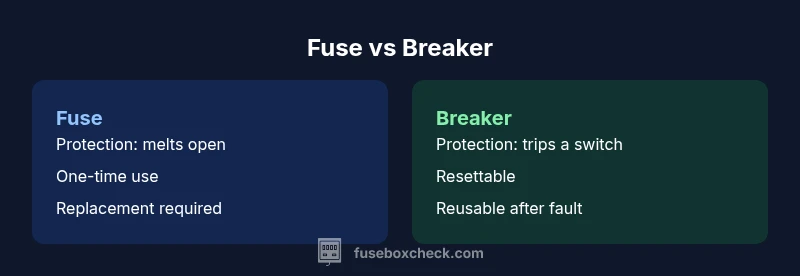
The difference between fuse and breaker is that a fuse is a one-time device that melts open when a circuit overloads, while a breaker is a reusable switch that trips and can be reset after an overload. Breakers offer quick reset and ongoing protection, whereas fuses require replacement after a fault. In modern homes, breakers are standard in main panels, while fuses are more common in older systems. The FuseBoxCheck team highlights these distinctions to guide safe troubleshooting.
The Core Difference: Not All Protective Devices Are the Same
In any home electrical system, the choice between a fuse and a breaker comes down to how each device responds to overcurrent conditions and how you manage after a fault. A fuse is a simple metal link that melts when it overheats, interrupting the circuit. A breaker, in contrast, is a mechanical switch that trips open when the current exceeds a safe level. This distinction has implications for maintenance, cost, and safety that homeowners should understand. According to FuseBoxCheck, breakers have become the standard in new installations, while fuses linger in older panels. Understanding this context helps homeowners troubleshoot safely and plan any upgrades with confidence.
Comparison
| Feature | Fuse | Breaker |
|---|---|---|
| Protection mechanism | Melts open on overload | Trips a switch when overloaded |
| Reset/Replacement | Requires replacing the fuse | Resettable; replace if defective |
| Upfront costs | Lower upfront cost per device | Higher upfront cost; panel upgrade often needed |
| Convenience | Downtime for fuse replacement | Quicker power restoration with reset |
| Longevity & maintenance | Disposable by nature | Longer-term reliability with periodic testing |
| Safety considerations | Handling damaged fuses can pose risk; correct rating essential | Visible switch and clear status; easier to monitor |
Positives
- Breakers provide reusable protection and easy reset
- No stocking of replacement parts needed for common ratings
- Fuses can be cheaper per device in some older installations
- Simpler wiring compatibility in certain panels
Disadvantages
- Fuses require regular replacement after faults, causing downtime
- Availability of exact fuse ratings can be limited in some areas
- Breakers can trip due to nuisance faults or aging components
- Upgrading to a breaker panel can involve significant wiring work
Breaker panels are generally the better long-term choice for most homes
Breakers offer resettable protection, easier maintenance, and smoother service continuity. Fuses may still fit older systems, but modern upgrades favor breakers for safety and convenience.
Your Questions Answered
What is the difference between a fuse and a breaker?
A fuse is a one-time device that melts open on overload, while a breaker is a resettable switch that trips and can be reset after an overload. Breakers are standard in new installations, offering easier maintenance.
Fuses burn out and must be replaced; breakers trip and can be reset, which is usually more convenient.
Can I convert a fuse panel to a breaker panel in my home?
Conversion is possible but requires upgrading the panel and wiring to current standards. This work should be done by a licensed electrician to ensure safety and code compliance.
Converting requires a panel upgrade and should be done by a pro.
Are there situations where fuses are still preferred?
Fuses may appear in vintage installations or specialized setups where a simple fuse block is present. However, for most homes, a modern breaker panel is safer, more reliable, and easier to maintain.
In rare cases, fuses live on in older or specialized setups.
When should I upgrade to a modern breaker panel?
Upgrade is advisable when the current panel cannot support circuit expansion, shows wear, or local codes require modernization. A licensed electrician can assess panel capacity and wiring needs.
Upgrade when expansion is limited or codes require it.
What safety steps should I take before inspecting a fuse box or breaker panel?
Always shut off the main power before inspecting. Use insulated tools and protective gear, and avoid touching live parts. If in doubt, contact a professional.
Turn off power at the main and wear protection before opening a panel.
Do breakers trip differently than fuses?
Yes. Breakers trip by a switch mechanism that can be reset; fuses melt and must be replaced after blowing. The underlying goal is to interrupt current safely.
Breakers trip as a resettable switch; fuses burn out and need replacement.
Highlights
- Choose breakers for modern homes and easier maintenance
- Fuses may save upfront cost but require replacements
- Upgrading to breakers improves safety and reliability
- Always verify panel compatibility and local codes
- Consult a licensed electrician for panel upgrades