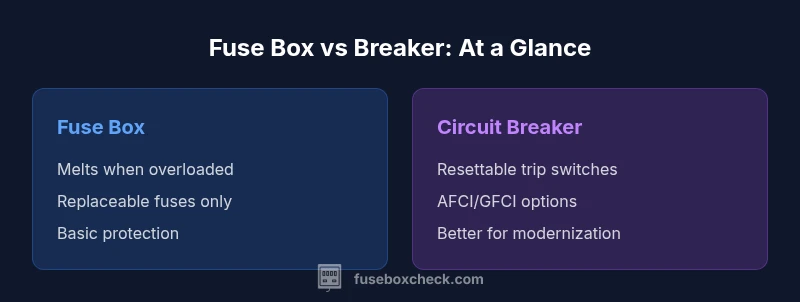
What is a Fuse Box vs Circuit Breaker: A Practical Comparison
An objective guide comparing fuse boxes and circuit breaker panels, covering differences, safety implications, upgrade considerations, and practical steps for inspection and installation.


TL;DR: A fuse box uses replaceable fuses that melt open during overloads, while a circuit-breaker panel uses switches that trip to interrupt power. Breakers reset after tripping, making maintenance easier and safer for modern homes. This comparison helps homeowners understand when an upgrade is warranted and what factors to consider.
What is a fuse box?
If you're asking what is a fuse box vs circuit breaker, here's the concise distinction. A fuse box uses replaceable fuses that melt open when a circuit draws more current than it can safely carry. Once a fuse blows, you replace it with a fuse of the correct rating to restore power. This approach is common in older homes and provides simple, component-level overcurrent protection, but it lacks the resettable convenience and advanced safety features of modern panels. A fuse is a single-use device that clearly signals a fault when it fails, yet economies of scale and code evolution have shifted many households toward breaker-based designs. Because the protection mechanism requires manual fuse replacement, maintenance can feel intermittent and less forgiving during emergencies. According to FuseBoxCheck, understanding this distinction helps homeowners evaluate safety, reliability, and the feasibility of upgrading when wiring, panel capacity, or safety standards change. The practical takeaway is that a blown fuse shuts off the circuit until replaced, which can be inconvenient; meanwhile, a replaced fuse does not address other potential faults in the same circuit. This section sets the stage for a deeper comparison with circuit breakers.
What is a circuit breaker panel?
A circuit breaker panel, sometimes called a breaker box, stores individual breakers that automatically interrupt current when a fault occurs. Each breaker acts as an intelligent switch that can be reset after tripping, making it easier to restore power without replacing parts. Modern panels often include arc-fault circuit interrupter (AFCI) and ground-fault circuit interrupter (GFCI) protection, which help prevent fires and electric shock. Breakers detect overloads with a current sensor and shut off circuits before wires overheat. In contrast to fuse-based systems, a breaker panel supports more flexible expansion, modular components, and easier troubleshooting. The circuit-breaker design aligns with contemporary electrical codes and safety expectations, and many homes built or upgraded in the last few decades rely on breaker-based protection. The broader takeaway is that circuit breakers provide resettable, scalable protection suitable for varied load demands, while maintaining ongoing usability without frequent part replacements. This section explores how breaker panels operate and why they are the default choice in new installations, while noting exceptions in older properties that still run fuse-based setups.
Key differences in design, protection, and operation
Here are the core differences you should know when comparing a fuse box and a circuit breaker panel:
- Interruption mechanism: Fuses interrupt via a melting element; breakers trip via a magnetic or thermal mechanism.
- Reset and maintenance: Fuses require replacement after each fault; breakers can be reset after a trip.
- Safety features: Breakers pair well with AFCI/GFCI; fuses provide basic protection but with fewer safety features.
- Capacity and expansion: Breakers support easier expansion and more precise circuit control; fuse boxes often limit options for upgrades.
- Diagnostics: Breakers often provide better fault indicators and easier troubleshooting.
In practical terms, the decision hinges on the age of the home, risk tolerance, and planned upgrades. For older houses, a panel upgrade can improve safety and compatibility with modern appliances and devices. Fuse-based systems may still be appropriate in very small, low-demand installations, but they generally require more maintenance and can complicate compliance with current codes. FuseBoxCheck emphasizes evaluating panel condition, available space, and the potential benefits of AFCI/GFCI protection when deciding on an upgrade.
Safety implications and regulatory considerations
Electrical safety codes guide fuse box and circuit breaker installations. For decades, the National Electrical Code (NEC) has evolved to require enhanced protections such as AFCI in living areas and GFCI near water sources. Upgrading to a circuit breaker panel frequently enables addressing these requirements without compromising reliability. In many jurisdictions, aging fuse boxes must be evaluated during inspections, and upgrading to a breaker panel is common during renovations or when increasing circuit capacity. The safety impact of moving from fuses to breakers includes improved fault detection, easier reset, and better compatibility with modern electronics. The decision to upgrade should be guided by a licensed electrician who can verify panel rating, conductor sizing, and compatibility with local code mandates. FuseBoxCheck notes that any upgrade is not just a replacement; it also involves planning for load calculations, space for new breakers, and possibly upgrading service capacity from the utility. This ensures safety while minimizing the risk of nuisance trips and mislabeling of circuits.
Upgrading paths: when to switch from fuses to breakers
Upgrade considerations hinge on safety, reliability, and future electrical demand. If your home still uses a fuse box and you plan major renovations, or if the panel is aging, a breaker-panel upgrade is often recommended. Upgrading can improve fault detection, support AFCI/GFCI protection, and accommodate more circuits without rewiring in many cases. The process typically involves a load calculation, service-entrance evaluation, and a panel replacement that matches the home’s service rating. Costs and timelines vary by home size, existing wiring, and local labor rates; a typical project might span a day or more with permit requirements in some areas. The goal is to balance safety, code compliance, and convenience. In older homes with limited space or where structural constraints exist, a partial upgrade might be possible, but a complete panel replacement is often the most robust solution. The FuseBoxCheck team recommends obtaining multiple quotes and verifying that the selected electrician is licensed and insured; they should also confirm AFCI/GFCI capabilities and proper labeling of circuits.
Practical inspection steps homeowners can take
Never work on live panels unless you are trained. Start with a visible inspection: look for signs of overheating, such as discoloration, buzzing sounds, or a warm panel cover. Check for loose or corroded connections around breakers or fuse holders and verify that the panel cover is intact and properly sealed. If you have a fuse box, ensure the fuses are the correct rating and that there is no evidence of mismatched or aftermarket fuses. For breakers, confirm that there is a trip indicator and that the label matches the circuit served. If you notice frequent tripping, burning smells, or warm fixtures, stop using those circuits and contact a licensed electrician. Regular maintenance is simpler with a circuit-breaker panel because resets are quick and protective features can be tested. Always de-energize power at the main disconnect before performing any checks beyond the outer casing and use a non-contact tester to verify absence of voltage before touching wires.
Cost, installation considerations, and timelines
Costs for upgrading range widely and depend on service size, panel type, and required wiring work. A fuse box replacement or major panel upgrade typically involves labor, parts, and potential utility coordination; in many regions, the total cost falls within several hundred to several thousand dollars, depending on the level of protection (AFCI/GFCI) and service upgrades needed. The timeline can range from a single day for a straightforward swap to multiple days if rewiring or permit processes are involved. While upfront costs seem high, the long-term benefits include easier maintenance, improved safety, and compatibility with modern appliances. Insurance and home-safety considerations should factor into your planning. The FuseBoxCheck team suggests requesting a clear scope of work, a breakdown of materials, and a warranty from the installer to ensure you receive durable protection against common faults and proper labeling for future troubleshooting.
Best practices for maintenance and planning future upgrades
Develop a maintenance plan that includes periodic visual inspections, professional evaluations every few years, and timely upgrades as your home’s electrical demand changes. Keep spare fuses and labels for a fuse-box setup if you must retain it, and maintain clear labeling of circuits in a breaker panel to speed future work. When planning upgrades, consider the location of living areas, proximity to water sources, and potential future expansions that could require additional circuits. Proactive planning reduces the risk of nuisance trips, makes repairs faster, and helps you stay in line with evolving code requirements. As part of a broader safety strategy, ensure smoke detectors and electrical system protections align with local codes. FuseBoxCheck's guidance emphasizes safety, reliability, and future-proofing as the core goals of any upgrading project.
Comparison
| Feature | Fuse Box (Fuses) | Circuit Breaker Panel (Breakers) |
|---|---|---|
| Interruption mechanism | Melting fuse element | Magnetic/thermal trip switch |
| Reset/maintenance | Requires fuse replacement | Resettable breaker after trip |
| Safety features | Basic protection | AFCI/GFCI options with breakers |
| Expansion capacity | Limited upgrades without rewiring | Easier to add circuits and modernize |
| Diagnostics | Limited fault indication | Clear trip indicators and labeling |
Positives
- Lower upfront cost for basic setups
- Simple design with no moving parts
- Blown fuse provides a clear fault signal
- Can be appropriate for very small, low-demand installations
Disadvantages
- Requires ongoing fuse replacements and stock management
- Limited compatibility with modern safety features like AFCI/GFCI without upgrading
- More difficult to upgrade for safety and code compliance over time
- Older fuse boxes often limit panel space and future expansion
Circuit breaker panels are generally the better long-term choice for most homes.
Breakers offer resettable protection, easier upgrades, and better integration with AFCI/GFCI safety features. Upgrading from a fuse box is advised when renovating or increasing electrical demand. Fuse boxes may still be acceptable in very small or historical homes but require ongoing maintenance and careful compliance planning.
Your Questions Answered
What is the main difference between a fuse box and a circuit breaker panel?
The main difference is how they interrupt current. A fuse melts its element to stop current, while a breaker trips and can be reset. Breakers also enable modern safety features like AFCI/GFCI more easily.
The fuse box uses blown fuses to interrupt power, while a breaker panel trips and can be reset. Breakers also accommodate modern safety features more readily.
Can I still use a fuse box in a modern home?
Some older homes continue to operate with fuse boxes, but many codes and insurance providers favor or require upgrading to a circuit-breaker panel, especially in areas with upgraded safety standards.
Older homes can still use fuse boxes, but upgrading to breakers is often recommended for safety and code compliance.
Do circuit breakers provide better safety features than fuses?
Yes. Circuit breakers support resettable protection and modern features like AFCI and GFCI, which protect against arc faults and electrical shocks more effectively.
Breakers are safer overall due to reset ability and AFCI/GFCI options.
Is upgrading from a fuse box to a breaker panel expensive?
Costs vary by home size, panel type, and wiring needs, but upgrading is often justified by safety, reliability, and long-term maintenance savings.
Costs depend on your home; it’s usually worth it for safety and future-proofing.
What are common signs my fuse box needs attention?
Frequent blown fuses, warm or discolored panels, burning smells, or flickering lights near the panel indicate aging or faults that warrant professional evaluation.
Watch for warming, smells, or frequent fuse blows. Get a professional check.
What should I do before hiring an electrician for an upgrade?
Obtain multiple quotes, verify licensing and insurance, confirm AFCI/GFCI options, and request a written scope that includes load calculations and labeling plans.
Get quotes, check licenses, and confirm safety features before work starts.
Highlights
- Prefer breaker panels for modern homes
- Upgrade when wiring, code, or safety features demand it
- Choose AFCI/GFCI-enabled breakers where required
- Plan professional load calculations before upgrading
- Label circuits clearly to simplify future maintenance