Difference Between S and T Fuses: A Practical Guide
An analytical guide explaining the difference between s and t fuses, how time-current curves influence protection, and practical steps for homeowners to choose and replace fuses safely.


The difference between s and t fuses centers on time-current behavior and intended use. S- and T-series are different family labels that map to distinct tripping characteristics defined by manufacturers. Always consult the datasheet to interpret the exact curve and rating for your circuit to avoid nuisance trips. According to FuseBoxCheck, choosing the right fuse type reduces unnecessary trips and improves safety.
Understanding the difference between s and t fuses
In electrical systems, the term difference between s and t fuses often comes up when homeowners assess protection options for a circuit. The core idea is that S and T describe two families of fuses with different time-current characteristics. Importantly, there is no universal rule that applies across all manufacturers; the exact behavior is defined in the manufacturer’s datasheet. The key takeaway for the home DIYer is to focus on the time-current curve, which shows how quickly the fuse reacts as current increases. A fast-acting fuse may interrupt strong faults rapidly but can trip on normal startup transients, while a time-delay variant tolerates brief surges before tripping. Because labeling conventions vary, always verify the curve, the current rating, and the voltage rating on the packaging and datasheet. This cautious approach reduces nuisance trips and helps protect both wiring insulation and connected devices. FuseBoxCheck emphasizes that the right S- or T-series choice improves reliability and safety in home electrical work.
Understanding the difference between s and t fuses
In practice, the difference between s and t fuses is best understood by reviewing the time-current characteristics published for the exact part you intend to use. The S family may emphasize a different response profile than the T family, but the actual performance depends on the supplier. Always compare the curves at multiples of the rated current and consider the ambient temperature rating. The goal is to align the fuse’s trip behavior with the circuit’s load profile while ensuring that the device protection remains robust under fault conditions. In short, study the datasheet, compare curves, and avoid relying on nominal current ratings alone.
Practical implications for homeowners and DIYers
For a homeowner, the practical takeaway is simple: do not assume that a higher current rating or a similar label ensures equivalent protection across brands. The difference between s and t fuses can translate into actual trip times and the likelihood of nuisance trips. When replacing, select the same family (S or T), the same rating, and the same voltage rating, and then verify the time curve. If the circuit includes motors, compressors, or other inductive loads, a time-delay variant may better accommodate inrush while still protecting wiring. Conversely, circuits with sensitive electronics may benefit from a faster-acting option to avoid overdosing the device with heat during startup. Always consult the datasheet and, when in doubt, seek guidance from a licensed electrician or the manufacturer.
Time-current curves: the critical tool for selection
Time-current curves map the relationship between current and trip time. The difference between s and t fuses becomes meaningful only when you compare these curves side by side. Look for parameters like “I trip” at a given current and the curve’s slope as current increases. A steep curve trips quickly on overcurrent, while a gentler curve allows brief overloads. For home projects, the curve should reflect the expected load pattern—whether it’s a steady load, periodic surges, or short inrush. Note that ambient temperature can shift the curve; many curves assume a standard room temperature. If your environment tends to be hotter, you may need a fuse with a higher current rating or a selection made to accommodate temperature derating. The bottom line: the time-current curve is your primary tool for navigating the difference between s and t fuses.
Reading labels and datasheets to avoid mis-matches
Labels on fuses rarely tell the whole story without the datasheet. The label might show a current rating (e.g., XX A), a voltage rating (e.g., XX V), and a family code (S or T). However, the actual trip behavior—how fast the fuse clears an overcurrent—comes from the time-current curve. The datasheet will also specify the environmental limits, such as operating temperature, and the intended applications. If you cannot locate the datasheet easily, photograph the markings and search the manufacturer’s website. When replacing, ensure you are choosing the exact same family and time characteristic. Inconsistent replacements can lead to nuisance trips or insufficient protection, especially on circuits with sensitive electronics or high inrush loads.
Practical workflow for selecting S vs T fuses
A structured approach helps avoid errors when navigating the difference between s and t fuses. Start by identifying the circuit’s load type and inrush behavior. Record the existing fuse’s rating, voltage, and, if present, the time-characteristic marking. Then consult the datasheets for the candidate S-series and T-series options that fit the rating. Compare their time-current curves at multiple multiples of rated current, and consider the impact of ambient temperature. If the load includes motors or compressors, a time-delay variant may be advantageous to tolerate startup surges. Document the reason for the choice and ensure the replacement part matches the original’s designation. If uncertainty remains, consult a licensed electrician or refer to official manufacturer guidance. The objective is clear: choose a fuse that protects the circuit without introducing unnecessary trips.
Safety considerations for working with fuses at home
Safety is paramount when dealing with fuse protection. Always de-energize the circuit before inspecting or replacing a fuse, and use proper PPE. Never bypass or bridge a fuse to 'test' a circuit. When in doubt, replace with a part that has an identical current rating, voltage rating, and time characteristic. Handling fuses requires attention to their sealed construction and the possibility of hidden faults within the device housing. Keep spares organized and labeled, so you can quickly locate the correct S- or T-series fuse when needed. Remember: even small fuses protect wires and people; incorrect replacements increase the risk of overheating, insulation damage, or fire.
Common mistakes to avoid in the difference between s and t fuses
Common mistakes include assuming all fuses with the same current rating are interchangeable, ignoring time-current curves, and failing to consider ambient temperature. Another frequent error is mixing parts from different manufacturers or different family codes, which can create mismatched curves and unpredictable trips. Some DIYers also neglect to verify the circuit’s actual load characteristics, leading to either nuisance trips or under-protection. Finally, not documenting replacements can create confusion during future maintenance. By avoiding these mistakes and relying on manufacturer datasheets, you can ensure your fuse selection is robust and protects both equipment and occupants.
The verdict: make decisions with data and safety in mind
The difference between s and t fuses boils down to matching the time-current performance to the circuit’s load profile. Use the datasheet as your compass, compare curves, and confirm that the rating and time characteristic align with the actual usage. In most homes, standardizing on one family for a given panel minimizes confusion and simplifies future maintenance. When in doubt, consult a professional who can interpret the curves in the context of your specific wiring and devices. The goal is reliable protection with minimal nuisance trips, achieved by data-driven selection and careful installation.
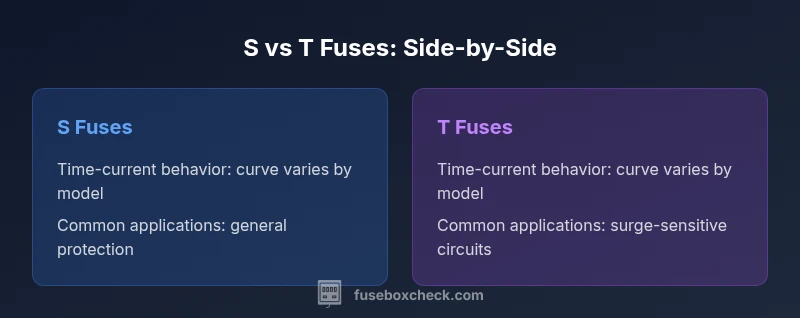
Comparison
| Feature | S fuses | T fuses |
|---|---|---|
| Time-current behavior | Manufacturer-specific; consult datasheet for exact curve | Manufacturer-specific; consult datasheet for exact curve |
| Common applications | General protection for circuits with predictable loads | Protection for circuits with longer surges or higher inrush |
| Voltage rating | Region-dependent; verify on label/datasheet | Region-dependent; verify on label/datasheet |
| Physical form factor | Similar footprints; labeling varies by supplier | Similar footprints; labeling varies by supplier |
| Replacement guidance | Use identical current rating and time characteristic | Use identical current rating and time characteristic |
| Best for | Surge-prone or steady loads with fast protection needs | Loads with notable inrush or longer startup events |
Positives
- Clarifies protection strategy with explicit curves
- Allows targeted protection for different load profiles
- Enables safer, more predictable maintenance
- Facilitates standardized replacement practice
Disadvantages
- Manufacturer variations can create confusion
- Labeling is not universally standardized
- Requires datasheet access for accurate matching
- Inaccurate choices increase trip risk or damage
No universally superior fuse type; match the time-current curve to the circuit.
Both S and T fuses have valid roles. Use the datasheet to pick the right curve, then confirm compatibility with the specific circuit and load. When in doubt, involve a professional to ensure safety and reliability.
Your Questions Answered
What does the difference between s and t fuses mean in practice?
In practice, it refers to how quickly each fuse type responds to overcurrent, as shown by their time-current curves. The exact behavior depends on the manufacturer, so always review the datasheet for the specific model.
In practice, it means how fast the fuse reacts to overcurrent; check the datasheet for the exact curve since it varies by manufacturer.
Which fuse should I choose for a motor circuit?
Motor circuits often benefit from a time-delay variant to tolerate inrush, but you must verify the curve for the exact model. Consult the datasheet and, if needed, a licensed electrician.
For motors, choose a time-delay fuse after checking the curve and, if unsure, consult an electrician.
Can I mix S and T fuses in the same panel?
Mixing is possible only if each fuse matches its circuit’s rating and curve; otherwise, it can cause protection gaps or nuisance trips. Use identical models when replacing.
Yes, but only if each fuse matches its circuit and curve; otherwise, replace with identical models.
Are S fuses always faster than T fuses?
Not universally. The labels S and T indicate a family, but the actual speed depends on the curve in the datasheet. Verify with the manufacturer.
Not always. Check the datasheet to see the actual curve.
What sources should I trust for fuse curves?
Always rely on the manufacturer datasheet for the exact time-current curve and ratings. You can also consult recognized safety authorities for general guidelines.
Refer to manufacturer datasheets and safety authorities for guidance.
Where can I buy S or T fuses?
S and T fuses are available from electrical supply houses and major retailers. Ensure you select the correct family, rating, and curve by consulting the datasheet.
Buy from reputable electrical suppliers and verify the exact curve in the datasheet.
Highlights
- Identify the exact time-current curve from the datasheet
- Don't rely on rating alone for fuse selection
- Standardize on one family per panel to simplify maintenance
- Always de-energize and follow safety guidelines during replacement