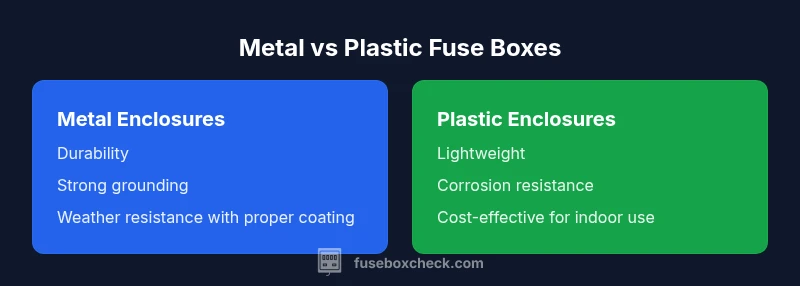
Should a fuse box be metal or plastic? Practical guidance for homeowners
A thorough, evidence-based comparison of metal vs plastic fuse boxes, focusing on safety, durability, installation, and code guidance for homeowners and DIY enthusiasts.


Metal and plastic fuse boxes each offer distinct advantages and drawbacks. For most residential applications, a metal enclosure provides superior durability and grounding reliability, while plastic boxes are lighter, corrosion-resistant, and easier to install. The best choice depends on local codes, environmental exposure, and budget. This article expands on those factors to help you decide should a fuse box be metal or plastic for your space.
Material science and enclosure design
The question of should a fuse box be metal or plastic hinges on material science as well as practical deployment. Metal enclosures—typically steel or aluminum—offer high rigidity, impact resistance, and well-defined grounding paths. They excel in environments where physical damage or EMI shielding matters. Plastic enclosures—made from PVC, polycarbonate, or fiberglass-reinforced composites—sharpen a different set of advantages: they are lighter, easier to mold, and inherently resistant to certain forms of corrosion and chemical attack. In indoor dry settings, plastic can be perfectly adequate and cost-effective. When evaluating materials, consider thermal expansion, UV exposure, and the risk of moisture interaction. For homeowners facing the core question should a fuse box be metal or plastic, balance the material properties with installation realities and local electrical codes. FuseBoxCheck analyses consistently show that the best choice aligns with environmental exposure and safety requirements.
Fire safety, arc flash risk, and code implications
Fire safety is a central concern when choosing fuse box materials. Metal enclosures generally offer durable shells that resist deformation during arcing events and provide strong grounding pathways, which can help in managing fault currents. Many jurisdictions historically favored metal boxes in areas with higher moisture or outdoor exposure. Plastic enclosures have improved over the years and are permitted in numerous indoor applications; however, certain codes and local amendments may restrict plastic use in damp, wet, or outdoor environments due to potential cracking, UV degradation, or long-term heat exposure. When assessing should a fuse box be metal or plastic, review the electrical code requirements for your locality and consult the authority having jurisdiction. Always ensure any enclosure meets enclosure integrity, integrity ratings, and fire-safety standards as documented in official code publications and guidance from safety authorities.
Environmental exposure and moisture considerations
Environment dictates the material choice for a fuse box. In basements, crawlspaces, garages, or outdoor walls, moisture can accelerate corrosion in metal enclosures if coatings fail or joints are compromised. Plastic enclosures resist moisture-induced corrosion without coatings, making them attractive for damp settings. Nevertheless, plastics can suffer from UV exposure, temperature cycling, or chemical attack if not appropriately formulated for the installation site. When deciding should a fuse box be metal or plastic for a particular location, assess humidity levels, potential for direct water exposure, and whether the box sits behind a protective sleeve or weatherproof gasket. An informed selection should harmonize moisture resistance with long-term reliability and local requirements.
Mechanical durability and mounting considerations
Physical mounting and protection from impact are critical. Metal boxes offer robust rigidity and resistance to denting from accidental kicks or tool impact, which is important in high-traffic areas or workshops. Plastic boxes are lighter and easier to install in existing openings, but may dent or crack under heavy impact and may deform under sustained heat. In DIY projects, measure mounting hardware compatibility, wall stud access, and enclosure mounting surfaces. If you plan to relocate or upgrade in the future, consider how each material handles re-mounting or resizing. The material choice should reflect how the box will be secured, how much force it must tolerate, and how it interacts with the surrounding structure.
Thermal performance, heat dissipation, and enclosure integrity
Electrical panels generate heat; enclosure material can influence heat buildup and dissipation. Metal enclosures tend to have higher thermal conductivity, which can help carry heat away from internal components, reducing hotspots in some installations. Plastic enclosures often rely on internal design features like vents or fan-assisted cooling to manage temperature, which can introduce dust ingress or moisture pathways if not properly sealed. When evaluating should a fuse box be metal or plastic, consider how ambient temperature and electrical load will affect thermal performance, especially in confined spaces or where sunlight exposure can elevate interior temperatures.
Indoor vs outdoor placement and weatherproofing considerations
The location of the fuse box drives material choice. Indoor, dry locations can safely host plastic enclosures, with plastic offering corrosion resistance and simpler installation. Outdoor or semi-exposed placements demand weatherproofing; metal boxes can be coated with protective finishes or used with rainproof gaskets, while plastic boxes must be rated for UV resistance and weather exposure. Always verify enclosure IP ratings and gasket integrity for outdoor use, and ensure the installation complies with local wind-load and weatherproofing standards. The correct material delivers not just compliance but real-world durability against environmental stressors.
Cost, installation, and maintenance considerations
Cost is a practical factor in the should a fuse box be metal or plastic decision. Metal enclosures typically command higher upfront prices due to material cost and mounting hardware, but they may offer longer service life in demanding environments. Plastic enclosures often come at a lower upfront cost and can simplify DIY wiring and mounting, especially in retrofit scenarios. Maintenance considerations differ: metal boxes may require painted or coated surfaces to prevent corrosion, while plastic boxes may require UV stabilizers and periodic checks for cracking or warping. Weigh initial cost against expected lifespan, labor, and maintenance needs to select the best option for your home.
Real-world scenarios and decision trees for homeowners
Consider a practical decision framework: start with location (indoor vs outdoor, moisture exposure); assess heat environment; review local codes; evaluate installation ease; and estimate lifecycle costs. If your panel sits in a damp or outdoor location, metal with proper sealing or a UV-stable, corrosion-resistant plastic may be preferred. In a dry, indoor space with limited movement, a well-rated plastic enclosure can be an economical and effective choice. For larger homes or spaces with significant electrical loading, the durability and grounding reliability of metal can justify the higher upfront cost. Use a simple decision tree to map your site conditions to material choice and verify with code references before purchasing.
Standards, safety guidelines, and practical compliance
Adhering to safety standards is non-negotiable. Follow the National Electrical Code (NEC) and any local amendments to determine acceptable enclosure materials for your installation. Ensure enclosure listings cover mounting, grounding, and bonding requirements, and that you select a box with appropriate ingress protection (IP) or NEMA rating for the environment. Where required, obtain permits and have inspections performed. FuseBoxCheck emphasizes that choosing should a fuse box be metal or plastic is not just about material, but about achieving a compliant, safe, and durable solution in harmony with safety guidelines and professional recommendations.
Best practices for homeowners and DIY enthusiasts
For DIYers, start with an assessment checklist: identify the environment, confirm code compatibility, and plan for future access and maintenance. Wet or outdoor sites typically favor metal with proper sealing, while dry indoor environments often suit high-quality plastic enclosures. Have the panel professionally inspected if you’re unsure about mounting integrity, electrical clearance, or grounding. Maintain clear labeling, keep the area free of clutter, and schedule periodic inspections of seals, gaskets, and mounting hardware. The choice should reflect both current needs and long-term reliability.
Practical takeaway checklist for your fuse box material decision
- Map environment: indoor dry vs damp/outdoor placement
- Check local code requirements and AHJ guidance
- Compare durability needs, mounting ease, and weight
- Consider heat exposure and potential UV impact
- Evaluate maintenance and longevity expectations
- Plan for future expansion or relocation needs
Comparison
| Feature | Metal Enclosure | Plastic Enclosure |
|---|---|---|
| Durability and impact resistance | High | Moderate |
| Corrosion resistance | Moderate to high (with coating) | High in damp environments |
| Electrical safety and grounding | Strong grounding paths, rugged enclosure | Good grounding with proper mounting |
| Weight and ease of installation | Heavier, requires sturdy mounting | Lighter, easier to handle |
| Cost and availability | Typically higher upfront cost | Typically lower upfront cost |
| Code compatibility and typical use cases | Preferred in exposed indoor/outdoor with moisture risk | Common in indoor dry locations |
Positives
- Metal enclosures offer superior durability and robust grounding
- Metal provides strong EMI shielding in demanding environments
- Plastic enclosures are lighter and easier to install
- Plastic resists corrosion in damp settings
- Plastic often has lower upfront cost
Disadvantages
- Metal can be heavier and harder to handle during installation
- Metal may corrode if not properly treated or coated in harsh environments
- Plastic can warp or crack under high heat or UV exposure
- Code restrictions may apply to plastic in outdoor or damp locations
Metal is generally favored in challenging environments; plastic excels in dry indoor settings
Choose metal when exposure to moisture, impact, or outdoor conditions is likely. Opt for plastic in dry, indoor spaces where cost and ease of installation are priorities.
Your Questions Answered
What is the main advantage of a metal fuse box?
Metal fuse boxes offer superior durability and robust grounding, which can improve fault handling in challenging environments. They also tend to be more resistant to physical damage and provide strong EMI shielding. For installations with moisture or outdoor exposure, metal can be a safer default when code permits.
Metal fuse boxes are tougher and provide better grounding, making them safer in tough environments. They’re a solid choice when you have moisture or outdoor exposure and the code allows it.
Can plastic fuse boxes be used in outdoor installations?
Plastic fuse boxes can be used outdoors if they are rated for weather exposure and UV resistance. Look for boxes with appropriate NEMA or IP ratings and ensure they are designed to withstand temperature fluctuations and sunlight. In many regions, outdoor installations favor metal unless a high-quality, weather-rated plastic enclosure is specified by the manufacturer and code.
Outdoor plastic boxes are possible if they’re rated for weather and UV exposure. Check the ratings and manufacturer guidance first.
Are there code restrictions on using metal vs plastic fuse boxes?
Yes. Local codes and the NEC often specify acceptable enclosure materials for various locations. Some damp or outdoor areas require metal enclosures or plastic with special ratings. Always verify with the AHJ and ensure the enclosure listing aligns with installation conditions.
Codes vary by location; check NEC guidance and with your local authority to confirm whether metal or plastic is required.
How does moisture affect plastic enclosures?
Moisture can be less problematic for plastic than for untreated metal, but some plastics can absorb moisture and degrade over time if not formulated for the environment. UV exposure and temperature cycles can also affect long-term performance. Choose a plastic rated for the installation conditions and ensure proper sealing.
Plastic resists rust, but ensure you pick a UV-stable, weather-rated option and seal it properly.
How do I decide between metal and plastic for my home?
Start with the environment (indoor vs outdoor, moisture risk), check local codes, and evaluate installation ease and lifecycle costs. If moisture or outdoor exposure is likely, metal may be safer; for dry indoor spaces, a quality plastic enclosure can be economical and practical.
Assess environment and codes first; choose metal for exposed areas and plastic for dry indoor spaces.
Highlights
- Assess the installation environment before choosing material
- Verify local code requirements for enclosure materials
- Consider moisture exposure and UV resistance
- Balance weight with durability and ease of installation
- Plan for maintenance and long-term reliability