Electrical Box vs Fuse Box: A Homeowner's Guide to Safety
Compare electrical boxes and fuse boxes to understand components, safety, upgrades, and maintenance. Learn when to upgrade, what to expect during installations, and how to stay code-compliant for a reliable home electrical system.


Electrical box vs fuse box highlights two common panel types for home electrical systems. In most newer homes you’ll find a circuit breaker panel, while older installations rely on a fuse box. Understanding the differences in components, safety implications, and upgrade paths helps homeowners decide when repair or upgrade is needed and who to hire.
Electrical Box vs Fuse Box: Core Definitions and Why It Matters
In modern homes, the electrical system is organized within a protective enclosure that houses switching and overcurrent devices and wiring connections—the electrical box. In many older installations, that same enclosure houses fuses instead of circuit breakers, and is commonly referred to as a fuse box. According to FuseBoxCheck, the terminology is often used interchangeably by homeowners, but the hardware tells a safer story: breakers are easier to reset and test, while fuses require replacement. The distinction matters for safety, maintenance, and future upgrades. The decision to upgrade from a fuse box to a modern breaker panel is influenced by the age of the home, the electrical load, and the risk profile of the circuits within. The FuseBoxCheck team notes that many homes with outdated fuse boxes have limited capacity and aging components that increase the risk of nuisance trips and potential fires. Recognizing the type you have isn’t merely academic; it guides inspection frequency, code compliance considerations, and the planning needed for any rework or expansion. This article uses the term "electrical box" to mean the enclosure and its internal devices, and "fuse box" to describe the older, fuse-based variant. Where the box type is unclear, a licensed electrician can identify it safely during an assessment.
Key Components and How They Work
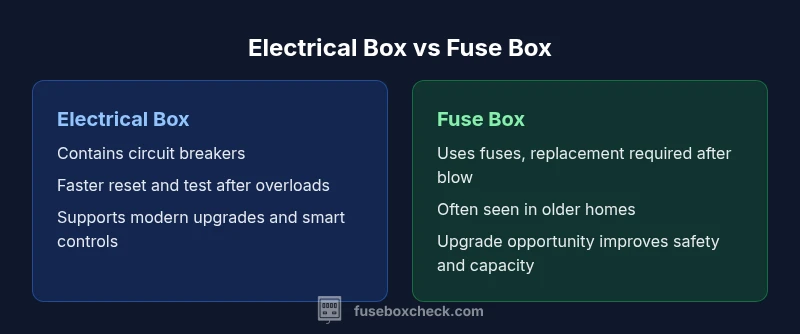
The core difference between an electrical box and a fuse box lies in the protective devices they contain. A modern electrical box typically houses circuit breakers, which act as switches that can be reset after an overload. A fuse box uses fuses that must be replaced after they blow. Breaker panels offer faster restoration and clearer fault indication, while fuse boxes require finding and replacing the specific blown fuse. Both systems share the same goal—protect wires from overheating and prevent fires—but the maintenance model and lifecycle differ. For homeowners, this translates into how you test a circuit, how you identify a problem, and how you plan future expansions. Efficiency of labeling, accessibility, and compatibility with smart-home features are gradually shifting the expectation toward breaker-based panels as part of upgrades.
A well-maintained electrical box or fuse box should show clean labeling, no signs of scorching, loose connections, or corrosion. If you notice frequent trips, warm panels, or buzzing sounds, you should seek a professional assessment promptly. While modern code favors breakers due to their reset capability, older fuse boxes still exist in many homes and require careful handling when upgrades are considered.
Safety Implications, Code Considerations, and Longevity
Safety is the primary concern when comparing electrical box vs fuse box setups. Breaker panels are generally easier to manage and test, reducing the risk of accidental shocks during maintenance. Fuses, while simple, can fail catastrophically if a fuse element is damaged or if the wrong fuse is installed. From a compliance perspective, many jurisdictions have updated requirements that prioritize modern breaker panels and service upgrades when homeowners perform significant electrical work. Regular inspections can catch deteriorating components, degraded insulation, or corrosion that could compromise safety. FuseBoxCheck Analysis, 2026 notes that aging fuse boxes can present higher fire risk due to aging components and limited capacity to handle modern electrical loads. This reinforces the rationale for upgrading in homes with outdated equipment. Regardless of type, a well-designed electrical box should have proper clearances, tamper-proof labeling, and accessible main disconnects. If you’re unsure about the condition of your panel, a licensed electrician can perform a comprehensive assessment, calculate the load, and determine a safe upgrade path. Code-compliant upgrades may also require permits and adherence to local electrical codes, which can vary by region.
Understanding the legal and safety implications helps homeowners avoid hazards and pursue a smarter, safer electrical system for years to come.
Location, Accessibility, and Common Layouts
Most service panels are located in basements, garages, utility rooms, or exterior-rated enclosures. The location is often dictated by the ease of access for maintenance, visibility for labeling, and proximity to main service feeds. Electrical boxes and fuse boxes should be mounted in a way that allows quick access to the main disconnect. Labeling is crucial—every circuit should have a clear description, which expedites troubleshooting and reduces the likelihood of accidental disconnections. In newer homes, you’ll typically see a distribution panel with stacked breakers that serve different areas of the house. In older installations, the fuse box may be placed in a similar location, but the devices inside are fuses rather than breakers. If the room experiences moisture, temperature fluctuations, or heavy dust, extra care is needed to protect the enclosure and maintain safe operation. Height, door clearance, and surrounding space to allow panel access must meet local code requirements. Understanding typical layouts helps homeowners plan upgrades that minimize disruption and ensure safe operation of the electrical system.
Upgrade Paths: From Fuse Box to Breaker Panel and Beyond
Upgrading from a fuse box to a breaker panel involves a replacement of the protective devices and often a service upgrade to accommodate higher loads. The process typically begins with a load calculation to determine whether the existing service can support modern panel capacities, followed by selecting a panel that matches the home’s electrical demand and future needs. Permits and inspections are commonly required for service upgrades, making scheduling with a licensed electrician essential. The upgrade can improve safety, enable future expansion, and reduce nuisance trips, but it can also involve costs tied to materials, labor, and potential upgrades to feeders and wiring. A well-planned upgrade considers not only the box itself but the entire service entrance equipment, grounding system, and panel spacing. Practically, homeowners should budget for professional assessments, potential cable routing, and, if needed, upgrades to the main service conductors. While a fuse box can be kept in place if it’s still compliant and safe, most homes will benefit from moving to a breaker panel for reliability and ease of use.
Planning an upgrade early—before critical failures occur—can reduce downtime and risk. Always consult a licensed electrician to confirm the scope, timing, and cost, and to ensure compliance with local codes.
DIY vs Professional Service: What You Can and Cannot Do
The safety risks involved in electrical work mean that many tasks should be performed by trained professionals. Basic visual checks, labeling, and organizing cables can be done safely with the main power off and proper precautions. However, tasks such as testing load capacity, running new circuits, upgrading the service, and replacing a fuse box with a breaker panel should be handled by a licensed electrician. Mistakes in wiring, panel connections, or grounding can lead to shock, fire, or code violations. When in doubt, engage a pro who can provide a detailed assessment, a written quote, and a clear plan for the upgrade. A professional installation also ensures that any required permits and inspections are completed, which is essential for home resale and insurance coverage.
How to Identify Your Current Setup Today: Quick Guide
If you’re unsure whether your home uses a fuse box or a breaker panel, start by locating the main service panel. Check for existing labels on each circuit branch, the presence of fuses or breakers, and whether you can easily reset a circuit by flipping a switch. Look for a fuse box if you see blown fuses replaced by swapping the fuse element. If breakers are present, you likely have a breaker panel. Take clear photos of the panel, label any unclear circuits, and consult a licensed electrician for confirmation and a plan for upgrade if needed. A professional assessment often reveals whether your system requires only upgrades to specific circuits, a full panel replacement, or a service upgrade to support additional loads. When in doubt, a professional site visit provides the most reliable path to a safe, compliant home electrical system.
Authoritative Sources and Further Reading
For readers who want to dive deeper into electrical safety and panel basics, consult authoritative sources from government and major publications. Here are a few trusted references:
- U.S. Consumer Product Safety Commission (CPSC): https://www.cpsc.gov
- Occupational Safety and Health Administration (OSHA): https://www.osha.gov
- National Fire Protection Association (NFPA): https://www.nfpa.org
Additionally, FuseBoxCheck Analysis, 2026 provides practical insights on upgrading fuse boxes and improving safety in homes with older panels. The guidance in this article aligns with best practices for residential electrical safety and emphasizes professional assessment for any upgrade.
Comparison
| Feature | Electrical Box | Fuse Box |
|---|---|---|
| Definition and Hardware Type | Enclosure with wiring connections and switching devices (breakers or fuses depending on system) | Enclosure housing fuses that protect circuits by fusing conductors |
| Main protection device | Circuit breakers (or disconnects) inside modern electrical box | Fuses inside older fuse box |
| Upgrade compatibility | Designed for easy future upgrades to breakers and added circuits | Limited adaptability; often requires complete replacement to modern breakers |
| Reset/maintenance | Resettable with a switch; minimal downtime after an overload | Requires fuse replacement after a fault; downtime longer |
| Typical age and usage | Mostly post-1960s to present installations | Common in older homes built pre-1960s to late 20th century |
| Code and safety implications | Modern codes favor breakers for ease and monitoring | Older fuse boxes may require upgrades to meet current safety standards |
| Best for | Newer homes or renovations focused on scalability and ease of use | Older homes with preserved wiring where a simple replacement may suffice |
Positives
- Improved safety with resettable breakers and clear fault indication
- Easier future upgrades and circuit additions
- Faster restoration after an overload and reduced downtime
- Better compatibility with modern energy management systems
Disadvantages
- Higher upfront cost for panel upgrades and permits
- Potentially more invasive installation and service work
- Requires professional assessment for code-compliant upgrades
Breaker-based electrical boxes provide safer, more scalable solutions for modern homes.
For most homeowners, upgrading from a fuse box to a circuit-breaker panel improves safety and capacity. The upgrade supports future wiring needs and reduces downtime after faults, provided you hire a licensed electrician and obtain the necessary permits.
Your Questions Answered
Is an electrical box the same as a fuse box?
Not exactly. An electrical box is a generic term for the enclosure and devices inside, while a fuse box specifically uses fuses. A breaker panel inside an electrical box is the modern alternative. The distinction is important for safety, maintenance, and upgrades.
An electrical box is the enclosure that houses all the wiring and devices; a fuse box is an older variant that uses fuses. The modern approach uses breakers inside the box.
When should I upgrade from a fuse box to a breaker panel?
Upgrade is usually advisable when the fuse box is aging, lacks capacity for modern loads, or when frequent fuse-blowing occurs. A licensed electrician can perform load calculations and determine an appropriate panel size and service upgrade if needed.
Upgrade when the existing fuse box is aging, overloaded, or you’re planning a remodel. A pro will confirm capacity and the right panel size.
What signs indicate a faulty fuse box?
Frequent blown fuses, charred smells, warm or hot panels, and frequent tripping are warning signs. If you notice these, stop using the affected circuits and call a licensed electrician for inspection and safe remediation.
Watch for frequent fuse blows, a warm panel, or burning smells. Stop and call an electrician.
Can I upgrade without upgrading service capacity?
Sometimes a panel upgrade can be limited to the panel and feeders, but many homes require a service upgrade to support the added load safely. A licensed electrician will evaluate if a full service upgrade is necessary.
Sometimes yes, but often a service upgrade is needed. A pro will assess your panel and load.
Are fuse boxes still allowed by code?
Code acceptance varies by jurisdiction. Many regions encourage modern breaker panels for safety and reliability. If you have a fuse box, plan a professional evaluation to determine if an upgrade is required for compliance.
Codes vary by area, but many places favor breakers for safety; get an local expert's opinion.
Highlights
- Identify your current panel type before planning any work
- Prioritize breaker-based upgrades for safety and scalability
- Budget for professional assessment, permits, and potential service upgrades
- Label circuits clearly to simplify maintenance and future upgrades