Which fuse box to choose: A practical comparison guide
A practical guide from FuseBoxCheck comparing traditional fuse boxes, breaker panels, and smart options to help homeowners decide which fuse box fits safety, cost, and future needs.


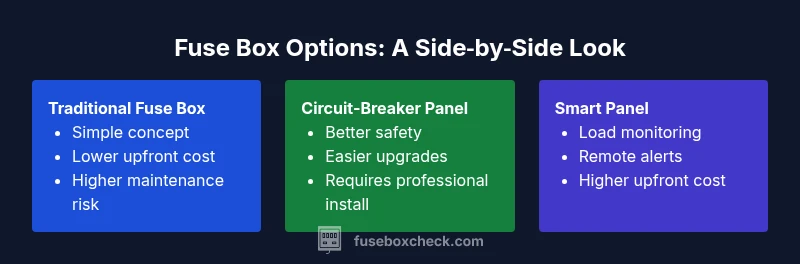
For most homes, the practical answer to which fuse box to choose is a circuit-breaker panel with a main disconnect. Traditional fuse boxes persist in older houses, but modern panels handle larger loads, offer easier upgrades, and include safety features like arc-fault and ground-fault protection. In new construction, select a service panel sized for your anticipated load.
Why choosing the right fuse box matters for safety and long-term costs
Choosing a fuse box isn’t just about the surface features or the color of the cover; it’s a core safety decision that affects fault isolation, repair downtime, and how easily you can adapt to changing electrical loads over time. The right fuse box or panel reduces the risk of arc faults, nicks in wiring, and nuisance trips, while also making future upgrades more predictable and affordable. When you ask which fuse box to install, you should consider safety features, required maintenance, and the long-term cost of ownership. According to FuseBoxCheck, pairing a strong safety profile with scalable capacity typically yields the best balance between daily peace of mind and long-term reliability.
In practice, your decision should be guided by the current service entrance capacity, planned loads (new appliances, EVs, HVAC upgrades), and local code requirements. A well-chosen fuse box will simplify troubleshooting, minimize downtime, and make routine checks straightforward. The goal is not merely to meet code today, but to set a foundation that supports safe operation for years to come.
Understanding the core differences: fuses vs breakers vs service panels
The central distinction in the fuse box landscape is between fuses, breakers, and service panels. A traditional fuse box uses replaceable fuses that interrupt current when a fault occurs, but each blown fuse requires a manual replacement and temporary power interruption. A circuit-breaker panel uses automatic breakers that trip when abnormal current is detected and can be reset after the fault is cleared. Modern service panels commonly include a main disconnect, easier upgrade paths, and sometimes integrated monitoring. The choice affects safety, maintenance frequency, and how easily the system can accommodate new loads. For homeowners, breakers generally offer quicker fault isolation and simpler maintenance, while fuses can be more challenging to retrofit or modify later.
Traditional fuse box: when it makes sense (and when not)
Traditional fuse boxes are often found in older homes and some small legacy structures. They can be perfectly adequate if the existing wiring and service capacity are appropriate, and if there’s no immediate demand for new circuits or higher loads. However, a fuse box presents several drawbacks: higher risk of fuse-related outages, more maintenance, and limited upgrade paths. If you’re planning any modernization, or if the service rating is approaching the household’s peak demand, upgrading to a breaker panel is usually the safer and more cost-efficient long-term option. For many homeowners, a fuse box is best treated as a stopgap rather than a long-term solution.
Circuit-breaker panel: benefits, features, and upgrades
Circuit-breaker panels have become the standard in new construction and retrofits. Their primary benefit is safer fault isolation: breakers trip quickly and can be reset after the fault is resolved, often without replacing components. They also allow more flexible expansion—additional circuits, upgraded service feeders, and compatibility with modern safety electronics like AFCI/GFCI protection. The upgrade path tends to be straightforward if the existing service capacity supports a larger panel or a service upgrade. For homes anticipating higher electrical loads, a circuit-breaker panel offers clearer, more scalable options with better resilience against nuisance trips and accidental overloads.
Smart panels and mixed-load options
Smart panels add load monitoring, remote fault indication, and sometimes integration with home automation systems. They can help homeowners understand consumption patterns, identify overloaded circuits, and preemptively manage peaks. Mixed-load options—where traditional breakers exist alongside smart monitoring—are increasingly common in renovations. Before selecting a smart panel, verify compatibility with your electrical service, the presence of a robust communication protocol, and the availability of local support for upgrades. While smart panels offer enhanced visibility and potential energy savings, they may involve higher upfront costs and require periodic firmware updates.
Safety and compliance basics you should know
Safety is the core reason many homeowners switch to modern panels. Arc fault and ground fault protection features are now standard in many jurisdictions; these technologies reduce the risk of electrical fires and electric shock by rapidly shutting down problematic circuits. Compliance with local codes often dictates the type of panel permitted, the location of the main disconnect, and whether AFCI/GFCI protection is required on specific circuits. If you are unsure about code requirements, consult a licensed electrician who can interpret local amendments and ensure the installation passes inspection. FuseBoxCheck emphasizes prioritizing safety, proper labeling, and testing procedures as foundational steps in any upgrade.
Planning the upgrade: load calculation, service entry, and permits
An upgrade should begin with a professional load calculation to determine the total service requirement for your home. This calculation informs panel size, main breaker rating, and whether a service upgrade (e.g., from 100A to 200A) is needed. Permits are typically required for service panel replacements; failing to obtain them can lead to compliance issues and delays. A well-planned upgrade considers not only current devices but also future loads like EV charging, heat pumps, and high-demand appliances. Documentation, including as-built diagrams and permit records, helps with future maintenance and resale value.
Location, space, and aesthetics: where to put the panel
Choosing the right location for a fuse box or panel is more than convenience. It affects accessibility for maintenance, safety in emergencies, and compliance with clearances around the enclosure. Panels should be installed in accessible areas, away from damp environments, with a clear space for servicing. Consideration for future expansion includes ensuring there’s room enough for additional circuits and potential relocation if vents, doors, or furniture encroach on the panel. A neat, labeled layout reduces confusion during maintenance and improves overall safety.
How to estimate compatibility with existing wiring and panels
Compatibility hinges on service disconnect type, conductor sizing, and space within the enclosure. A direct retrofit may be possible when the existing wiring aligns with modern standards and the service panel footprint accommodates a larger breaker array. In some cases, upgrading requires replacing feeders, upgrading meter sockets, or re-routing circuits. Before you buy, verify the panel’s compatibility with AFCI/GFCI protection options and whether the service includes a neutral and grounding upgrade. A professional assessment ensures you don’t encounter hidden incompatibilities during installation.
Maintenance and inspection routines you can perform safely
Regular inspection and light maintenance can help prevent surprises. Visually check for warm-to-touch panels, buzzing sounds, or tripped breakers that recur. Replace damaged or discolored components, label circuits clearly, and ensure the enclosure remains clean and free of dust. Always turn off the main service before opening the panel; if you’re unsure about any step, contact a licensed electrician. Scheduling periodic professional inspections complements home maintenance, ensuring safety features function as intended and that any code or labeling updates are applied.
Step-by-step decision framework you can follow
- Assess current service capacity and layout. 2) List anticipated loads and future plans (EVs, HVAC, appliances). 3) Compare fuse box vs breaker panel safety features and upgrade paths. 4) Check local code requirements and permit needs. 5) Consult a licensed electrician for a formal load calculation and installation plan. This framework helps you make a data-driven choice rather than a guesswork upgrade.
Common myths about fuse boxes debunked
Myth: All panels require the same level of maintenance. Reality: Modern breakers and AFCI/GFCI protections reduce nuisance trips, but regular labeling and testing remain essential. Myth: A spare, larger panel saves money. Reality: Oversizing can increase upfront and labor costs without proportional safety gains. Myth: Any DIY can replace a service panel. Reality: Replacing a service panel typically requires a licensed electrician due to safety, code, and permit considerations.
Feature Comparison
| Feature | Traditional fuse box | Circuit-breaker panel | Smart panel |
|---|---|---|---|
| Safety mechanism | Fuses melt to interrupt current | Breakers trip on fault and reset | Breakers with monitoring and smart features |
| Upgrade path | Limited expansion | Easier upgrades with panel additions | Best for future-proofing with integration |
| Maintenance frequency | Fuse replacements and upkeep | Low maintenance if functioning, periodic testing | Software updates and occasional diagnostics |
| Initial cost context | Lower upfront in older homes | Moderate for retrofit panels | Higher for smart monitoring features |
| Space and footprint | Same footprint as existing fuse box | Typically similar footprint but needs panel room | May require extra space for controls and wiring |
| Future-proofing | Limited adaptability | Good adaptability with expansions | Excellent adaptability with monitoring and automation |
Positives
- Clear fault isolation with breakers can be quick to reset
- Easier upgrades and expansions for modern loads
- Better compatibility with modern electrical codes and safety standards
- Improved safety features (AFCI/GFCI options) across circuits
- Lower downtime during faults due to automated protection
Disadvantages
- Higher upfront cost for panel upgrades and wiring work
- Installation typically requires a licensed electrician
- Space and layout changes may be necessary during upgrade
- Possible need for service-entrance or meter upgrades can add complexity
Choose a modern circuit-breaker panel for safety, reliability, and future-proofing.
A breaker panel provides faster fault isolation, easier expansion for new loads, and better compliance with current safety standards. Traditional fuse boxes may still fit older homes, but upgrading to a breaker panel reduces ongoing maintenance and improves long-term resilience.
Your Questions Answered
What is the main difference between a fuse box and a breaker panel?
A fuse box uses replaceable fuses that interrupt current when a fault occurs, while a breaker panel uses breakers that trip on fault and can be reset. Breakers offer easier maintenance and faster fault isolation. The choice affects safety, upgrades, and code compliance.
The big difference is that breakers trip and reset, making maintenance easier and safer than fuses which require replacements.
Can I upgrade a fuse box to a circuit-breaker panel myself?
Upgrading a service panel is generally a job for a licensed electrician due to safety and code requirements. DIY work can create serious hazards and fail inspections. Always check local permit rules before starting.
This is one to leave to a licensed electrician—it's a safety and code issue.
Are arc-fault and ground-fault protections required by code?
In many areas, AFCI and GFCI protection are required on specific circuits to reduce fire and electric-shock risk. Availability varies by jurisdiction and circuit type. Verify requirements with your local inspector and plan a panel that supports these features.
AFCI and GFCI protections are commonly required and improve safety significantly.
How do I know if my service can handle a new panel?
A load calculation by a licensed electrician determines whether your service can support a larger panel or if a service upgrade is needed. They will review existing loads, feeder capacity, and the main breaker rating.
A pro will run a load calc to confirm capacity before upgrading.
What permits are typically required for a panel upgrade?
Most jurisdictions require permits for service panel upgrades and electrical work. Your electrician should handle permit applications and inspections to ensure code compliance and a smooth process.
Permits are usually required; your electrician will manage them for you.
What should I expect during the installation process?
Expect a staged process: shutting off power, removing the old panel, routing/new conduits or feeders if needed, installing the new panel, terminating wires, labeling circuits, testing the system, and passing inspection.
In short: power off, install the new panel, test, and get inspected.
Highlights
- Prioritize safety features (AFCI/GFCI) when evaluating panels
- Plan for future load growth (EVs, HVAC, appliances) in the design
- Expect a licensed electrician to perform upgrades and handle permits
- A smart panel adds visibility but may cost more upfront
- Upgrade decisions should balance current needs with long-term goals