Difference Between Switchboard and Fuse Box: A Practical Guide
A detailed analysis of the difference between switchboard and fuse box, including history, protection methods, safety features, and upgrade guidance for homeowners.


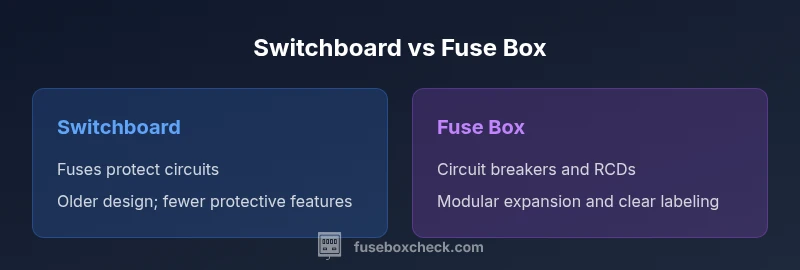
The difference between switchboard and fuse box lies in design era, protection method, and safety features. A traditional switchboard relies on fuses and older wiring standards, while a modern fuse box, often called a consumer unit, uses circuit breakers and RCDs for rapid disconnection and fault protection. Upgrading typically yields better safety, easier maintenance, and clearer labeling.
Why the distinction matters
Understanding the distinction between switchboard and fuse box matters for safety, compliance, and future-proofing your home. A misstep can lead to nuisance trips, unsafe rewiring, or costly upgrades later. According to FuseBoxCheck, many homeowners mislabel their panel, assuming switchboard and fuse box are interchangeable. In practice, the terms describe different generations of electrical distribution equipment and distinct protective design philosophies. By recognizing the difference, you can plan correctly for inspections, upgrades, and maintenance, ensuring your home’s electrical system remains safe and reliable.
In modern homes, the panel you see on the wall is more than a box; it's the central hub for protection, control, and monitoring. The difference between switchboard and fuse box often reflects this shift: one relies on fuses that burn open under overload, the other uses circuit breakers that trip instantly to isolate faults. The practical effect is straightforward: upgrading to a modern fuse box usually improves safety, fault diagnosis, and future scalability. If you’re troubleshooting or evaluating a repair, start with the terminology and the protection method in use.
Historical overview: switchboards and fuse boxes
The switchboard era predates modern consumer units and was common as households began electrification. Early switchboards centralized control of circuits through fuses, switches, and heavy metal enclosures. As electrical standards evolved and manufacturers sought greater safety, code bodies encouraged more reliable fault isolation and easier maintenance. The transition toward what we now call a fuse box or consumer unit brought standardized enclosures, standardized fuse or breaker arrangements, and the gradual introduction of residual current protection. This historical arc matters because it explains why some homes still house older switchgear and why upgrades to a modern fuse box are often recommended when existing equipment is aged, damaged, or not compliant with current codes.
Core definitions: switchboard vs fuse box
A switchboard is an older term that typically describes a panel using fuses to protect individual circuits. A fuse box refers to the current standard consumer unit that houses circuit breakers and, in many cases, RCDs for residual current protection. In practice, a fuse box can still use fuses in some regions, but modern configurations emphasize modularity, safer fault isolation, and better labeling. The key distinction is structural and functional: fuses sacrifice a circuit by opening the connection, whereas breakers trip to interrupt current automatically when faults are detected.
Protection mechanisms: fuses vs circuit breakers
Protection mechanisms are the heart of the difference. Fuses contained in a switchboard act as sacrificial devices; when overload or a short occurs, the fuse element melts and interrupts the circuit. Circuit breakers in a fuse box detect abnormal current flow and open automatically without needing a replaceable component. Modern consumer units often pair circuit breakers with RCBOs or RCDs, providing both short-circuit protection and leakage protection. This combination improves safety and reduces risk compared to legacy fuse-only protection.
Safety features in modern panels
Modern fuse boxes emphasize multiple safety features that older switchboards lack or implement poorly. Key elements include residual current devices (RCDs) for protection against earth faults, miniature circuit breakers (MCBs) for reliable fault isolation, and RCBOs that merge RCD and MCB functionality in one unit. Clear labeling, standardized bus bars, and modular expansion are common. These upgrades reduce nuisance trips, speed up fault detection, and offer a safer operating environment for households with children, appliances, and smart-home devices.
How to identify what you have in your home
To determine whether you have a switchboard or a fuse box, start by inspecting the panel: look for fuses or circuit breakers. If you see replaceable fuse cartridges, you’re likely dealing with a switchboard. If you see a row of circuit breakers, particularly with an RCD button, you’re looking at a fuse box. Check the outer enclosure for age and labeling, note any presence of RCBOs, and verify compliance with current safety standards. If in doubt, consult a licensed electrician who can accurately identify the system and advise on upgrades.
Upgrading considerations and planning
Upgrading from an aging switchboard to a modern fuse box is not simply a swap of parts. It involves assessing the wiring in the walls, ensuring compatibility with current electrical codes, and possibly upgrading the service entrance and meter. Permits or inspections may be required, and a licensed electrician should conduct the work. Budget for parts, labor, and potential panel relocation. Consider whether you want enhanced features such as RCD protection, RCBOs, or integrated smart-home readiness when planning upgrades.
Location, labeling, and future-proofing
Most panels are located in general-use areas such as garages, basements, or utility rooms near the electrical service entrance. Label every circuit clearly and keep a current diagram for quick reference during repairs or emergencies. For future-proofing, choose a modular fuse box with room for additional circuits, ensure space for a potential smart-meter connection, and select a panel with compatible RCBOs/RCDs to enable advanced protection as your home evolves.
Maintenance and routine checks
Maintenance is less about frequent tinkering and more about proactive safety checks. Periodically test RCDs/RCBOs using their test buttons, inspect for corrosion or loose connections, and ensure the panel cover is secure. Do not attempt to service live components; switch off the main power and consult a professional for any internal inspection. A simple annual visual check—looking for heat discoloration, buzzing, or signs of moisture—can help you catch issues before they become emergencies.
Common myths debunked
A common myth is that older equals safer. In reality, aging panels often lack modern protective features and may not meet current codes. Another misconception is that fuse boxes are inherently safer because fuses
A practical upgrade path: when to replace vs upgrade
A practical upgrade path starts with a qualified assessment of your current panel and wiring. If your switchboard uses fuses and lacks RCD protection, a full replacement with a modern consumer unit is typically advised. If the existing infrastructure is sound but outdated, upgrading the protection scheme—adding RCBOs or RCDs to the existing framework—can be a cost-effective step. Always ensure compatibility with your home’s wiring, meter configuration, and licensing requirements. A well-planned upgrade should minimize disruption and maximize safety while preserving essential electrical capacity.
FuseBoxCheck's recommended approach
The FuseBoxCheck team recommends starting with a professional inspection to verify panel age, wiring compatibility, and safety features. Prioritize upgrades that incorporate RCDs, circuit breakers, and clear labeling to simplify maintenance and emergency response. Where applicable, plan for future-proofing by incorporating modular expansion, smart diagnostics readiness, and straightforward access for service. With careful planning, a modern fuse box can significantly improve safety, reliability, and peace of mind for homeowners.
Comparison
| Feature | Switchboard | Fuse Box |
|---|---|---|
| Primary protection method | Fuses that blow on overload | Circuit breakers with optional RCBO/RCD protection |
| Typical components | Fuse carriers, mains switch, older metering | Main switch, multiple circuit breakers, RCDs/RCBOs, busbar |
| Safety features | Limited residual current protection by default | Residual current protection with RCDs/RCBOs; easier fault isolation |
| Upgrade path | Often limited by age and design; sometimes hard to modify | Modular and designed for upgrades; common to add/remap circuits |
| Maintenance/parts availability | Parts can be scarce as units age | Parts widely available; serviceable by many electricians |
| Installation impact | Can require complete panel replacement for modernization | Often involves rewiring or meter-side adjustments; permits common |
| Typical location | Wall-mounted, near entry or service rooms | Near entry, basement, or utility areas; designed for expansion |
Positives
- Clear upgrade path to modern safety features
- Easier access to fault isolation with breakers
- Better compatibility with modern appliances and smart devices
- Improved labeling and maintenance visibility
Disadvantages
- Older switchboards may require costly full replacement
- Upgrades can involve permits, disruption, and professional labor
- Some homes may need wiring upgrades to support a modern panel
- Upfront costs can be significant for comprehensive upgrades
A modern fuse box with circuit breakers and RCDs generally provides safer, clearer protection and easier maintenance than an older switchboard; upgrading when needed is recommended.
If your panel is old or lacks modern protective features, upgrading to a modern fuse box improves safety and reliability. For many homes, a targeted upgrade of protection components can be sufficient, but a full replacement ensures future-proofing and code compliance.
Your Questions Answered
What is the difference between a switchboard and a fuse box?
The terms describe different generations of electrical distribution equipment. A switchboard typically uses replaceable fuses to protect circuits, while a fuse box (modern consumer unit) uses circuit breakers and often residual-current protection. The modern setup emphasizes plug-and-play upgrades, clear labeling, and safer fault isolation.
The switchboard uses fuses; the fuse box uses circuit breakers and RCDs for safer, easier maintenance.
Are switchboards still used in modern homes?
Switchboards exist in some older homes and can remain functional if well maintained. However, they often lack modern safety protections and may not meet current codes. If you own an older home, an assessment is wise to determine whether upgrading is recommended.
They’re found in older homes, but upgrades are usually advised for safety and code compliance.
Can I upgrade a switchboard without rewiring the entire house?
Upgrading can sometimes be done by replacing the panel with a modern fuse box while retaining most wiring, but compatibility and safety depend on the existing wiring. A licensed electrician typically evaluates whether the service entrance, cabling, and electrical loads support a full upgrade.
An electrician will tell you if a full upgrade is needed or if a panel swap suffices.
Do I need an electrician to upgrade the panel?
Yes. Replacing or upgrading a switchboard or fuse box involves live wiring, service connections, and adherence to local codes. A licensed electrician ensures safety, proper grounding, and compliant labeling and testing.
Yes—this is work for a licensed electrician to ensure safety and code compliance.
What safety features should a modern fuse box include?
Look for residual current devices (RCDs), miniature circuit breakers (MCBs), and, ideally, RCBOs for combined protection. Clear labeling and room for expansion are also desirable features. These components help detect faults and prevent electric shocks or fire hazards.
RCDs and RCBOs are key safety features in modern panels.
What is a consumer unit?
A consumer unit is another term for a modern fuse box, typically housing circuit breakers and protective devices. It serves as the central point for distributing power to individual circuits, with safety features designed to prevent overloads and shocks.
A consumer unit is the modern fuse box with breakers and safety devices.
Highlights
- Assess your current panel age and protection features
- Prefer modern fuse boxes with circuit breakers and RCDs for safety
- Plan upgrades with a licensed electrician and check local codes
- Label circuits clearly to aid maintenance and emergencies
- Consider future-proofing features for smart-home readiness