Fuse Box Not Getting Power: Step-by-Step Troubleshooting
Urgent, practical guidance to diagnose and fix a fuse box not getting power. Learn safe steps, common causes, diagnostic flow, and when to call a professional. FuseBoxCheck provides expert tips for homeowners troubleshooting fuse boxes.


If your fuse box not getting power, the most likely culprits are a tripped main breaker or blown fuse, plus occasional outages from your utility. Start by resetting the main breaker and, if needed, replacing the fuse with the same rating. Next, check for tripped branch circuits and test a known-working outlet to confirm power is restored.
Understanding the Problem and Why Power Can Drop
When the fuse box not getting power, it’s a signal that something in the power path has tripped or failed. In many homes the issue starts at the service entrance: a tripped main breaker, a blown main fuse, or an upstream utility outage can cut power to the entire panel. According to FuseBoxCheck, most residential power-loss incidents originate at the main disconnect rather than at individual circuits. This means your first moves are safety-focused checks and controlled reset attempts. Identify whether the power loss affects the whole house or just one area, because the remedy changes based on scope. By recognizing the pattern behind fuse box not getting power, you can avoid dangerous work and move quickly toward a safe resolution. The goal is to restore power while staying within your safety limits, then determine whether professional help is needed.
Safety First: Before You Touch the Panel
Never touch energized conductors. Wear rubber-soled shoes and use insulated tools if you must interact with a panel. Keep a clear workspace, and keep children and pets away. If you notice burning smells, melted insulation, or scorch marks, stop immediately and call a licensed electrician. If you suspect a utility fault, contact your electric provider rather than attempting risky repairs. Always verify the environment is dry and your hands are dry before handling any equipment. By prioritizing safety, you reduce the risk of electric shock, arc flash, or further damage when the fuse box not getting power scenario occurs.
Quick Checks You Can Do Right Now
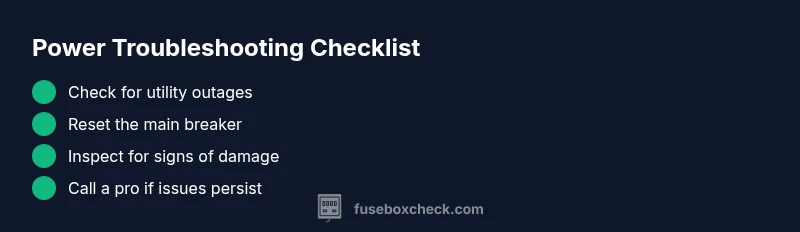
- Check for a known outage with your utility provider and confirm the rest of the house is affected. If only the panel is affected locally, proceed with further checks.
- Locate the main service disconnect and see if the switch is in the ON position. If it shows TRIP or OFF, switch it OFF, then back to ON slowly until you hear a click.
- Look for obvious signs of damage near the panel: scorch marks, melted insulation, or a warm panel. Do not touch any charred components.
- Test a known-good outlet or light fixture in a separate circuit to verify whether power has returned to the circuit you’re testing. If power is still not present, avoid energizing tools and call for professional assistance.
Diagnostic Flow: Symptom to Diagnosis (simple, practical guide)
If the symptom is fuse box not getting power, start with: Is there a utility outage? Is the main breaker tripped? Are branch circuit breakers all reset? Is there any visible damage or burning smell? For each step, confirm with safe tests (no live exposure). Based on the result, the diagnosis guides you toward either a reset, a fuse replacement (older panels), or a call to a pro for a service issue beyond your control. FuseBoxCheck analysis shows that in most homes the first indication is a tripped main breaker; these issues are usually resolved by a controlled reset, but faulty service connections require professional service.
When the Most Likely Cause Is a Tripped Main Breaker or Blown Fuse
Resetting the main breaker is the fastest way to restore power when the fuse box not getting power is caused by a trip. If you have an older fuse panel with fuses instead of a breaker, replace the blown fuse with one of the same rating. Always confirm there is no burn or heat on the panel after resetting or replacing. If the main disconnect or bus bar shows signs of damage, stop and call an electrician immediately. If the panel remains unpowered after these steps, the problem may lie with the service from the utility or with the meter.
Special Cases: Lost Neutral, Meter, or Service Drop Issues
Sometimes a lost neutral or a faulty meter can leave a fuse box not getting power without tripping the main breaker. In such cases, you might notice upstairs outlets or bathrooms are dead while others still function. Do not attempt to rewire the service; these scenarios require a professional assessment. If your meter base is hot to the touch, or if the utility has reported an outage or planned work, treat as urgent.
Common Mistakes to Avoid
Avoid jumping to rewiring or using improvised fuses or higher-rated components. Do not bypass a trip by wiring across loads. Do not use metal tools to prod inside the panel. Avoid opening the panel in wet conditions, and never work alone if you’re unsure.
Prevention and When to Call a Pro
Regular inspection, labeling circuits, and testing GFCI outlets can help prevent future problems. If you’re dealing with a fuse box not getting power repeatedly, consider upgrading to a modern circuit-breaker panel. The FuseBoxCheck team recommends scheduling annual safety checks and upgrading older fuse panels to reduce risk. For any sign of burning, buzzing, or heat, stop and call a licensed electrician immediately.
Steps
Estimated time: 20-40 minutes
- 1
Safety gear and prep
Put on rubber-soled shoes and non-conductive gloves. Clear the area around the panel and remove nearby metal objects. Confirm you have a dry environment before touching the panel.
Tip: Never work on a panel if you’re unsure about your safety—call a pro before proceeding. - 2
Locate the main service disconnect
Find the main disconnect at the panel or service entrance. Read the labeling to identify the main breaker. If you’re unsure, do not proceed and consult a professional.
Tip: Take a photo of the panel labeling for quick reference later. - 3
Reset the main breaker
If the main breaker shows TRIP or OFF, switch it OFF, then firmly ON until you hear a click. Do not force it beyond the point of resistance.
Tip: If it won’t reset, stop and seek professional help. - 4
Check for tripped branch circuits
With the main secured, reset individual branch breakers one by one. If any trip again, note the circuit it protects rather than flipping others.
Tip: Avoid loading the circuits you’re testing with heavy appliances. - 5
Inspect for signs of damage
Look for scorch marks, melted insulation, or a warm panel. Do not touch if anything looks abnormal—this is a red flag.
Tip: If you smell burning, evacuate and call emergency services if needed. - 6
Test loads and restore power gradually
Plug in a known-good device to test a circuit after resetting. If the panel remains unpowered, do not continue—call a licensed electrician.
Tip: Restart large loads one at a time to avoid immediate re-tripping.
Diagnosis: Fuse box not getting power
Possible Causes
- highTripped main breaker
- mediumBlown main fuse (older panels)
- lowUtility outage or service drop issue
- lowLoose service connections or damaged bus bar
Fixes
- easyReset main breaker (OFF, then ON)
- easyReplace blown main fuse with same rating (older panels)
- easyCheck for utility outage or meter status; contact provider
- mediumCall a licensed electrician for service faults or damaged components
Your Questions Answered
What should I do first if the fuse box not getting power?
Check for a utility outage and verify whether the main breaker is tripped. If safe, reset the main breaker and then inspect branch circuits for trips. If power remains off, seek professional help.
First, check for outages and the main breaker, then reset if safe. If power stays off, contact a licensed electrician.
Is it safe to reset the main breaker myself?
Resetting the main breaker is generally safe if you follow safety guidelines: dry hands, dry environment, and no damaged components. Do not touch live conductors or force a stubborn switch; if anything looks abnormal, call a pro.
You can reset the main breaker if you follow safety steps; if anything looks off, get a professional.
When should I call a professional?
Call a professional if you smell burning, see scorch marks, if the panel feels warm, if a reset doesn’t restore power, or if you suspect a utility fault or meter issue.
Call a professional if there are signs of damage or power won’t return after safe resets.
Can a partial outage be due to a fuse box issue?
Yes, a partial outage can occur if a single branch circuit trips or if there’s a service problem. A licensed electrician can diagnose whether the issue is localized or service-wide.
Partial outages can be panel-related or due to a faulty branch; get a pro to check.
Should I upgrade an old fuse box?
Older fuse panels are less safe and more prone to nuisance trips. Upgrading to a modern circuit-breaker panel can improve safety and reliability.
An upgrade is often a smart move for safety and reliability.
How often should I inspect fuse box safety?
Inspect annually or after major weather events. Label circuits and test outlets to catch problems early.
Annual checks are a good practice to prevent surprises.
Watch Video
Highlights
- Reset the main breaker first to restore power when safe.
- Do not bypass safety devices or modify the service panel.
- Look for utility outages and faulty service connections as root causes.
- Upgrade old fuse panels to modern breakers for safer, reliable power.