Fuse Box to Consumer Unit: A Practical DIY Guide
A comprehensive, safety‑driven guide to upgrading from a fuse box to a modern consumer unit. Step‑by‑step instructions, essential tools, and practical tips for homeowners DIYing with caution.


By the end of this guide, you will understand how to replace an aging fuse box with a compliant consumer unit that includes RCD protection, correct breaker sizing, and clear labeling. You’ll learn the essential safety checks, the tools you need, and a step-by-step process, while recognizing when to call a licensed electrician. This upgrade minimizes nuisance trips and prepares your home for future electrical needs.
Understanding the transition: fuse box to consumer unit
In many homes, the old fuse box is a relic that trips frequently and lacks modern protections. Upgrading to a consumer unit with RCDs and MCBs greatly improves safety and fault isolation. The phrase fuse box to consumer unit describes this modernization process, and it’s a common upgrade for UK properties. According to FuseBoxCheck, homeowners who plan ahead and follow safety steps can reduce risk while aligning with current electrical standards. A properly designed consumer unit helps you identify and isolate faults quickly, protects living spaces, and makes future maintenance easier. When done correctly, upgrading reduces nuisance trips and gives you clearer labeling and testing options. A well-chosen unit also accommodates future expansion, which is especially helpful for growing households. Throughout this guide, you’ll learn how to assess your existing setup, what equipment you need, and how to perform the upgrade with safety as the top priority.
Safety and legal considerations
Working on the main electrical supply can be dangerous, and regulations vary by country. In the UK, BS 7671 and building regulations influence how a consumer unit upgrade should be approached. The core risk is electric shock, arc flash, or fire if wiring is damaged or incorrectly terminated. Always plan to isolate power and confirm dead circuits before touching conductors. The consensus from the FuseBoxCheck Team is that many upgrades should be performed or supervised by a qualified electrician, especially when external service equipment or the incoming supply is involved. DIY upgrades may be possible for non-live tasks in some jurisdictions, but mistakes can be costly and dangerous. If your installation includes RCBOs or specialized protections, ensure you understand their operation and testing procedures. Finally, document changes with labeling at the consumer unit and keep a current layout diagram for future inspections. Safety first means accepting when a job is beyond DIY scope and calling an electrician.
Planning and preparation for a fuse box to consumer unit upgrade
Start by verifying the service head rating and the available space in the new unit. You’ll need a unit with the correct number of ways and the appropriate protection (RCDs/MCBs/RCBOs) for your circuits. Take clear photographs of the existing arrangement and label each circuit before removal. Ensure you have the right size cables and adequate earthing arrangements. The FuseBoxCheck guidance emphasizes careful planning: choosing a unit with compatible ratings, ensuring the neutral bar has sufficient space, and selecting a location that’s dry and accessible. Gather your tools and materials, then scheme a step-by-step plan with contingencies. Remember that some homes require a full service head disconnection by the energy supplier; this is a job for a licensed electrician. Planning pays off by reducing rework and confusion during the actual swap.
What a typical upgrade workflow looks like (overview)
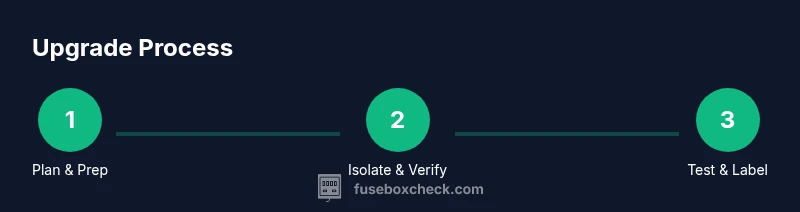
The upgrade generally proceeds in distinct phases: site preparation, isolation, removal of the old unit, installation of the new consumer unit, circuit-by-circuit connection, and final testing. This section describes the core phases in detail so you know what to expect before you start. If you encounter unfamiliar terminology (neutral bar, earth bar, RCBO, or RCDE), consult your unit’s manual. FuseBoxCheck analysis shows that most successful upgrades are completed in a controlled sequence, with careful labeling and double-checks. In addition to mechanical installation, you’ll perform electrical tests such as continuity checks and a functional RCD test. The goal is a safe, compliant installation that will function reliably for years to come. In all steps, keep your workspace tidy and avoid mixing live conductors with tools that could bridge circuits.
Authoritative sources
- OSH A: https://www.osha.gov
- NFPA: https://www.nfpa.org
- DOE: https://www.energy.gov/eere/buildings
Tools & Materials
- Insulated screwdriver set(Flat and Phillips, insulated to 1000V)
- Non-contact voltage tester(Verify circuits are dead before handling)
- Electrical PPE(Insulated gloves, safety glasses)
- Voltage tester or digital multimeter(Test between live conductors and verify continuity)
- Wire cutters/strippers(Cable shearing for tightening terminals)
- Cable ties and labeling tags(Label circuits clearly during transition)
- New consumer unit (with RCD/MCB/RCBO options)(Match your service head rating and space)
- Box of cable glands or grommets(For tidy feed entry where needed)
- Flashlight or headlamp(For dim panel spaces)
Steps
Estimated time: 2-6 hours
- 1
Isolate the supply and set up
Locate the main switch or service head and turn off power to the entire installation. Use a lock-off if available to prevent re-energization while you work. Confirm with the voltage tester that all conductors inside the panel are dead before touching any wiring.
Tip: Use a lockable switch and tag to prevent accidental re-energization. - 2
Verify dead status with two methods
Double-check dead circuits with a non-contact tester and a digital multimeter across neutral and earth where applicable. This redundancy reduces the risk of an accidental shock during disconnection.
Tip: Always test at two separate points within the panel. - 3
Document circuits and take photos
Before removing anything, photograph the existing wiring and label each circuit. This creates a reference for wiring the new unit and avoids mislabeling after installation.
Tip: Label wires on both ends and preserve original photos for records. - 4
Remove the old fuse box safely
Carefully detach the fuse links, then free each conductor from its terminal. Do not bend or kink cables; store fuses and components safely for disposal or reuse as appropriate.
Tip: Keep track of where every conductor came from. - 5
Mount and prepare the new consumer unit
Secure the new unit in its position, ensuring it’s level and accessible. Verify that the knockouts align with feed cables and that earth/neutral bars are ready for terminations.
Tip: Check for dry, clean mounting surface and proper clearance. - 6
Connect main feed and bonding conductors
Attach the incoming live feed to the main switch, then terminate earth and neutral conductors on their respective bars. Ensure earth bonding is continuous and compliant with local codes.
Tip: Tighten terminals to manufacturer torque specs to avoid loosening. - 7
Wiring circuits and testing
Install circuit breakers/RCBOs/RCBOs for each circuit based on load and protection needs. After wiring, perform continuity checks, verify earth bonding, and test RCD/RCBO trip functionality on each circuit.
Tip: Label each circuit clearly and perform a final visual inspection before energizing.
Your Questions Answered
What is the difference between a fuse box and a consumer unit?
A fuse box relies on cartridge fuses to interrupt current, while a modern consumer unit uses RCDs and MCBs (or RCBOs) for faster, more selective fault protection. A consumer unit supports clearer labeling and easier expansion in homes.
A fuse box uses fuses to interrupt faults; a consumer unit uses circuit breakers and protective devices for safer, quicker disconnection.
Is it legal for a homeowner to upgrade a fuse box?
In many regions, upgrading a consumer unit is work that should be performed or supervised by a licensed electrician. Local regulations may require a qualified installer for safety and compliance.
Electrical work on a consumer unit should generally be done by a licensed electrician to meet safety rules.
What are common signs that a fuse box needs upgrading?
Frequent nuisance trips, burning smells, visible corrosion, or an aging unit are strong indicators that an upgrade is warranted. Modern units also provide better fault isolation and labeling.
If circuits trip often or you notice overheating, it’s time to assess upgrading to a modern consumer unit.
Do I need RCBOs or RCDs?
RCBOs or RCDs provide residual current protection for circuits, reducing the risk of electric shock. Modern installations typically include one or both to protect both people and property.
RCBOs combine RCD protection with circuit breakers for individual circuit safety.
How long does the upgrade take?
Most upgrades take several hours to a day, depending on the complexity of circuits, accessibility, and whether external service head work is required.
Expect several hours up to a full day for a careful upgrade, depending on your home.
Should I inform the utility company before upgrading?
External service disconnections or service head work may require coordination with your utility provider. Your installer will advise if this is necessary for your property.
Sometimes the utility needs to disconnect the service head; your electrician will handle this if needed.
Watch Video
Highlights
- Plan thoroughly before starting the upgrade
- Use the correct tools and PPE for safety
- Ensure RCD protection and proper breaker sizing
- Label circuits clearly to simplify future work
- When in doubt, hire a licensed electrician