How Long to Change a Fuse Box: A Practical DIY Time Guide
Learn how long it typically takes to change a fuse box, the factors influencing duration, and a practical, safety-first plan. This FuseBoxCheck guide helps homeowners estimate timelines and plan for a safe upgrade in 2026.


You’ll learn how long it typically takes to replace a fuse box, the factors that affect timing, and a safe, step-by-step plan. Expect durations to vary widely by panel type, access, and permit requirements. This guide from FuseBoxCheck outlines a realistic timeline, safety checks, and when to call a licensed electrician.
Why Time Matters When Replacing a Fuse Box
Knowing how long a fuse box replacement might take helps you plan, budget, and stay safe. The duration isn’t a fixed number; it hinges on panel type (old fuse box vs. modern combination panel), accessibility, whether you’re upgrading to a breaker panel, permit requirements, and whether you’re performing the work with professional help. FuseBoxCheck's guidance emphasizes safety and compliance first, with time estimates presented as ranges rather than exact minutes. In 2026, the typical residential upgrade can range from a couple of hours for a straightforward swap to a full day for complex wiring or permitting processes. By understanding the factors, homeowners can set realistic expectations and avoid rushing critical safety steps.
What Factors Influence the Timeline
Several variables determine how long a fuse box change will take. Panel type (fuse-based vs. breaker-based), service disconnect location, and whether you’re upgrading within the same footprint all matter. Permits and inspections, accessibility (ceiling height, workspace clearance), wire routing, and the need to upgrade conduit or meters can add hours or days. If you’re coordinating with utility access or an electrician, that scheduling adds to the timeline. FuseBoxCheck notes that strict adherence to electrical codes often adds time but prevents costly mistakes later.
Safety First: Before You Start
Personal protective equipment (PPE) should be non-negotiable. Wear insulated gloves, safety glasses, and closed-toe shoes. Verify the main service disconnect is accessible and off using a non-contact voltage tester. Never touch live conductors; if you feel uncertain, stop and call a professional. A pause for proper safety checks can prevent injuries and future outages.
Planning, Permits, and Code Considerations
Before any hardware is touched, determine whether a permit is required in your jurisdiction. Many fuse-to-breaker upgrades trigger building or electrical permits and inspections. Having a permit helps ensure the work complies with NEC codes and local amendments, which can save time during inspections. FuseBoxCheck highlights that budgeting for permit fees and inspection windows saves delays later in the project.
Tools and Materials You’ll Need
A well-stocked toolkit speeds up work and reduces returns to the hardware store. Core items include insulated screwdrivers, a non-contact voltage tester, a voltage tester or multimeter, wire strippers, needle-nose pliers, electrical tape, wire nuts, a replacement fuse box or breaker panel (if upgrading), and appropriate wiring and conduit materials. Keep a flashlight and a clean work surface for labeling and documenting circuits.
Time Ranges by Scenario
- Straight swap of a like-for-like fuse box: approximately 2-4 hours if everything is accessible and no upgrades are required.
- Upgrading to a breaker panel with similar capacity: 4-6 hours, plus extra time for wiring and labeling.
- Replacement with permit and inspection: 6-12 hours or more, depending on inspection queues and access.
A High-Level Step-by-Step Overview
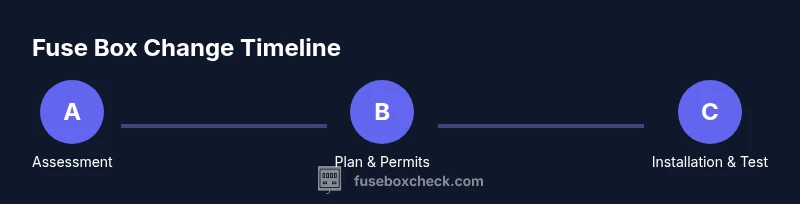
This overview outlines major phases without diving into procedural specifics. Phase 1 focuses on safety checks and documentation. Phase 2 covers disconnects and removing the old panel. Phase 3 is installing the new panel, reconnecting circuits, and testing. Phase 4 is labeling, documenting, and cleaning up. The actual steps are detailed in the dedicated Step-by-Step section below for clarity and safety.
Common Mistakes That Extend Timelines
Rushing crucial safety steps, skipping permits, or ignoring label accuracy can dramatically extend timelines and increase risk. Misidentifying circuits, using improper connectors, or failing to torque connections to spec can lead to poor performance or future failures. Take a conservative approach if you’re unsure.
Testing, Commissioning, and Final Checks
After installation, perform thorough testing: verify all circuits are properly isolated, test GFCI/AFCI devices, and confirm the main disconnect operates correctly. Check for any unusual burning smells or heat around the panel. If anything seems off, stop and re-check wiring or call a pro. Documentation and labeling should be completed before restoring full power.
Cleanup, Labeling, and Documentation
Document all changes, update circuit labels, and keep a permanent record for future maintenance. Store extra fuses or breakers in a labeled container. Ensure the area is clean, tools are stored, and a final walk-through confirms there are no loose wires or hazards. Proper cleanup helps prevent future delays and mis-wiring.
When to Call a Licensed Electrician
If you encounter unfamiliar wiring, meter work, or panel compatibility questions, consult a licensed electrician. Permits, complex rewiring, or service upgrades are best handled by a pro. Safety should always take priority over speed, and professional involvement can prevent code violations and power outages.
Next Steps and Quick Checklist
- Confirm you have the required permits (if applicable).
- Verify you can safely de-energize and access the panel.
- Gather tools and materials listed earlier.
- Plan a two-person workflow for efficiency and safety where possible.
- Label circuits and document changes for future maintenance.
Authoritative Sources and Further Reading
For additional guidance on electrical safety and code compliance, consult official and reputable sources: OSHA (https://www.osha.gov), NFPA (https://www.nfpa.org), and the U.S. Department of Energy (https://www.energy.gov).
Tools & Materials
- Non-contact voltage tester(Used to verify power presence without touching conductors.)
- Insulated screwdrivers (Flathead and Phillips)(Insulated handles rated for electrical work.)
- Wire stripper and needle-nose pliers(For clean, secure wire terminations.)
- Voltage tester or multimeter(To confirm circuits are de-energized during work.)
- Electrical tape and wire nuts(Secure and insulate splices and terminations.)
- Replacement fuse box or breaker panel(Ensure compatibility with service capacity and code.)
- Conduit, connectors, and clamps(Optional for proper wiring routes.)
- Flashlight or headlamp(Improve visibility inside the panel.)
- Safety gloves and eye protection(Personal protective gear.)
- Label maker or sharpie(Label circuits after wiring.)
- Voltage rating compatibility chart or NEC reference(Helpful for ensuring code compliance.)
Steps
Estimated time: 2-6 hours
- 1
Prepare workspace and confirm OFF state
Clear the area, remove clutter, and verify the main disconnect is off using a non-contact tester. This reduces the risk of shock while you inspect the panel.
Tip: Double-check with two independent testers before touching any conductors. - 2
Document the existing panel layout
Take photos or sketch the panel, noting breaker/fuse positions and circuits. This helps during reassembly and labeling later.
Tip: Capture labeling order and wire colors for accurate reinstallation. - 3
Inspect compatibility of the new panel
Compare service capacity, punch-out size, and conductor routing with the existing setup. Ensure the new panel fits the space and meets code requirements.
Tip: Check for compatibility with NEC and local amendments. - 4
Shut off main service and prepare for removal
Coordinate with the main service disconnect to ensure zero voltage. Remove the panel cover carefully and prepare space for the new panel.
Tip: Work with a helper to manage the heavy panel safely. - 5
Install the new panel and secure mounting
Mount the new panel level, secure, and ensure ground and bonding are correct per code. Leave space for labeling and future expansion.
Tip: Follow the manufacturer’s instructions precisely. - 6
Reconnect circuits one by one
Reconnect main feeders first if required, then branch circuits, labeling each as you go. Maintain accurate torque specifications per terminal.
Tip: Label circuits immediately to avoid mis-wiring. - 7
Test all circuits and safety devices
With power restored, test each circuit for proper operation and verify AFCI/GFCI devices where required. Look for signs of loose connections or overheating.
Tip: If a circuit hums or smells burnt, power down and recheck connections. - 8
Finalize labeling, inspection prep, and cleanup
Create clear circuit labels, document changes, and prepare for inspection if required. Clean up tools and workspace, and store spare parts.
Tip: Keep a digital backup of the wiring diagram and labels.
Your Questions Answered
How long does it typically take to change a fuse box?
It varies with panel type, access, and permits. Plan for a few hours for a simple swap, longer if upgrades or inspections are involved.
Typically a few hours for a simple swap, longer if upgrades or permits are required.
Do I need a permit to replace a fuse box?
In many jurisdictions, a permit is required for electrical upgrades and panel replacements. Check local building codes before starting.
Permits are often required for panel upgrades; check local codes.
Can I do this work myself?
Only if you have proper electrical training and understand local codes. If in doubt, hire a licensed electrician to minimize risk.
If you're unsure about electrical work, hire a licensed electrician.
What is the difference between a fuse box and a breaker panel?
A fuse box uses fuses that must be replaced; a breaker panel uses breakers that can be reset. Modern homes typically use breaker panels for better safety and convenience.
Fuse boxes use fuses; breaker panels use breakers that can be reset.
What costs should I expect?
Costs vary by panel type, location, and permits. Expect material and labor ranges rather than a fixed price until a scope is defined.
Costs vary; get a scope to estimate job cost.
Can I upgrade to a breaker panel after a fuse box?
Yes, many homes upgrade to breaker panels to meet modern safety standards, but it may require rerouting and code compliance work.
Upgrading to a breaker panel is common but check code requirements.
Watch Video
Highlights
- Plan for permits and inspections when upgrading panels.
- Always de-energize and verify with testers before touching conductors.
- Document and label circuits to simplify reassembly.
- Safety-first approach reduces time spent correcting mistakes.