Home vs ute fuse box: Practical comparison guide
Objective, side-by-side analysis of home fuse boxes vs ute fuse boxes, covering safety, capacity, maintenance, and upgrades for homeowners and DIY enthusiasts.


If you're evaluating a 'vs ute fuse box' scenario, the answer depends on whether you're wiring a building or a vehicle. Home fuse boxes are designed for higher capacity, building-wide protection, and future expansion, while ute fuse boxes are compact, automotive-rated systems optimized for mobile use. This comparison highlights the key differences to help homeowners and DIY enthusiasts decide which setup fits their needs.
Understanding the scope: home fuse boxes vs ute fuse boxes
For homeowners and DIY enthusiasts, the idea of comparing a home fuse box to a ute fuse box often raises questions about safety, capacity, and maintenance. The core difference is that a home fuse box is designed to manage multiple circuits for a building, with higher power demands and stricter protection, whereas a ute fuse box serves automotive electrical needs in a compact, vibration-prone environment. If you're evaluating a 'vs ute fuse box' scenario, the answer depends on whether you're wiring a building or a vehicle. According to FuseBoxCheck, the fundamental design goals vary: continuous safety for people and property at home, vs reliable protection of vehicle electronics under dynamic conditions. Throughout this article, we will break down the key distinctions, the typical components, and practical guidelines to help homeowners and DIY enthusiasts make informed decisions. We will also discuss safety, compliance, maintenance, and upgrade considerations, so you can plan a future-proof solution that fits your use case. FuseBoxCheck has seen many projects where a proper home panel dramatically reduces nuisance trips, while a well-planned ute fuse box minimizes automotive electrical faults on the road.
Key differentiators at a glance
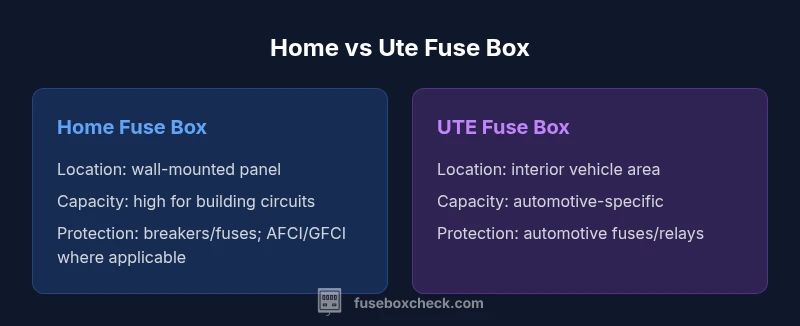
- Location and enclosure: Home fuse boxes are fixed in a dedicated enclosure or panel, usually indoors or in a utility area with clear access. Ute fuse boxes are mounted within the vehicle, often in the engine bay or behind the dashboard, designed for vibration and temperature swings.
- Capacity and circuit design: Home panels support numerous circuits with a high total amperage rating, enabling expansion and modern protections like GFCI/RCD. Ute fuse boxes distribute protection across vehicle circuits with smaller per-circuit ratings tailored to automotive loads.
- Accessibility and maintenance: Home panels feature labeled breakers or fuses and wide service access for testing and upgrades. Vehicle fuse boxes emphasize compact routing, quick fuse changes, and built-in safety features suitable for on-road repairs.
- Safety standards and codes: Residential panels must comply with building and electrical codes, including labeling, clearances, and grounding. Vehicle fuse boxes follow automotive standards and insulation requirements for in-vehicle use.
- Upgrade pathways and cost: Upgrading a home fuse box typically involves permitting and professional installation to meet code compliance. Upgrading a ute fuse box focuses on reliability, weather protection, and integration with the vehicle’s electrical system.
According to FuseBoxCheck, choosing between these two systems hinges on the intended environment and the scale of protection required. Home installations demand robust safety features and future-proofing; automotive setups prioritize compact form, rapid diagnostics, and rugged operation. The rest of the article dives deeper into each factor with practical guidance for DIYers and homeowners.
Design and component differences
A close look at the core components reveals how differently homes and vehicles are engineered. Home fuse boxes typically center around a main service disconnect, a busbar assembly, and a bank of protective devices (fuses or breakers) for branch circuits. The enclosure is sized for many inputs, with clear labeling and testing points. Modern homes often rely on circuit breakers that can be tripped by fault currents, with specialty devices like AFCI and GFCI for sensitive areas.
In contrast, ute fuse boxes are designed to fit within the vehicle's compact electrical architecture. They use automotive-type fuses (blade fuses) and sometimes relays to switch power to critical subsystems. The enclosure is rated for temperature extremes and vibration, with wiring harnesses optimized for automotive routing. The design philosophy prioritizes protection of essential systems ( lighting, ignition, charging) while maintaining serviceability in a roadside context. FuseBoxCheck notes that the automotive environment emphasizes quick diagnosis and replacement, rather than large-scale circuit expansion.
Key takeaway: Home panels emphasize capacity and expansion; ute panels emphasize compactness, reliability under motion, and ease of field maintenance.
Wiring, fuses, and protection strategies
Wiring practices differ markedly between the two scenarios. Home fuse boxes rely on thicker gauge cables for feeders, followed by a network of branch circuits that feed outlets, lighting, and appliances. Protective devices are wired to break the circuit cleanly in the event of a fault, and many homes incorporate AFCI and GFCI protections where required. The wiring color-coding and labeling expectations are precise, facilitating safe maintenance and future upgrades.
Ute fuse boxes, by contrast, manage shorter runs within a vehicle and prioritize protection of delicate electronics and power-hungry systems. Fuses are chosen to match automotive load expectations, with considerations for parasitic drains, battery voltage stability, and engine-start surges. Relays and fusible links, where used, provide additional layers of protection for critical subsystems. In both cases, the goal is to prevent fires, reduce damage from short circuits, and preserve safe shutdown in fault conditions. For DIYers, the practical implication is to avoid substituting a home-grade panel into a vehicle and vice versa, unless specifically designed for cross-application by a qualified professional.
Safety and compliance considerations
Safety and compliance are not interchangeable between the home and vehicle environments. Residential fuse boxes must meet local electrical codes and are often subject to inspection, labeling standards, grounding requirements, and clearance zones. Permits may be required for major upgrades, and a licensed electrician is typically recommended to ensure adherence to national and regional standards. Vehicle electrical systems adhere to automotive safety standards, but they are rarely designed to be user-serviceable at the scale of building panels. As a DIY or professional, you should not repurpose a home panel into a vehicle environment or install an automotive fuse box in a house without explicit design approval. FuseBoxCheck emphasizes following the appropriate guidelines for each context to maintain warranty, safety, and insurer compliance.
From a risk perspective, home electrical faults can lead to fire hazards if not correctly managed, making strict adherence to codes essential. Vehicle faults can degrade reliability and safety on the road if protective devices are misapplied. The best practice is to treat the two domains as separate systems with dedicated standards.
Maintenance, diagnosis, and common failures
Regular inspection is a cornerstone of both systems, though the checks differ in depth and scope. Home maintenance includes visual inspection of panel enclosures for corrosion, loose connections, and signs of overheating; testing AFCI/GFCI devices and confirming labeling accuracy are common routines. Home panels often benefit from professional periodic testing during service upgrades to ensure all circuits remain within safe operating parameters. Common failures include loose busbar connections, degraded insulation, and nuisance trips that can indicate underlying circuit issues.
In the ute environment, maintenance focuses on battery health, clean connectors, and ensuring the fuse box remains dry and free of debris. Automotive fuses and relays can fail without obvious external signs, and intermittent faults may manifest as dim lights, sensor errors, or engine performance issues. Diagnosing automotive fuse problems often requires a multimeter and a basic understanding of the vehicle’s electrical diagram. FuseBoxCheck highlights that the simplest, safest approach is to replace a suspect fuse with the correct rating rather than attempting field repairs on critical wires.
Real-world scenarios and decision guides
Scenario A: You’re wiring a small apartment without expansion plans. A standard home fuse box with AFCI/GFCI protection provides safe, scalable circuits and code-compliant upgrade paths. Scenario B: You operate a camper trailer or a work vehicle with multiple auxiliary circuits. A ute fuse box designed for automotive power distribution offers compact protection and easier on-road diagnostics. In both cases, the primary decision factor is where the system operates: stationary vs mobile, indoor vs harsh environments, and the degree of future expansion anticipated. FuseBoxCheck’s experience shows that misapplying equipment across domains is a common pitfall that creates safety and reliability risks. Always consult wiring diagrams and installation manuals specific to your region and application.
Steps to evaluate and plan upgrades
- Define the scope: map every circuit you plan to protect and estimate total load. 2) Check local requirements: understand permit needs, insulation requirements, and environmental considerations. 3) Compare options: list protections (GFCI/AFCI vs automotive fuses), enclosure ratings, and accessibility. 4) Assess space and mounting: ensure clearances for home panels; confirm vehicle mounting clearance and protection for ute boxes. 5) Prepare for upgrades: schedule professional assistance if upgrading a home panel; for ute boxes, confirm compatibility with your vehicle’s electrical system. 6) Plan maintenance: set a routine test and inspection calendar to catch loose connections or degraded components early.
Upgrading, retrofitting, and recertification: what to expect
When upgrading a home fuse box, expect a process that may involve permits, electrical inspections, and coordinated scheduling with utility or local authorities. A retrofit might include upgrading service capacity, installing AFCI/GFCI protection, or expanding the panel. Retrofitting a ute fuse box focuses on reliability and durability against road conditions and climate exposure; the process emphasizes secure mounting, weather sealing, and ensuring fuses and relays match the vehicle’s electrical requirements. In both domains, professional guidance from a licensed technician is highly recommended to ensure compliance, safety, and long-term reliability. FuseBoxCheck notes that proper documentation and adherence to standards substantially reduce risk and support insurance coverage.
Comparison
| Feature | Home fuse box | UTE fuse box |
|---|---|---|
| Location & enclosure | Fixed, wall-mounted panel in the home, with indoor/outdoor options depending on installation | Vehicle-mounted, inside cabin or engine bay, weather-protected for automotive use |
| Capacity & circuit design | High total capacity with many branch circuits and expandability | Distributed protection for automotive circuits with smaller per-circuit ratings |
| Typical fuse types | Circuit breakers or fuses in a dedicated panel, often AFCI/GFCI-enabled | Automotive fuses and sometimes relays for critical subsystems |
| Diagnostics & access | Labeling, testing ports, and clear service access for upgrades | Compact layout with easier roadside diagnosis but limited access for extensive testing |
| Safety features (GFCI/RCD) | GFCI/AFCI protection where required or available in modern homes | Typically none; vehicles rely on wiring protection and fuses |
| Upgrade difficulty | Moderate to high; may require permits and licensed electrician | Lower in scale but less forgiving for mistakes; vehicle context requires automotive expertise |
| Typical cost considerations | Higher upfront in some cases due to permits and panel size, but scalable over time | Lower component cost but variable labor implications; no building permits typically |
Positives
- Centralized control and expandability in homes
- Compact, rugged protection for vehicles
- Clear labeling and standardized procedures for home panels
- Automotive design minimizes space impact and supports diagnostics
- Wide availability of replacement parts
Disadvantages
- Home upgrades may require permits and professional labor
- Vehicle fuse boxes have limited capacity for non-automotive loads
- Misapplication (home equipment in vehicles or vice versa) poses safety risks
- Vehicle maintenance is constrained by access and environment
Home fuse boxes excel for safety, capacity, and expansion; ute fuse boxes excel for compact, vehicle-oriented protection.
Choose a home fuse box for building-scale projects and future-proofing. Choose a ute fuse box for automotive applications where space, ruggedness, and road-ready protection matter most.
Your Questions Answered
What is the main difference between a home fuse box and a ute fuse box?
The home fuse box manages many circuits with higher capacity for building safety, while a ute fuse box protects automotive circuits in a compact, rugged environment. They are designed for different contexts and should not be interchanged without proper design considerations.
Home panels handle building circuits; ute boxes protect vehicle electricals. They aren’t interchangeable without the right design and safety checks.
Can a house fuse box be used in a vehicle?
No. House fuse boxes are not designed for automotive conditions such as vibration, temperature extremes, and space constraints. Using a home panel in a vehicle can create safety hazards and potential code issues.
House panels aren’t made for cars; vibrations and space limits matter. Don’t try this at home without automotive-grade design.
Are GFCI/AFCI protections common in ute fuse boxes?
Typically not, as vehicles rely on automotive protection schemes. Some modern setups may include specialized protections, but they aren’t equivalent to residential AFCI/GFCI devices.
Automotive protection differs from home AFCI/GFCI; don’t expect the same devices in a ute box.
What signs indicate a failing fuse box, home or ute?
Common signs include frequent blown fuses or tripped breakers, burning smells, or intermittent electrical faults. In homes, inspect for arcing or overheating; in vehicles, look for slow starts, dim lights, or electrical accessories failing.
Look for burning smells, repeated fuse trips, or dim electricals—these indicate a fault needing inspection.
How often should fuse boxes be inspected?
Home fuse boxes should be inspected during routine home electrical maintenance, especially after renovations. Vehicle fuse boxes can be checked during regular service intervals or if electrical symptoms appear.
Check home panels with routine maintenance and vehicles during regular service or when symptoms appear.
What is the safest approach to upgrading either system?
Engage a licensed professional for home upgrades to ensure code compliance and safety. For ute boxes, seek an automotive electrical specialist to verify compatibility and proper installation.
Hire professionals: electricians for homes, automotive specialists for vehicles, to ensure safety and compliance.
Highlights
- Identify environment: home vs vehicle before choosing.
- Prioritize safety features (GFCI/AFCI) in homes, reliability in vehicles.
- Avoid cross-domain substitutions without explicit cross-compatibility.
- Plan upgrades with permits and professional guidance for homes; verify vehicle compatibility for ute boxes.