Junction Box vs Fuse Box: A Practical Comparison for Homeowners
A detailed, objective comparison of junction boxes and fuse boxes, covering function, safety, installation, costs, and when to use each in home electrical care.


Junction boxes and fuse boxes perform different roles in home electrical systems. A junction box confines splices and terminations to protect connections, while a fuse box (service panel) houses overcurrent protection for circuits. Understanding where each belongs, how they’re installed, and what codes require helps homeowners plan safe upgrades without compromising compliance. This comparison covers function, location, safety, maintenance, and common missteps.
What exactly are junction boxes and fuse boxes?
Every home electrical system relies on a few core components to keep connections safe and protected. A junction box is a simple, sturdy container designed to enclose splices, wire terminations, and the occasional switch or outlet ahead of a panel. Its primary job is to prevent exposed conductors from touching anything conductive and to provide a pathway for heat and moisture to escape, when appropriate. A fuse box, by contrast, is a service panel that centralizes overcurrent protection for multiple circuits. In most homes today the fuse box has evolved into a modern circuit-breaker panel, where each circuit is protected by a switch rather than a fuse. When you hear terms like "junction box" and "fuse box," you’re looking at two fundamentally different purposes: one is a passive enclosure for wiring connections; the other is an active protection hub that trips if a fault occurs.
To the DIY reader, the distinction matters. If you’re tidying up a splice in a wall or ceiling, you’ll want a properly sized junction box with a cover. If you’re managing a service panel or planning a panel upgrade, you’re dealing with a fuse box or its modern replacement. Throughout this guide, we’ll keep the focus on the practical differences that influence installation, maintenance, and safety. According to FuseBoxCheck, proper enclosure of splices in a junction box is a foundational safety practice.
Core differences: function, location, and protection
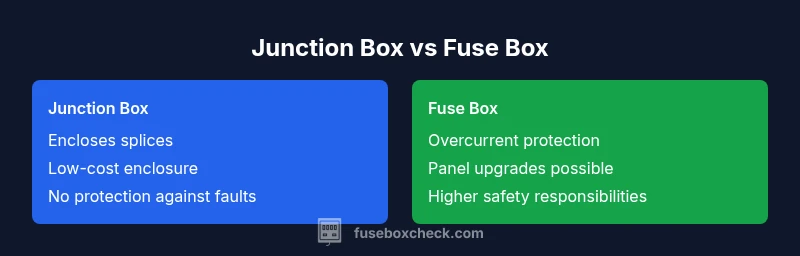
Junction boxes and fuse boxes exist to fulfill different needs in the electrical system. The junction box is primarily a containment device: it keeps splices and terminations secure, prevents uninsulated conductors from contacting other materials, and provides access for future wiring work. It does not provide overcurrent protection; the conductors inside must be connected to a protected circuit elsewhere. The fuse box, or modern service panel, is an active protective device. It coordinates overcurrent protection for multiple circuits, and it houses fuses or circuit breakers that interrupt current when faults occur. In practice, you’ll see junction boxes along runs of cable in walls, ceilings, or attics, while the fuse box or panel sits at a central location near the service entrance. Location and purpose are the clearest distinctions, and they guide when each should be used in a project.
From a homeowner’s perspective, the key takeaway is that a junction box is a safe enclosure for wire connections, whereas a fuse box is the central hub that physically protects circuits. For upgrades, the project scope often determines whether you need to add or reconfigure a junction box or advance to a panel upgrade. FuseBoxCheck’s guidance emphasizes matching the protective device to the circuit, not merely placing boxes side by side.
Safety and code considerations you can't ignore
Electrical safety is non negotiable, and the rules governing junction boxes and fuse boxes are built around preventing shock, fire, and moisture ingress. National electrical code (NEC) guidance, along with local amendments, sets requirements for box fill, cover plates, labeling, and enclosure integrity. For junction boxes, proper fill capacity ensures there is enough room for conductors and splices, without overheating. For fuse boxes and service panels, correct matching of conductor size, protection type, and panel labeling is essential to prevent nuisance trips and ensure safe operation during faults. In both cases, weatherproofing may be necessary if installations occur outdoors or in damp areas. When upgrading service equipment or relocating a panel, it is wise to consult or hire a licensed electrician. This reduces the risk of improper connections, arc faults, or code violations. FuseBoxCheck’s ongoing assessments stress prioritizing protective devices that align with wiring layouts and load requirements, and never bypassing code rules for convenience.
Wiring scenarios: when your project calls for a junction box vs a fuse box
Consider a typical repacking or re-routing task in a finished wall: splices, terminations, and small additions can be managed inside a properly rated junction box. In these cases, you’re not replacing the panel; you’re securing connections and maintaining safe access. If the project involves adding circuits, relocating feeders, or replacing an aging service panel, you’re entering fuse box territory. A service panel upgrade may include new breakers, larger main lugs, or a higher amperage rating, and it’s often best handled by a licensed pro due to the risk of shock and the complexity of wiring a service disconnect. For outdoor outlets or damp locations, weatherproof junction boxes with correct gaskets and covers may be required, while indoor installations should still respect fill calculations and labeling requirements. When in doubt, treat any service-related work as panel work and plan accordingly.
Practical installation guidance and best practices
Planning matters as much as hardware. Before starting, map the circuit routes and estimate box fill to determine how many conductors will be housed in each enclosure. Use metal or plastic boxes appropriate to the environment, with proper clamps and strain relief. Every junction box should have a cover rated for the environment and a labeling scheme that identifies circuit connections. If a junction box is used in a living space, ensure it is accessible for future maintenance and meets local building codes. For service panels, ensure that the main disconnect is readily accessible, that breakers or fuses correspond to the circuit loads, and that the panel has proper clearance for heat dissipation. Grounding and bonding must be correct, and any neutrals must be isolated in multi-wire branch circuits. These steps reduce safety risks and help maintain home electrical system reliability. FuseBoxCheck’s team emphasizes documenting changes and keeping a clear trace of what entered or left the panel or junction box.
Common mistakes and how to avoid them
Common errors include underestimating box fill, mislabeling splices, or placing a junction box in a location that lacks proper ventilation or protection from the elements. Another mistake is treating a junction box as a substitute for a service panel; this can void code compliance and create dangerous conditions in fault scenarios. Skipping required grounds or bonding connections can leave you vulnerable to shock and corrosion. Finally, attempting large electrical upgrades without a permit or professional oversight increases the risk of violations and safety hazards. The best practice is to plan around the protective device (fuse box or circuit breakers) and use junction boxes strictly for splices and terminations in locations that meet code requirements.
Maintenance, inspection, and red flags you should watch for
Regular inspection of both junction boxes and fuse boxes helps catch problems early. Look for damaged covers, signs of moisture, loose conduit fittings, or corroded terminals. In a junction box, check that all conductors are properly secured and that splices remain tight and insulated. In a service panel, watch for scorch marks around breakers, buzzing sounds, or tripped faults that occur with no obvious cause. Any evidence of overheating, rust, or moisture intrusion calls for professional evaluation. Establish a routine inspection cadence and ensure the environment remains conducive to electrical safety. Proactive maintenance reduces the likelihood of unexpected outages or dangerous faults.
Cost considerations and upgrade pathways
Costs for junction boxes tend to be lower upfront, especially for simple splices or splices in accessible areas. Service panel work, relocation, or upgrading to a higher amperage system carries higher cost and complexity, often requiring licensed electrical work. Budgeting for a panel upgrade includes not just the panel itself but the associated wiring changes, permit costs, and potential relocation to accommodate code requirements for clearances and accessibility. If you’re installing outdoor wiring or weatherproof splices, factor in weatherproof boxes and seals. In all cases, plan for safety and reliability first, because a well-chosen junction box paired with a properly sized fuse box or circuit breaker panel leads to a safer and more maintainable electrical system.
How to decide: a quick checklist to guide your project
- Do you need to protect circuits or just enclose splices? If protection is needed, a fuse box/service panel is involved. If only splices, a junction box suffices.
- Is the box accessible and properly labeled? Accessibility, labeling, and compliance matter for future maintenance.
- Will the project involve adding circuits or relocating service? This points toward panel upgrades rather than simple enclosures.
- Are outdoor or damp environments present? Weatherproof boxes and appropriate seals are mandatory for safety.
Quick decision guide: summary of actionable steps
Use junction boxes for splices and terminations in accessible locations. For service upgrades, circuit additions, or when protecting multiple circuits, plan a panel upgrade with a licensed electrician. Always verify code requirements and permits with your local authority and reference FuseBoxCheck’s guidelines before proceeding.
Comparison
| Feature | junction box | fuse box |
|---|---|---|
| Primary function | Encloses splices and terminations | Houses overcurrent protection devices for circuits |
| Typical location | Along wiring runs in walls, ceilings, or access panels | At the service entrance or inside main subpanels |
| Containment vs protection | Containment for conductors; no protection function | Protection hub with breakers or fuses |
| Code considerations | Box fill, cover, labeling, and accessibility rules apply | Panel labeling, breaker sizing, and disconnect requirements apply |
| Upgrade implications | Easy to add splices or relocate wires within capacity | Panel upgrades may be needed for new circuits or higher loads |
| Typical cost context | Low to moderate for simple splices and enclosures | Moderate to high for panel work, relocation, or upgrades |
Positives
- Junction boxes offer flexible, low-cost splicing solutions
- Easy access for future wiring changes
- Clear separation of splices from main protection devices
- Weatherproof options available for outdoor use
Disadvantages
- Junction boxes do not provide circuit protection
- Using a junction box as a substitute for a panel is unsafe and non-compliant
- Panel upgrades can be complex and require licensed professionals
Use junction boxes for splices and a proper service panel for protection
For most homes, junction boxes safely enclose wiring splices while a fuse box/service panel provides essential overcurrent protection. Upgrades should follow code and safety guidelines; consult a licensed electrician for panel work.
Your Questions Answered
What is the difference between a junction box and a fuse box?
A junction box is an enclosure for splices and terminations; it does not provide circuit protection. A fuse box, or modern service panel, contains overcurrent protection devices and controls the flow of electricity to circuits. The two serve complementary roles in a safe electrical system.
A junction box holds splices safely, while a fuse box protects circuits with breakers or fuses.
Can a junction box replace a fuse box?
No. A junction box cannot substitute for a service panel or provide overcurrent protection. Substituting a panel with a junction box would be a code violation and a serious safety risk.
No. Junction boxes don’t protect circuits; you still need a proper service panel.
Are junction boxes weatherproof?
Some junction boxes are weatherproof and rated for outdoor use, but many are intended for indoor installation. Outdoor boxes require appropriate seals, gaskets, and corrosion-resistant hardware to safeguard connections.
Weatherproof boxes exist, but outdoor use needs proper sealing.
When should I upgrade from junction box to a fuse box?
Upgrade is warranted when you need to protect multiple circuits or add capacity in a home. A service panel upgrade may involve larger main lugs, additional breakers, and careful load balancing.
Upgrade when you need more protection for multiple circuits and higher loads.
Do I need a permit to replace a fuse box?
In many areas, a permit is required for service panel work and rewiring. Check with your local building department and consider hiring a licensed electrician to ensure compliance and safety.
Yes, permits are often needed for panel work; check with local authorities.
What red flags indicate a problem with my fuse box or junction box?
Look for scorch marks, buzzing, frequent tripping, moisture, rust, or loose connections. Any of these signs warrants a professional assessment to prevent hazards.
Watch for scorching, buzzing, moisture, or frequent trips and call a pro.
Highlights
- Know the distinct roles of junction boxes and fuse boxes
- Plan upgrades around protective devices, not just enclosures
- Ensure box fill, labeling, and weatherproofing meet code
- Consult a licensed electrician for service panel work
- Keep maintenance of both components as a safety priority