Fuse Box vs Class: A Practical Home Electrical Guide
Objective comparison of fuse boxes and class-rated electrical panels, focusing on safety, maintenance, cost, and practical home-use guidance for homeowners and DIYers.


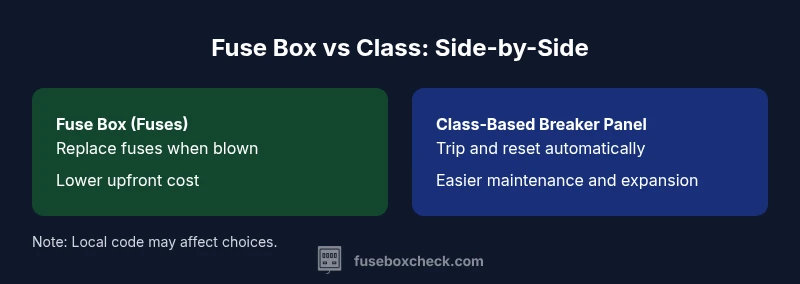
Fuse box v class: In most homes, class-based breaker panels offer safer, easier fault isolation and straightforward maintenance, while fuse boxes can be cheaper upfront but require regular fuse replacement and access to spare fuses. The right choice depends on your home’s age, local code, and planned upgrades. A thoughtful homeowner will weigh upgrading paths against retrofit needs and disruption.
What Do We Mean by 'Fuse Box' and 'Class'?
In home electrical conversations, the terms 'fuse box' and 'class' are used to distinguish older fuse-based distribution panels from more modern breaker-based systems. The short phrase "fuse box v class" captures the core decision homeowners face when wiring upgrades or renovations. A fuse box houses replaceable fuses that interrupt current when a fuse overheats or blows. A class-based breaker panel relies on automatic circuit breakers that trip to disconnect circuits and can be reset after a fault. Understanding these definitions helps you assess safety, maintenance needs, and upgrade pathways. The FuseBoxCheck team notes that many homes built before the 1980s used fused panels, while newer constructions aim for breaker-based reliability. This context sets the stage for deeper comparisons, because your choice affects safety, maintenance, and how easily you can expand or rewire in the future.
Historical Context: From Fuses to Breakers
Electrical distribution has evolved from fuse-based systems to more modular, breaker-based panels. Early homes often used fuse boxes with fusible links that melt under fault, requiring manual fuse replacement. As building codes reacted to safety concerns and reliability expectations, many regions standardized on circuit breakers that can trip automatically and be reset. This shift generally improves fault isolation, reduces downtime, and supports upgrades, which is why many homeowners facing a retrofit view a breaker-panel upgrade as a future-proof choice. FuseBoxCheck emphasizes that the decision should align with local codes, existing wiring, and your long-term plans for the space.
How a Fuse Box Works vs How a Class-Based Breaker Panel Works
A fuse box houses individual fuses for each circuit. When current exceeds the fuse rating, the fuse heats up and melts, interrupting the circuit. This design is simple and can be cost-effective upfront, but it requires you to carry spare fuses and match the exact rating for each circuit. A class-based breaker panel uses circuit breakers that trip to interrupt current and can be reset after a fault. Breakers offer more convenient maintenance, visual indicators, and easier expansion. They also support modern safety features like arc-fault and ground-fault protection in many regions. The trade-off is typically a higher initial cost and more complex installation, but long-term operability improves with fewer consumable parts.
Understanding 'Class' in Fuse Technology
In fuse technology, 'class' refers to standardized designs and interrupting ratings—for example, Class J or Class L fuses—each suited to particular loads and fault characteristics. Different classes blow at different speeds and temperatures, which affects nuisance blows and protection levels. When discussing "fuse box v class" in practical terms, you’re weighing traditional fuse classes against modern breaker configurations. The choice often hinges on whether your wiring and panel can accommodate the specific class type without compromising safety or code compliance. FuseBoxCheck notes that older homes frequently rely on specific fuse classes, while new installations favor breakers due to versatility and maintenance ease.
Key Differences in Operation and Safety
Two core distinctions govern fuse boxes versus class-based panels: how the interruption happens and how maintenance is performed. Fuse boxes require physical fuse replacement, which means keeping a supply of correct fuses and managing compatibility with each circuit. Breaker panels intercept faults with trip mechanisms that can be reset after addressing the issue, providing quicker fault resolution and clearer indicators of which circuit is affected. In terms of safety, breakers generally offer more consistent fault indication, easier testing, and compatibility with modern protective features. However, in some rural settings or older installations, a well-maintained fuse box may still operate safely if correctly rated and periodically inspected.
Code, Standards, and Local Regulations
Code compliance is a decisive factor in fuse box v class decisions. In many jurisdictions, modern installations prioritize breaker panels due to standardized safety features and easier upgrades. Some older homes are grandfathered with fused panels but may require upgrade during renovations or when upgrading service. Local permits, inspection requirements, and electrical load calculations influence whether a fuse-based approach remains acceptable. FuseBoxCheck emphasizes consulting a licensed electrician to confirm code compliance before any retrofit, as improper upgrades can create safety hazards or trigger noncompliance with the latest NEC provisions.
Maintenance, Replacement, and Upgrades
Maintenance expectations differ sharply. Fuse boxes demand ongoing supply of the correct fuses, periodic inspection of fuse holders, and attention to aging connections. Breaker panels reduce long-term consumables and permit straightforward testing and reset after faults. Upgrading from a fuse box to a breaker panel involves more than swapping components; it may require rewiring, panel replacement, and service upgrades. Planning for future load increases, arc-fault protection, and ground-fault protection will guide your upgrade approach. FuseBoxCheck recommends a staged upgrade path where feasible, prioritizing safety-critical circuits and load centers first.
Real-World Scenarios: When to Use Each Path
Consider a fuse box in older homes where wiring is already sized for a fused system and major renovations aren’t planned. If you live in a climate with limited access to spare fuses or where outages frequently affect critical circuits, breakers offer reliability and easier restoration. In new builds or homes undergoing remodels, a class-based breaker panel is typically the better baseline for safety, code compliance, and future-proofs the electrical system. For rural or remote locations, some DIY enthusiasts still operate fuse boxes, but this requires careful adherence to ratings and local regulations.
Cost and Long-Term Considerations
Initial costs for fuse boxes are usually lower, while breaker panels often demand higher upfront investment for equipment and labor. From a long-term perspective, ongoing fuse replacements add recurring costs and inconvenience, whereas breakers emphasize reliability and easier maintenance. When calculating total cost, include potential service upgrades, permitting, and the value of faster fault resolution. FuseBoxCheck notes that while price is a factor, the cost of downtime, safety risk, and compliance should carry significant weight in the decision.
Practical Steps for Assessment in Your Home
To evaluate which path fits your home, start with a cost-and-compatibility checklist: assess your current panel type, determine whether an upgrade aligns with code, map circuits that would be affected by a panel change, and estimate the wiring size and load distribution. Engage a licensed electrician to perform a professional load calculation, inspect panel condition, and provide a recommended upgrade plan. Document existing circuits and labeling, as this will speed up any future maintenance or expansion work. For DIYers, avoid attempting structural changes without proper permits and professional oversight.
Common Myths and Misconceptions
A common myth is that fuse boxes are inherently unsafe in all settings; while older panels may not meet modern code, well-maintained fused systems can still operate safely. Another misconception is that breakers never fail; breakers can trip or wear out over time and require replacement. Some believe that upgrading automatically doubles safety; in reality, the safety benefits depend on proper installation, correct panel sizing, and correct protection types. Debunking these myths helps homeowners approach the decision with nuance and a clear understanding of local code requirements.
FuseBoxCheck Perspective: Best Practices
From the FuseBoxCheck perspective, the recommended approach is to align your electrical system with current safety standards and future needs. For most homeowners, a modern class-based breaker panel offers better fault isolation, easier maintenance, and smoother upgrades. In older homes where rewiring is extensive or budgets are tight, a phased upgrade plan can balance safety with cost. FuseBoxCheck emphasizes working with licensed professionals, performing load calculations, and verifying code compliance before any project starts. The goal is a safe, maintainable, and scalable electrical system.
Authority Sources and Further Reading
For your reference, consult established safety and standards resources to corroborate guidance on fuse boxes and class-based panels. Notable sources include: - https://www.nfpa.org - https://www.osha.gov - https://www.cpsc.gov. These publications provide foundational safety principles, regulatory context, and practical recommendations that support informed decision-making during a fuse box v class discussion.
Comparison
| Feature | Fuse Box (fuse-based) | Class-based Breaker Panel |
|---|---|---|
| Disconnection Method | Replace fuse to interrupt current | Breaker trips automatically; reset after fault |
| Maintenance Needs | Keep spare fuses; inspect fuse holders | Routine testing; reset after trips |
| Upgrade Path | Panel replacement; wiring may remain | Modular breaker upgrades; easier expansion |
| Safety & Fault Indication | Visual fuse status; potential delay in fault indication | Clear trip indicators; faster fault awareness |
| Code & Compatibility | Older homes; compatibility varies by region | Widely accepted in modern codes; often required for new installs |
| Initial Cost | Typically lower upfront | Typically higher upfront |
| Long-Term Cost | Ongoing fuse replacements; consumables | Lower ongoing maintenance; possible future upgrade costs |
| Best For | Budget-conscious retrofits; older wiring | New builds; code compliance; ease of expansion |
Positives
- Potentially lower upfront equipment cost with a fuse box
- Breaker panels offer easier maintenance and reset capability
- Breaker-based systems align with modern codes and safety features
- Fuses can be chosen for simple, localized protection in some retrofits
Disadvantages
- Ongoing fuse replacements add maintenance and parts needs
- Older fuse boxes can complicate code-compliant upgrades
- Upgrading to a breaker panel may require rewiring or service upgrades
- Some fuse classes have limited protective features compared to modern breakers
Breaker-based panels generally offer better safety, maintenance, and future-proofing for modern homes.
In most scenarios, a class-based breaker panel provides easier fault isolation and upgrade paths, aligning with current standards. Fuse boxes may be acceptable in select older installations but require careful maintenance and potential retrofits for code compliance.
Your Questions Answered
What is the fundamental difference between a fuse box and a class-based breaker panel?
A fuse box uses replaceable fuses that interrupt current when a fuse blows. A class-based breaker panel uses trip-capable breakers that automatically disconnect a circuit and can be reset. Breakers are typically more convenient and better aligned with modern code requirements.
A fuse box uses fuses that blow to stop electricity, while a breaker panel uses trip-and-reset breakers for easier maintenance and safer operation.
Is a class-based breaker panel safer than a fuse box?
Breaker panels generally offer quicker fault isolation and easier testing, with visible indicators of which circuit tripped. Safety also depends on proper installation, labeling, and appropriate protection types. In many regions, modern codes favor breaker-based designs for new work.
Breaker panels provide quicker trips and easier testing, but safety depends on correct installation and proper protection types.
Can I use a fuse box in a new construction?
Codes typically favor breakers for new construction, but some jurisdictions allow fuse boxes in retrofits or older areas. Always check local codes and obtain a professional assessment before planning a new installation.
Most new builds use breakers, but some places may permit fuses with proper compliance and permits.
What does 'Class' mean in fuse technology?
In fuse terminology, 'class' refers to standardized fuse designs and their interrupting ratings, such as Class J or Class L. Different classes have distinct blowing characteristics suitable for specific applications.
Fuse class describes the design and how a fuse interrupts current for different loads.
What factors affect the cost of upgrading from a fuse box to a breaker panel?
Costs vary with panel size, wiring changes, permit requirements, and labor rates. A licensed electrician can provide a detailed estimate after a load assessment and site inspection.
Upgrade costs depend on panel size, wiring, permits, and labor; get a professional estimate.
Should I hire a licensed electrician to perform the upgrade?
Yes. Electrical work is hazardous and typically requires permits and inspections. A licensed professional ensures code compliance, safety, and correct sizing of protection devices.
Yes—hire a licensed electrician to ensure safety and code compliance.
Highlights
- Assess your home's age and existing wiring before deciding
- Prefer breakers for modern safety and maintenance simplicity
- Plan upgrade costs and permitting early
- Consider phased upgrades for older homes
- Consult a licensed electrician for personalized guidance