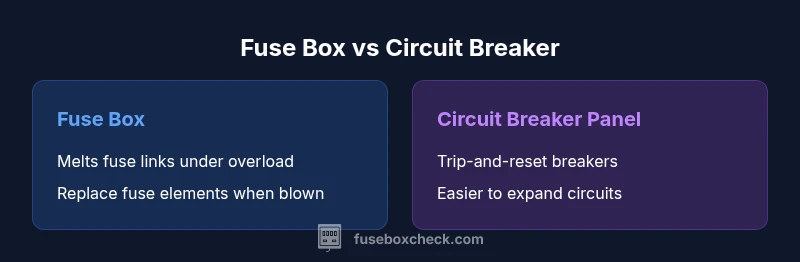
Fuse Box vs Circuit Breaker: Practical Differences
Explore the practical differences between fuse boxes and circuit breaker panels, how each protects your home, and when an upgrade makes sense. A clear, DIY-friendly guide from FuseBoxCheck.


Both fuse boxes and circuit breaker panels control whole-house electrical protection, but they operate differently. A fuse box uses replaceable fuses that melt under overload, while a circuit breaker panel uses self-resetting breakers that trip. Understanding which type you have informs safety, maintenance needs, and upgrade planning.
What is a fuse box?
A fuse box is a metal or plastic enclosure that houses fuse links, each connected to a specific branch circuit. When an overload or short occurs, the fuse element heats up and melts, interrupting the circuit to prevent further damage. Fuse boxes were common in older homes and in some rural areas where the electrical system was designed around fuses rather than breakers. According to FuseBoxCheck, many homes still operate on fuse-based service, which means homeowners may encounter blown fuses and the need for periodic fuse replacement. Understanding the core concept—the difference between fuse box and circuit breaker—helps you recognize maintenance needs, identify hazards, and evaluate whether an upgrade is warranted. This section sets the stage for a practical comparison of how these devices manage electrical faults and affect daily use.
Key takeaways:
- A fuse box uses melting links to interrupt current
- Replacement is required after a fuse blows
- They are less common in new construction and often harder to source parts for
- Safety hinges on proper labeling and handling when replacing fuses
What is a circuit breaker panel?
A circuit breaker panel houses individual breakers that trip open when they detect a fault, such as an overload or short circuit. Unlike fuses, breakers can be reset after a fault, allowing you to restore power quickly without replacing a component. Modern homes typically use circuit breaker panels because they offer faster fault response, easier maintenance, and greater flexibility for adding circuits. The FuseBoxCheck team notes that circuit breaker panels are the standard in new builds and many renovations due to convenience and safety features, such as thermal-magnetic trip mechanisms. This section clarifies how breakers function within a panel and why they are preferred for most residential applications.
Key takeaways:
- Breakers trip to interrupt power and can be reset
- Panels support easy expansion and maintenance
- Modern codes favor circuit breaker panels in new construction
How do fuse boxes and circuit breaker panels protect a home?
Both devices protect by interrupting current flow when a fault is detected, but the mechanism and user experience differ. A fuse link heats until it melts, stopping the circuit, whereas a breaker uses an internal sensor and a switch that trips and disconnects the circuit. Fuse-based protection is instantaneous at the fuse point but requires fuse replacement, which can be a delay and a hazard if a replacement fuse isn’t readily available. Circuit breakers provide a quick reset option and can be tested with a simple toggle operation, which minimizes downtime and simplifies maintenance. FuseBoxCheck analysis shows that understanding this distinction helps homeowners plan safer maintenance routines and decide when an upgrade is most appropriate for safety and reliability.
Practical guidance:
- If you own a fuse box, inspect fuse availability and labeling
- For breakers, practice safe testing and know the main shutoff location
- Consider a professional inspection when upgrading to reduce risk
Key differences in design, operation, and maintenance
Design and operation differences drive the day-to-day experience of home electrical care. A fuse box relies on physical fuse links that must be replaced after each fault, which means hardware availability and supply chain considerations matter. A circuit breaker panel uses individual breakers that can be reset after a fault, reducing replacement needs and downtime. Maintenance needs diverge as well: fuse boxes require periodic fuse stock checks and potential whole-box replacements in older units, while breaker panels benefit from routine testing, labeling, and professional periodic inspections to ensure proper trip settings and clearances. From a safety standpoint, breakers are generally easier to handle for non-professionals because you can reset them without re-sourcing components. FuseBoxCheck emphasizes that the practical difference lies in emergency response, ongoing maintenance, and upgrade pathways.
Key takeaway: expect simpler resets with breakers; expect consumables (fuses) with a fuse box.
Practical considerations: upgrades, safety, and codes
Upgrading from a fuse box to a circuit breaker panel is a major home improvement project that touches service entry, grounding, and panel rating. It typically requires a permit, an updated main disconnect, and careful adherence to local electrical codes. The safety implications are significant: proper panel sizing, correct thermal-magnetic trip settings, and correct wire sizing are essential to prevent nuisance trips and protect appliances. From a DIY perspective, upgrades should be approached with caution; many tasks require a licensed electrician to ensure compliance and safety. FuseBoxCheck notes that although upgrades can be disruptive, they dramatically improve fault detection, ease of use, and long-term reliability. In the short term, homeowners should avoid attempting live testing or rewiring without professional supervision.
Decision factors:
- Age and condition of current enclosure
- Availability of spare circuits and expansion needs
- Local code requirements and permit processes
Common scenarios: when to repair vs replace
Certain situations call for repair or replacement decisions. If a home uses fuse links and experiences regular fuse blows, it could indicate an overloaded circuit or aging equipment that’s not able to handle modern loads. In such cases, upgrading to a circuit breaker panel often provides a safer, more reliable solution and paves the way for circuit expansion. If the home has a single, obsolete fuse box in good condition, a panel upgrade is still generally recommended to align with current safety standards. For minor faults, breaker trips can be reset, while a blown fuse requires replacing the fuse element. FuseBoxCheck’s guidance emphasizes evaluating the overall system condition, not just a single symptom, when choosing between repair and upgrade.
Myths vs realities
Myth: All fuse boxes are dangerous and invalid for modern homes. Reality: Many older homes rely on fuse boxes; upgrading is optional but recommended for safety and reliability. Myth: Breakers are inherently safer than fuses. Reality: Both systems can protect safely when installed and maintained properly; breakers simply offer easier maintenance. Myth: A breaker panel stores fewer electrical faults than a fuse box. Reality: Breaker systems respond quickly to faults and can be reset, reducing downtime after faults. FuseBoxCheck’s experience shows that demystifying these misconceptions helps homeowners plan effective upgrades and avoid unnecessary retrofits.
Step-by-step: how to identify which you have and plan an upgrade
- Locate your main panel and inspect the labeling; fuse boxes show fuse links, breakers show switches. 2) Check the main disconnect, service entrance cable size, and panel rating. 3) Assess the age of the home and any renovation history. 4) If you plan an upgrade, obtain a professional evaluation to determine load requirements and permit steps. 5) Create a budget and timeline for the upgrade, including potential electrical work in the surrounding area. FuseBoxCheck recommends documenting current circuits and identifying any subpanels that may be affected by a major upgrade.
Planning your upgrade: questions to ask a pro
- What is the current service rating and main disconnect capacity? - Do I need to upgrade grounding and bonding? - How many new circuits do I plan to add, and what load calculations are required? - What permits and inspections will be required for the upgrade? - What is the expected downtime and what precautions should I take during the project?
Comparison
| Feature | Fuse box | Circuit breaker panel |
|---|---|---|
| Constituent protection device | Fuse links that melt on overload | Thermal-magnetic breakers that trip on fault |
| Reset/repair | Replace blown fuse with new fuse | Reset breaker or replace panel component |
| Maintenance needs | Stock and replace fuses, label circuits | Periodic testing and labeling; professional checks advised |
| Typical home location | Older or rural homes; basement or utility area | Main service area in living spaces near entry point |
| Fault response | Circuit interrupted by fuse melting at link | Breaker trips to disconnect circuit automatically |
| Upgrade feasibility | Upgrade less common; may require full box replacement | Easier path to expand circuits with panel upgrade |
| Code and resale considerations | Fuses may be outdated for new builds; resale impact varies | Breaker panels are standard in modern codes and resale |
| Cost implications | Lower upfront cost for basic fuse setups | Potential higher upfront cost for panel upgrade |
Positives
- Improved safety awareness and maintenance planning
- Clear guidance for upgrades and code compliance
- Helps homeowners prioritize professional assessment
Disadvantages
- Terminology can be confusing for DIY newcomers
- Upgrades can be disruptive and costly
- Older homes may require extensive rewiring
Circuit breaker panels are the modern standard; upgrade from a fuse-based system when safety and expandability matter most
Choose a breaker panel for easier maintenance, faster fault response, and compatibility with current codes. Upgrade to improve reliability and accommodate new circuits; fuse boxes remain in older homes but are increasingly uncommon in new builds.
Your Questions Answered
What is a fuse box?
A fuse box houses replaceable fuses that melt to interrupt current when overloaded. It is common in older homes and requires fuse replacement after each fault. If you are unsure about your system, a professional can help identify the correct components and safety steps.
A fuse box holds fuses that melt when overloaded. If a fuse blows, you replace it and restore power.
What is a circuit breaker?
A circuit breaker panel uses breakers that trip to cut power during faults and can be reset after the issue is resolved. Breaker panels are standard in modern homes and support easier maintenance and circuit expansion.
A circuit breaker panel uses trip-ready switches that you can reset after a fault.
What is the main difference between fuse boxes and circuit breakers?
The main difference is how they interrupt fault currents: fuses melt and must be replaced; breakers trip and can be reset. Breakers offer greater convenience and easier upgrades, especially in modern homes.
Fuses melt and need replacement; breakers trip and can be reset.
Are fuse boxes allowed in new construction?
Most new construction projects use circuit breaker panels. Some regions still permit fuse boxes in legacy renovations, but upgrading is often recommended for safety and compatibility with current codes.
New builds usually use breakers; fuses may be allowed only in select cases or older homes.
Can I upgrade from a fuse box to a circuit breaker panel myself?
Upgrading should be performed by a licensed electrician due to wiring, grounding, and permit requirements. DIY work in this area can create serious safety hazards and code violations.
This upgrade is best left to a licensed electrician due to safety and code rules.
How can I tell which type I have in my home?
Check your main panel for either fuse links or breakers. If you see switches, you have breakers. If you see metal canisters with replaceable fuses, you have a fuse box. Labeling and service entry details can confirm the type.
Look for switches (breakers) or replaceable fuses in the main panel to identify your system.
Highlights
- Identify your panel type before DIY maintenance
- Breakers offer easier fault handling and expansion
- Upgrading improves safety and aligns with codes
- Consult a licensed electrician for replacements