Is MCB Better Than Fuse? A Practical Comparison
Explore whether an MCB panel is better than a traditional fuse box. We compare safety, cost, maintenance, and real-world scenarios to help homeowners decide the right path for modern electrical upgrades.


The question is "is mcb better than fuse" for many homeowners. A modern MCB panel offers resettable protection, faster and more precise trip curves, and tighter safety standards, making it generally safer and more convenient than legacy fuse systems. The best choice depends on your current panel and local rules.
Background: MCBs vs Fuses — What they are and how they work
Miniature circuit breakers (MCBs) and traditional fuses protect electrical circuits by interrupting current when faults occur. MCBs trip automatically and can be reset, while fuses are single-use devices that must be replaced after they act. In residential panels, MCBs are the modern standard, designed for quick, predictable fault clearance and easier maintenance. The question is "is mcb better than fuse" for most homes? In many cases, yes, because resettable protection minimizes downtime and reduces waste over time. However, older installations may still rely on fuse boxes for compatibility or cost reasons. According to FuseBoxCheck, upgrading from fuses to MCBs often yields better safety margins and easier compliance with current codes, provided the panel accepts MCBs and local regulations permit the upgrade.
Key Differences at a Glance
- Protection and design: MCBs use thermal-magnetic trip mechanisms with predefined curves; fuses rely on a physical element that melts when overloaded.
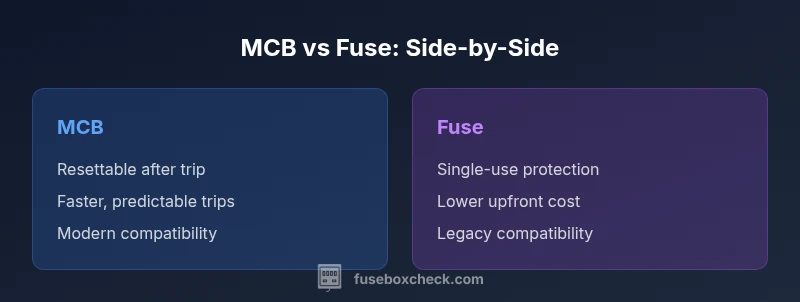
- Reusability: MCBs are resettable after a trip; fuses require replacement after actuation.
- Panel compatibility: MCBs fit modern consumer units; older panels may require complete replacement.
- Maintenance: MCBs reduce ongoing consumable parts; fuses demand ongoing stocking of spares.
- Safety and reliability: MCBs offer predictable tripping and reduced arc risk when sized correctly; fuses can fail in unpredictable ways if mismatched.
- Real-world cost: Upfront costs for MCB upgrades can be higher, but long-term maintenance costs are typically lower. The right choice depends on existing infrastructure and local codes.
Safety and Fault Response: MCBs vs Fuses
Safety hinges on reaction time, predictability, and repeatability. MCBs respond to overloads and short circuits within milliseconds, and they can be reset without replacing parts. This reduces downtime and the chance of mis-wiring during re-energization. Fuses, by contrast, interrupt current by melting a metal link, which is a one-time act and then discarded. While a properly sized fuse can react quickly, the lack of reusability can prolong downtime and complicate fault diagnosis. For homes with frequent load changes or sensitive electronics, MCBs offer clearer protection boundaries and easier restoration. If you’re evaluating options, remember that proper sizing and correct breaker/fuse type are critical to ensuring safety rather than relying on the device alone. For more on safety standards, consult authoritative sources such as NFPA and OSHA.
Longevity, Replacement, and Reliability
MCBs are designed for repeated use and long service life, provided they are kept within their rated range and installed in an appropriate panel. They tend to have durable mechanical components and rely on electronic or magnetic tripping mechanisms that can last many cycles. Fuses have a simpler design but are consumables; each actuation means a new fuse, and the retention of protective function depends on inventory and timely replacement. In practical terms, an MCB system often offers lower long-term maintenance and less downtime, which translates to higher reliability over years in a busy home. However, in very small or historic installations, a fuse-based system might still be acceptable if upgrading is not feasible and if protection standards are maintained.
Cost Considerations and Maintenance
Initial costs for an MCB upgrade include panel changes, wiring checks, and professional installation. While this upfront investment is typically higher than leaving a fuse box in place, ongoing maintenance costs tend to be lower with MCBs. Fuses incur ongoing costs for replacement elements and spare parts, and the downtime associated with fuse actuation can be disruptive. When evaluating total cost of ownership, consider the cost of potential downtime, panel upgrades, and compatibility with future electrical needs such as EV charging or high-demand appliances. FuseBoxCheck notes that while MCBs may demand a larger upfront investment, the lifetime value and safety benefits often justify the expense in modern homes.
Real-World Scenarios: When to Prefer MCB or Fuse
- New builds and major renovations: MCB-based consumer units are the standard for modern construction, offering easier future upgrades and better protection.
- Upgrading old fuse boxes: If the panel is outdated, upgrading to an MCB-based system improves safety, reliability, and code compliance.
- Homes with frequent impedance changes or sensitive electronics: MCBs’ precise trip curves help protect circuits with less nuisance tripping compared to older fuse schemes.
- Historical or very small installations: In some legacy settings, fuses may be cheaper upfront and may still be appropriate, but compatibility with other components should be checked with a licensed electrician.
- Areas with strict local codes: Always verify with local electrical codes and a licensed installer before proceeding with a switch to MCBs.
Upgrading Guidance: How to Switch Safely
Switching from a fuse box to an MCB-based panel is a substantial electrical upgrade that requires professional oversight. Start with a licensed electrician who can:
- Assess panel compatibility and available space for modern MCBs.
- Verify wiring integrity, grounding, and protection devices.
- Obtain necessary permits and schedule inspections to comply with local codes.
- Plan a staged upgrade if a full panel replacement is not feasible, to minimize downtime.
- Ensure that arc fault and ground fault protection requirements are met for added safety.
Prepare for a planned outage during the upgrade and arrange for temporary power if needed. The electrician should provide a written scope of work, estimated timeline, and a post-installation test plan.
Common Pitfalls and Myths Debunked
- Myth: MCBs always eliminate nuisance trips. Reality: Incorrectly sized MCBs can still trip unnecessarily; sizing matters.
- Myth: A panel with MCBs guarantees total protection. Reality: Proper installation, bonding, and grounding are equally important.
- Myth: All fuse boxes can be upgraded to MCBs without panel replacement. Reality: Some older panels aren’t compatible and require a full replacement.
- Myth: Replacing fuses with MCBs is always expensive. Reality: Costs vary by panel type and labor, and long-term maintenance often lowers overall spend.
Further reading and authority references: NFPA (nfpa.org), OSHA (osha.gov), and Energy.gov (energy.gov) provide guidance on electrical safety standards and best practices for residential installations.
Decision Framework: Quick Path to a Choice
When deciding whether to adopt MCBs over fuses, start with a simple checklist:
- Is the current panel compatible with MCBs, and are upgrades permitted by local codes?
- Do you desire resettable protection and faster fault clearance, with lower ongoing maintenance?
- Are you planning a home upgrade (e.g., EV charging, new appliances) that will stress the electrical system?
- What is the total cost of ownership, including labor, potential panel upgrades, and future maintenance?
- Are there safety requirements such as arc-fault or ground-fault protection to consider?
If the panel is compatible, and you seek higher reliability and easier maintenance, an MCB-based upgrade is typically the better long-term choice. If you need to preserve a legacy system or minimize upfront cost, discuss options with a licensed electrician and review local codes before proceeding.
Comparison
| Feature | MCB | Fuse |
|---|---|---|
| Protection Type | Thermal-magnetic trip with predefined curves | Meltable element that interrupts current |
| Reset Capability | Resettable after trip | Single-use; must replace after actuation |
| Reaction Time | Fast, predictable trips | Dependent on fuse rating and current; may vary |
| Upfront Cost | Typically higher due to panel compatibility | Lower per unit; dependent on availability |
| Long-Term Cost | Lower maintenance and stocking of parts | Ongoing fuse replacements and consumables |
| Best For | Modern panels, new builds, easy upgrades | Legacy installations, simple loads, budget focus |
Positives
- Safer operation with precise trip thresholds and reset capability
- Easier maintenance due to reusable protection
- Better compatibility with modern panels and protective devices
- Quicker restarts after trips
Disadvantages
- Higher upfront costs and potential panel upgrades
- Not all old systems are readily compatible without replacement
- MCBs can nuisance-trip if incorrectly sized
- Fuses may be preferred in very specific legacy scenarios
MCB-based protection is generally the better choice for modern homes; fuse-based systems persist in legacy setups where upgrades aren’t feasible.
Choose MCBs for safer, more reliable, and resettable protection in new builds or major renovations. Use a fuse-based system only if you must retain legacy compatibility and local codes permit it, and after a professional assessment.
Your Questions Answered
What is the main difference between MCB and fuse?
An MCB is a resettable protective device that trips on overload, allowing immediate reuse after switching off. A fuse is a one-time device that interrupts current by melting its element and must be replaced after actuation. Proper sizing and installation are essential for both.
MCBs reset after trips, while fuses require replacement; proper sizing and installation are essential for safety.
Is MCB safer than fuse in residential use?
Generally yes, due to precise trip curves and repeatable protection. However, safety depends on correct sizing, proper installation, and adherence to local codes.
Yes, MCBs are usually safer when properly sized and installed.
Can I convert a fuse box to an MCB-based panel?
Yes, but it requires upgrading the entire consumer unit, ensuring compatibility, and complying with local codes. A licensed electrician should perform the upgrade with permits and inspections as needed.
Yes, but you’ll need an electrician and code approval.
Do MCBs trip slower or faster than fuses?
MCBs generally trip faster and more predictably than fuses, which depend on the fuse rating and current conditions. Proper sizing minimizes nuisance trips.
MCBs trip faster and more predictably when correctly sized.
Are there cost differences for retrofit?
Costs vary by panel type and labor. Upfront upgrades to MCBs are typically higher, but long-term maintenance and downtime costs can be lower.
Costs vary; upfront may be higher, long-term maintenance often lower.
Are there reliability concerns with MCBs?
Modern MCBs are reliable when correctly sized and installed. Potential issues include nuisance trips if the circuit is misdesigned, but failures are uncommon with proper use.
Generally reliable with proper sizing and installation.
Highlights
- Assess panel compatibility before deciding
- MCBs offer resettable protection and faster trips
- Fuses may be cheaper upfront but require ongoing replacements
- Consult a licensed electrician for upgrades and code compliance