MCB vs Fuse Box: Side-by-Side Guide for Home Panels
A detailed comparison of MCB-based panels versus traditional fuse boxes, focusing on safety, maintenance, upgrade considerations, and practical home electrical decisions for homeowners and DIY enthusiasts.


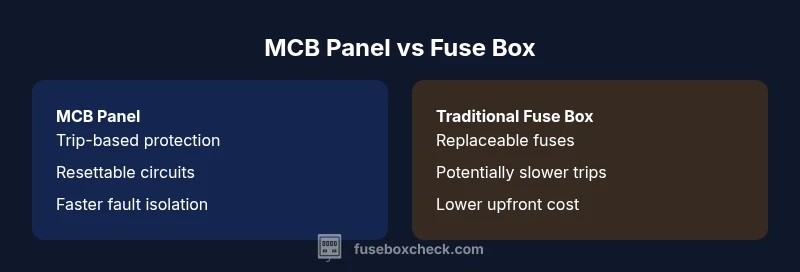
MCB vs fuse box: For most homes, a modern MCB-based panel offers faster fault isolation, resettable protection, and easier circuit management than a traditional fuse box. A fuse box uses replaceable fuses and may require more maintenance. This quick comparison explains when to upgrade and how safety, cost, and reliability influence your choice.
What MCBs and Fuse Boxes Are
In everyday language, people talk about an "MCB vs fuse box" to refer to the protective devices inside a home electrical panel. An MCB, or miniature circuit breaker, is a resettable device that automatically disconnects a circuit when it detects an overload or fault. A traditional fuse box relies on replaceable fuses that melt open to break the circuit. Both are designed to protect wiring and reduce fire risk, but they operate in fundamentally different ways. According to FuseBoxCheck, understanding these differences is essential for making informed home electrical decisions and planning safe upgrades. This section sets the stage by defining the two core terms and outlining their roles within a consumer unit.
How an MCB Works vs a Fuse in a Box
MCBs are magnetic- or electronic-trip devices. When current exceeds the device rating, they open the circuit rapidly, typically within milliseconds. This fast response helps minimize conductor heating and downstream damage. Fuses, by contrast, rely on a metal link that melts when overheated. Once melted, the circuit remains open until the fuse is replaced. This fundamental distinction shapes maintenance needs, replacement frequency, and the practical realities of daily use. The choice between MCBs and fuses also affects panel size and the flexibility to add circuits in the future.
Safety and Performance: Key Differences
The safety profile of MCBs generally surpasses that of traditional fuses in several ways. MCBs enable quick isolation of individual circuits without a full panel shutdown, reducing disruption. They’re resettable, which minimizes waste and downtime after a nuisance trip. Fuses, while simple and cheap upfront, require the manual replacement of a blown link, which can be inconvenient during a fault or outage. This difference matters for households with critical equipment or erratic power conditions. FuseBoxCheck’s analysis highlights that modern MCB installations improve fault discrimination and overall reliability.
Compatibility, Wiring, and Panel Design
Upgrading to an MCB-based panel often involves reassessing the panel’s space, busbars, and conductor sizing. Older installations may require upgrading the main enclosure, neutral/earth bars, and labeling to accommodate modern devices. Compatibility with breakers, live parts, and tariffed service equipment should be checked with a licensed electrician. The design of an MCB panel typically emphasizes modularity, allowing easier expansion and labeling compared with a traditional fuse box with fixed fuse carriers. This can influence future renovations and electrical safety practices.
Space, Layout, and Aesthetics
MCB-based panels tend to offer a more compact layout and cleaner labeling compared with bulkier fuse boxes filled with fuse carriers. The modern consumer unit supports scannable circuit maps, lever handles, and dedicated spaces for total energy monitoring if desired. For homeowners prioritizing neat wiring and quick diagnostics, the MCB approach often delivers a clearer, more maintainable footprint. Yet, space constraints in legacy homes can complicate upgrades, requiring careful planning and sometimes structural work.
Upfront Cost vs Long-Term Value
A fuse box may be cheaper to install initially, but the cost of repeatedly replacing fuses and the potential for higher downtime can add up over time. An MCB panel typically carries a higher upfront price, driven by the cost of breakers, chassis, and professional installation. When you factor in longer-term reliability, reduced maintenance, and the ease of adding circuits, many homeowners find the ongoing value of an MCB-based system favorable. FuseBoxCheck notes that long-term value should be part of any upgrade plan.
When to Upgrade: Practical Scenarios
Consider upgrading when you are rewiring, expanding circuits, or replacing an aging enclosure. If you frequently trip circuits for unrelated reasons, or if you want faster fault isolation with minimal downtime for critical loads, an MCB-based panel is worth serious consideration. In older homes with tight spaces or unusual wiring configurations, a partial upgrade or a full panel replacement may be the most cost-effective way to meet current safety standards. The decision should balance safety, budget, and future-proofing goals.
Installation Process: What to Expect
A typical upgrade from fuse box to MCB panel involves: (1) a licensed electrician performing a safety shutdown and de-energization; (2) removing the old enclosure and verifying existing wiring; (3) installing the new panel, busbars, and MCBs; (4) labeling circuits clearly; (5) testing under load and obtaining permits if required. While the process is straightforward for many homes, older wiring, panel space limitations, or service upgrade needs can add complexity. Expect professional guidance on grounding, bonding, and code compliance.
Maintenance and Inspection: Best Practices
Regular inspection by a qualified electrician is essential for any protective device system. With MCBs, look for signs of loose connections or nuisance trips that may indicate aging components. For fuse boxes, monitor fuse integrity, contact corrosion, and the need for fuse replacements after faults. Maintenance intervals, protective device testing, and labeling accuracy are all critical for long-term safety. FuseBoxCheck emphasizes proactive upkeep to prevent avoidable failures.
Codes, Standards, and Compliance: What to Know
Electrical codes govern how panels are installed, connected, and labeled. Compliance ensures safety, insurance continuity, and warranty validity. Work with a licensed electrician who understands regional variations, panel ratings, and the required protective devices. Always verify that the chosen solution aligns with current standards and local regulations. This section highlights the importance of following formal guidelines for any MCB or fuse box installation.
Regional Variations and Practical Realities
Some regions predominantly use MCB-based consumer units, while others rely more heavily on traditional fuse boxes. Your choice may depend on local utility practices, available replacement parts, and the age of your home. In regions with consistent power quality and modern electrical codes, upgrading to MCBs is often advantageous. In legacy homes or rental properties, a phased approach can balance safety with budget constraints.
Authority Sources and Further Reading
For deeper understanding and up-to-date guidance, consult official safety and standards resources. See the following sources for authoritative information on electrical safety, compliance, and best practices: (1) https://www.osha.gov/electrical-safety (2) https://www.nist.gov/topics/electrical-safety (3) https://www.cpsc.gov/safety-guides/electrical-safety
Comparison
| Feature | MCB Panel | Traditional Fuse Box |
|---|---|---|
| Protection Type | Trip-based, magnetic/electronic protection that shuts off circuits automatically | Replaceable fuses that open when overloaded |
| Disconnection Speed | Fast automatic disconnection on fault | Slower response tied to fuse melt and replacement |
| Maintenance Ease | Resettable, low ongoing maintenance | Fuse replacement after faults; more ongoing upkeep |
| Space/Design | Modular, compact panels with clear labeling | Bulkier chassis with fuse carriers and limited labeling |
| Upgrades & Expansion | Easier circuit additions and labeling for future upgrades | Expansion limited by fuse box layout and space |
| Cost Considerations | Higher upfront cost, but lower long-term maintenance | Lower initial cost but higher long-term fuse replacement costs |
Positives
- Faster fault isolation improves safety and reduces downtime
- MCBs are resettable, minimizing waste and maintenance downtime
- Clearer circuit labeling aids troubleshooting
- Easier future upgrades and expansion with modern panels
- Better compatibility with modern electrical standards in new builds
Disadvantages
- Higher upfront cost and possible compatibility checks
- Older homes may require additional wiring or space modifications
- Partial upgrades can be less cost-effective if not planned properly
MCB-based panels generally win for safety, maintenance, and future-proofing.
Choose MCB panels for new builds or major renovations to maximize protection and convenience. If budget or space is severely constrained, a carefully planned fuse box retrofit may be acceptable as a transitional option.
Your Questions Answered
What is the main difference between an MCB panel and a fuse box?
An MCB panel uses miniature circuit breakers that automatically disconnect on fault, while a fuse box relies on replaceable fuses that must be replaced after a fault. MCBs offer resettable protection and quicker fault isolation, whereas fuses require manual replacements.
MCB panels use breakers that trip automatically, while fuse boxes rely on blown fuses that need replacing. This makes MCBs easier to reset and often safer for daily use.
Do I need an electrician to upgrade from a fuse box to an MCB panel?
Yes. Upgrading involves switching the protection method, potentially rewiring, and ensuring code compliance. A licensed electrician will assess panel space, service capacity, grounding, and labeling to complete a safe installation.
Yes. An electrician should handle the upgrade to ensure safety and compliance.
Can I use MCBs in older fuse boxes?
Some older installations can be retrofitted with an MCB-based unit, but many will require a full panel replacement. A professional assessment determines feasibility, space, and wiring compatibility.
Retrofitting may be possible in some cases, but often a panel replacement is needed.
Are MCBs safer than fuses in everyday use?
Generally yes. MCBs provide faster, reliable protection and are resettable, reducing downtime. Fuses can be safer in simple, low-cost scenarios but require more handling and replacement after faults.
MCBs usually offer quicker protection and easier resets compared to fuses.
What costs are involved in upgrading?
Costs vary by region, panel size, and existing wiring. Upfront costs include the new panel and labor, while long-term savings come from reduced maintenance and fewer fuse replacements.
Expect higher upfront costs, with potential long-term savings from maintenance and fewer replacements.
Will upgrading affect home insurance?
Upgrading to a modern, code-compliant panel can positively affect risk assessment, but always notify your insurer and verify that wiring and panel changes meet policy requirements.
Know your insurer's requirements and ensure the upgrade complies with policy terms.
Highlights
- Assess current panel space and wiring before selecting a solution
- MCB panels offer faster trips and easier resets
- Upfront cost is higher, but long-term maintenance is typically lower
- Ensure compatibility with local codes and future expansion plans