How to replace fuse box with a consumer unit
Step-by-step guide to safely replace a fuse box with a modern consumer unit. Learn planning, safety, and when to hire a licensed electrician for compliance and peace of mind.


Replacing a fuse box with a consumer unit is a major electrical upgrade that enhances safety and circuit capacity. This high-risk task requires careful planning, code-compliant wiring, and proper protective equipment. If in doubt, hire a licensed electrician. This guide covers planning, materials, and essential precautions.
Why replace fuse box with consumer unit
Upgrading to a modern consumer unit is a practical way to improve electrical safety, reliability, and capacity for today’s devices. A consumer unit typically includes residual-current devices (RCDs) and multiple mini-circuit breaker (MCB) slots that isolate faults quickly, reducing the risk of fire and electric shock. Replacing an older fuse box can also simplify future wiring changes and support integration with smart-home devices that draw varying loads. According to FuseBoxCheck, a well-planned upgrade can reduce nuisance tripping and improve overall protection, but it must be executed with strict adherence to local codes and safety standards. If your current panel is ancient, frequently trips, or struggles to feed new circuits, a consumer unit upgrade is a wise long-term investment for home safety and energy management.
This section will help you understand why upgrading matters and what outcomes you can expect when you choose to replace your fuse box with a consumer unit.
Key features of a modern consumer unit
A contemporary consumer unit offers several safety and convenience benefits over a traditional fuse box. Look for RCD protection (which trips when a fault to earth is detected), MCbs for individual circuits, a main switch for emergency shut-off, and clear labeling for all circuits. Some units include RCBOs (combining RCD and MCB functions) for added fault protection on individual circuits. Space for future expansion, tamper-resistant shutters, and properly rated wiring compartments are also valuable. Choosing the right unit involves matching the service capacity to your home’s loads and ensuring compatibility with your distribution board, earth bonding, and neutral barriers. A well-chosen unit reduces nuisance tripping, simplifies maintenance, and supports safer upgrades in the future.
Understanding these features helps you select a unit that fits your home’s needs and local regulations.
Planning and compliance considerations
Before touching any wiring, plan the scope of the upgrade and verify compliance requirements. Check whether a permit or inspection is required in your jurisdiction and whether your local building authority mandates a professional installation. Verify that the service head and incoming supply can support a new consumer unit, and confirm ratings for voltage, frequency, and fault protection. Document existing circuits, labeling, and meter arrangements to aid the planning phase. FuseBoxCheck Team emphasizes that most homeowners should treat this as a regulated electrical project due to safety and code implications. Involving a qualified electrician early in the planning process can prevent costly missteps and ensure the work adheres to the latest electrical codes and standards.
This planning phase is vital to avoid surprises during installation and to ensure your new unit integrates smoothly with your home's electrical system.
Safety prerequisites before you begin
Safety is non-negotiable when replacing a fuse box with a consumer unit. Begin by isolating the property’s main power supply and confirming de-energization with a tester. Wear appropriate PPE: safety glasses, insulated gloves, and non-slip footwear. Keep liquids away from the work area and ensure children or pets are kept out of reach. Never work on a live circuit; if you detect warmth, burning smells, or sizzling sounds, stop immediately and consult a professional. Create a clear workspace with ample lighting, and have a fire extinguisher rated for electrical fires nearby. If you feel uncertain at any point, pause and seek professional help. The safest approach is to plan thoroughly, proceed methodically, and rely on qualified expertise for critical steps.
This block emphasizes practical safety measures and the mindset required for a high-stakes electrical upgrade.
Assessing compatibility and load calculations
A successful upgrade starts with compatibility checks and load assessments. Determine the existing service capacity (main fuse rating or service head rating) and compare it to the proposed consumer unit’s requirements. Calculate the expected load by summing major appliances, heating systems, and lighting to ensure the new unit won’t exceed the supply. If you’re upgrading in an older home, be cautious of degraded wiring, undersized cables, or corroded connections that could limit new equipment. In some cases, a service upgrade from the utility may be required to deliver higher amperage to the panel. Engage a professional to perform precise calculations and to verify whether any neutral or earth bonding upgrades are necessary. This step minimizes the risk of overloading and improves long-term reliability.
Accurate load calculations are essential for safe operation and code compliance.
The practical replacement process (high-level overview)
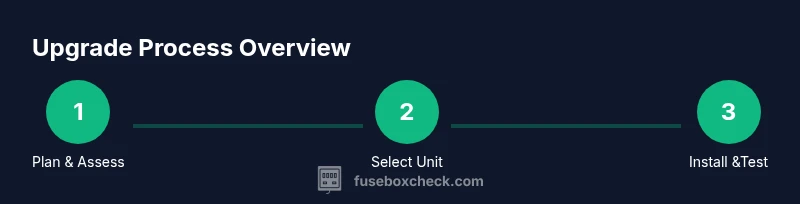
The replacement involves removing the old fuse box, preparing the space for the new consumer unit, and safely routing all circuit conductors into the new panel. The process typically includes mounting the unit, connecting the main supply, transferring and labeling branch circuits, and verifying all earth and neutral connections. Modern installations require proper isolation, RCD/MCB protection, and careful segregation of earth, neutral, and bonding conductors. Although this overview outlines the phases, the actual work involves precise measurements, cable sizing, and compliance checks that are best performed with the right tools and training. FuseBoxCheck recommends planning for contingencies (such as additional cable length or spare breaker spaces) to accommodate future needs while maintaining safety.
This section provides a high-level map of the physical work involved and the critical touchpoints to monitor during replacement.
Aftercare: testing, labeling, and inspection
After wiring is complete, perform a careful test regime to confirm correct operation and protection. Use a voltage tester to verify power is isolated before handling conductors, then test each circuit by turning on the main switch and sequentially enabling RCDs/MCBs. Label each circuit clearly and preserve a space for recording inspection dates. Arrange an official inspection if required by local regulations; an approved electrician or electrical inspector will validate compliance and safety. Maintain documentation for future reference, including wiring diagrams and the unit’s model number. A thorough post-installation check is the final safeguard against faults and miswiring.
Labeling, testing, and inspection are essential steps that ensure long-term safety and code adherence.
Common mistakes to avoid
Avoid common pitfalls that compromise safety and compliance. Do not reuse old or damaged cables, misconfigure RCDs/MCBs, or neglect proper earth bonding and neutral termination. Skimping on labeling or rushing the wiring layout increases the risk of confusion and errors during future work. Do not attempt a replacement if you’re unsure about service head capacity or if local regulations require a licensed electrician. Planning, patience, and adherence to standards minimize risk. FuseBoxCheck’s guidance emphasizes purposeful preparation, accurate calculations, and verified connections to ensure the upgrade meets modern safety expectations.
This section highlights practical missteps to prevent during a complex upgrade.
When to hire a qualified electrician
If you are unsure about any step—especially disconnection of the main supply, main-lug connections, or bonding—hire a licensed electrician. An electrician can perform load calculations, confirm service head compatibility, and handle permits or inspections when required. In some jurisdictions, a DIY approach is not permitted for this type of work. If your home has an old service drop, aluminum wiring, or a history of electrical problems, professional oversight is particularly important. The goal is to ensure safety, reliability, and compliance with current electrical codes. Investing in a professional assessment upfront saves time and reduces risk in the long run.
Authority sources
- https://www.osha.gov/electrical-safety
- https://www.energy.gov/articles/electrical-safety
- https://www.nfpa.org/
These sources provide foundational electrical safety guidance and code-related context to support the upgrade process.
Summary of local considerations
Always verify local permit requirements and inspection procedures before starting. Code rules can vary by region, and some areas require a licensed electrician for panel upgrades. Planning for permits, inspections, and compliance from the outset helps ensure a smooth process and long-term safety.
Tools & Materials
- Non-contact voltage tester(Verify circuits are de-energized without contact)
- Insulated screwdriver set(Flat and Phillips #2, insulated to 1000V)
- Wire strippers and cable cutters(Accurate sizing for 1.5–2.5 mm2 and larger conductors)
- Multimeter or voltage tester(For precise voltage verification)
- PPE (safety glasses, insulated gloves)(Personal protection for all live-conductors work)
- Lockout/Tagout kit(If available, to secure the main supply)
- New consumer unit with required ratings(RCD/MCB arrangement and space for future circuits)
- Appropriate wiring cables and connectors(Correct gauge and insulation for the service)
- Electrical adhesive labels and marker(Clear circuit labeling)
- Fire-rated cable clips and cable clamps(Secure and organize cables in the enclosure)
Steps
Estimated time: 6-12 hours
- 1
Plan and assess, then gather tools
Assess your service head capacity, planned circuit loads, and future needs. Gather all tools and a replacement unit sized for your home. This planning reduces surprises during the install.
Tip: Take photos of the existing layout for reference. - 2
Isolate power and verify de-energization
Shut off the main supply at the meter or main switch, then verify absence of voltage on all circuits with a tester.
Tip: Double-check with a non-contact tester on several points. - 3
Remove the old fuse box
Carefully detach the existing unit, label each circuit, and detach cables with care. Do not pull cables blindly; plan for re-routing.
Tip: Label every conductor and take a wiring diagram photo. - 4
Inspect cables and bonding provisions
Inspect for damaged insulation, corrosion, or overheating. Check earth bonding and neutral bars for secure connections.
Tip: Replace any damaged cable segments before proceeding. - 5
Mount the new consumer unit
Secure the new unit to a suitable wall, ensuring a solid backing and proper clearance. Pre-wire internal terminations only if recommended by the manufacturer.
Tip: Use correct fixings and keep cable runs neat. - 6
Connect the main supply to the new unit
Connect the incoming feed to the main switch, following the manufacturer’s wiring diagram. Ensure the supply conductor size is correct for the service.
Tip: Do not over-tighten terminals; use a torque wrench if provided. - 7
Wire branch circuits into RCD/MCB sections
Organize circuits into protected groups, ensuring correct wiring polarity and secure terminations. Leave room for future expansion.
Tip: Label each circuit clearly as you go. - 8
Check earth, neutral, and bonding
Ensure proper bonding and neutral connections. Verify there are no earth-neutral faults within the enclosure.
Tip: Keep earths and neutrals isolated from live parts. - 9
Test, label, and finalize documentation
Restore power, perform functional tests, and verify RCD/MCB operation on each circuit. Label circuits and record the installation details for future reference.
Tip: Keep a copy of the wiring diagram with the panel.
Your Questions Answered
Is it legal for a homeowner to replace a fuse box with a consumer unit?
In many regions, electrical work of this complexity requires a licensed electrician and permits. Check local codes and authorities before starting any work.
In many places you’ll need a licensed electrician and proper permits for a panel upgrade.
What is the main difference between a fuse box and a consumer unit?
A consumer unit provides RCD/MCB protection and better fault isolation, while a traditional fuse box uses fuses as protection. The modern unit improves safety and troubleshooting.
A consumer unit uses fuses or breakers plus RCD protection, giving better fault handling than older fuse boxes.
What are the biggest safety risks during replacement?
Electric shock, arc flash, and fire are the main risks if devices are re-energized improperly, connections are loose, or cables are damaged.
The main risks are electric shock, fires, and arc flash if you mishandle live parts.
How long does a typical consumer unit replacement take?
Time varies with house size and existing wiring, but a typical upgrade can span several hours to a full day under professional supervision.
Usually several hours to a full day depending on the home and wiring.
Will I need permits and inspections?
Permits and inspections are common requirements in many areas to ensure compliance with electrical codes. Check with your local authority.
Most places require permits and an inspection for a panel upgrade.
When should I replace the fuse box rather than upgrade gradually?
If the panel is old, shows signs of overheating, or cannot handle modern loads, a complete replacement is typically safer and more reliable than piecemeal upgrades.
If it’s old or overloaded, replacing is safer than piecemeal upgrades.
Watch Video
Highlights
- Plan the upgrade before touching wiring
- Prioritize safety and compliance at every step
- Engage a licensed electrician for permit and inspection needs
- Label circuits clearly and document the layout