Is It Safe to Turn Off Your Fuse Box? A DIY Guide Now
Learn when and how it's safe to turn off a fuse box, with practical steps, safety gear, and tips to avoid common mistakes. FuseBoxCheck guides homeowners through the correct process for safer power-downs in 2026.


Is it safe to turn off your fuse box? In most homes, yes, when done correctly for the right reasons. Use the main disconnect when possible and verify loss of power with a tester. Never touch live components, and call a licensed electrician if you’re unsure.
Safety baseline: is it safe to turn off the fuse box?
Many home maintenance tasks, from replacing a burnt outlet to addressing a tripping breaker, require shutting down power. The core question—is it safe to turn off the fuse box—has a straightforward answer: yes, with proper precautions. Power-downs reduce the risk of electric shock and arc flash when you’re working on wiring, outlets, or appliances. However, safety hinges on using the correct shut-off, testing for zero voltage, and avoiding wet conditions or damaged panels. The goal is to minimize exposure to live metal and to prevent accidental energization of circuits while you work. FuseBoxCheck emphasizes that preparation and respect for electricity are the foundations of any safe power-down.
Prerequisites: what you should have before you touch the panel
Before approaching the fuse box, gather PPE and tools, ensure the area is dry, and set expectations for a careful process. Wear dry, non-conductive footwear and insulated gloves rated for electrical work. Keep a flashlight handy and remove jewelry or conductive items. If you have any suspicion of moisture, smoke, or scorching noises, pause and seek professional help. A calm, methodical approach reduces risk and makes the process safer for everyone nearby.
Understanding the panel: main disconnect vs. branch circuits
Older homes may use a fuse box with individual fuses, while newer installations use circuit breakers. The main disconnect is a master switch that interrupts power to the entire panel, whereas branch switches control individual circuits. Knowing which one to flip depends on your task. If you’re addressing a single faulty circuit, turning off that specific breaker minimizes disruption to the rest of the house. If there’s a broad hazard or you’re performing major wiring work, the main disconnect is often the safer starting point. Always identify the precise switch before flipping any lever or button.
When to switch off the main disconnect vs individual circuits
For routine maintenance—like replacing a malfunctioning outlet or inspecting a breaker box—start with the main disconnect only if you must halt all power for safety. If you’re addressing a single circuit that routinely trips or shows signs of damage, turn off that circuit’s breaker first. In households with arc-fault or GFCI protection, triage may involve multiple breakers, but flipping a single, known-off circuit is a safer first step than disabling the main without necessity. FuseBoxCheck notes that methodical, deliberate power-downs reduce risk significantly.
How to act during an electrical emergency
If you smell burning, hear sizzling sounds, or see sparks, do not touch metal parts. If you can safely access the main disconnect, switch off power to the entire panel immediately to cut the source of hazard. Keep others away from the area and call emergency services if the hazard is ongoing or severe. After the initial shut-off, contact a licensed electrician to assess the cause before you restore power.
Verifying power-down and safer re-energizing
After you switch off the power, verify zero energy with a non-contact tester or a voltage meter, confirmed at multiple points in the panel. Wait a moment to let any residual charge dissipate, then proceed with the planned task. When you’re ready to restore power, turn circuits back on in the reverse order of how you turned them off, and test each circuit for proper operation before closing the panel door. If you notice any abnormal warmth, buzzing sounds, or breaker trips, stop and call a professional.
Common mistakes to avoid and best practices
- Avoid working on a wet surface or with wet hands; never stand on damp floors while handling a fuse box.
- Don’t bypass safety fittings or remove panel covers without PPE and clear rationale.
- Don’t rely on a panel light as a power indicator; always test with a proper meter.
- Don’t flip switches if you aren’t sure which circuit they control. Identify circuits with labels or a panel map.
- Do not rush. Slow, deliberate actions minimize shocks and missteps. FuseBoxCheck’s guidance stresses patience and preparedness as keys to safe power-downs.
Authority references and professional resources
For authoritative guidance on electrical safety, consult recognized sources. See OSHA’s electrical safety resources and CPSCs home electrical safety information for consumer-facing tips, in addition to general electrical safety best practices from Energy.gov. These references provide context beyond DIY steps and emphasize safe handling, PPE, and when to involve professionals. FuseBoxCheck encourages homeowners to treat these guidelines as baseline safety standards.
Authoritative references and professional resources (continued)
- OSHA electrical safety: https://www.osha.gov/electrical-safety
- CPSC home electrical safety: https://www.cpsc.gov/safety-information/home-electrical-safety
- Energy.gov electrical safety: https://www.energy.gov/eere/buildings/articles/electrical-safety
Tools & Materials
- Insulated rubber gloves (class 0-2)(Electrical work should be performed with proper insulation rated gloves.)
- Non-contact voltage tester(Use to verify absence of live voltage before touching components.)
- Voltage tester with lights(Helpful for quick checks in dim areas.)
- Flashlight(Keep hands free; use with PPE in low-light spaces.)
- Screwdrivers (flat-head and Phillips)(Use insulated handles; avoid metal jewelry on panels.)
- Safety glasses(Protect eyes from arc or debris.)
- Non-conductive footwear(Slip-resistant and dry for stability.)
- Dry hands, dry surroundings(Keep environment free from moisture before starting.)
Steps
Estimated time: 30-60 minutes
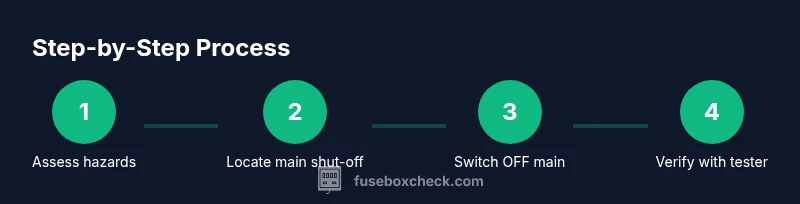
- 1
Assess hazards before touching
Scan the area for moisture, smoke, unusual smells, or visible damage. If any hazard is present, do not proceed and call a licensed electrician or emergency services as needed.
Tip: Stand on a dry, non-conductive surface and keep a partner nearby. - 2
Locate the main power shut-off
Find the main disconnect or main fuse switch for the panel. Read the panel label to identify which lever controls the entire system vs. individual circuits.
Tip: Use a flashlight; do not rush to force a switch that feels stiff. - 3
Switch the main disconnect to OFF
If you can safely reach the main switch, rotate or flip it to OFF fully. Do not handle live components or try to pry stuck switches.
Tip: Apply steady, firm pressure; if it won't move easily, stop and seek professional help. - 4
Verify energy is off with a tester
Use a non-contact tester or voltage meter to confirm no voltage is present at the panel and outlets you’ll touch next.
Tip: Test at multiple points to ensure complete de-energization. - 5
Proceed with your task or call for help
If the panel is de-energized and the area is safe, carry out the planned maintenance. If you’re unsure at any point, stop and call a pro.
Tip: Never override fault indicators or bypass safety devices. - 6
Restore power safely after completion
Turn circuits back on in the reverse sequence of how you turned them off. Confirm each circuit returns to normal operation before closing the panel.
Tip: If a breaker trips again, leave the panel closed and contact a licensed electrician.
Your Questions Answered
Is it safe to turn off the fuse box during a storm?
During a storm, turning off the main disconnect can reduce risk of electrical surges. Do not stand on wet surfaces or touch damp panels. If you’re unsure, wait for safer conditions or consult a professional.
During a storm, you can turn off the main disconnect to reduce surges, but avoid working on wet surfaces. If in doubt, wait or call a pro.
When should I use the main disconnect versus an individual breaker?
Use the main disconnect only when you need to de-energize all circuits or address a broad hazard. For routine work on a single circuit, turning off that circuit’s breaker is usually safer and less disruptive.
Use the main disconnect for all-power shutdowns; for single-circuit tasks, shut off the specific breaker.
What if I smell burning or see smoke from the panel?
If you smell burning or see smoke, switch off power immediately if safely accessible and call emergency services. Do not touch the panel or exposed wiring.
If you smell burning or see smoke, power down if safe and call emergency services.
Do I need an electrician for basic fuse box checks?
For routine checks, a homeowner with proper PPE can perform safe, non-invasive tasks. If you’re unsure about the panel type, the wiring condition, or you encounter burning smells, contact a licensed electrician.
If you’re unsure, it’s best to call a licensed electrician.
What safety gear is essential when working near the fuse box?
Essential gear includes insulated gloves, safety glasses, dry footwear, and a flashlight. Keep metal jewelry away and work on a dry surface.
Wear insulated gloves, safety glasses, and keep the area dry.
Can turning off the fuse box reset arc-fault or GFCI trips?
Turning off the main or a branch can reset trips by removing power, but repeated trips may indicate a wiring issue. Do not bypass protective devices; consult a professional if trips recur.
Turning off can reset trips, but recurring trips mean you should get a professional check.
Watch Video
Highlights
- Assess hazards before touching the panel.
- Know the difference between main disconnect and branch circuits.
- Test for zero voltage before and after working.
- Use proper PPE and follow a calm, step-by-step plan.
- Call a licensed electrician for unknown hazards or complex tasks.