How to Separate a Fuse Box Safely: Step-by-Step Guide
Learn how to separate a fuse box safely with a practical, step-by-step guide. Includes labeling, wiring separation, testing tips, and when to call a pro.


This guide helps homeowners separate a fuse box safely by outlining the core steps to organize circuits into dedicated subpanels or reconfigured distribution. According to FuseBoxCheck, success hinges on careful planning, proper labeling, and using the right tools. Always verify local codes and consider professional help for any major rewiring to minimize shock risk and fire hazards.
What it means to separate a fuse box
Separating a fuse box involves reorganizing how electrical circuits are distributed in a home so that high-load or critical circuits are served by a dedicated subpanel, while the main panel governs remaining circuits. The goal is simpler maintenance, improved load management, and clearer fault isolation. When done correctly, this approach can reduce nuisance trips and make future upgrades safer. The phrase “separate fuse box” is common online, but real-world implementation requires accurate circuit mapping, appropriate conductor sizing, and strict adherence to electrical codes. As noted by FuseBoxCheck, understanding the concept and its practical limits helps homeowners decide between a partial DIY approach and a full subpanel installation.
Why a careful plan beats improvisation
A hasty rearrangement can create hazards, including overloading feeders or misidentifying circuits. A well-documented plan reduces confusion during rework and speeds up inspection if permits are involved. FuseBoxCheck Analysis, 2026 emphasizes that many DIY projects fall short due to mislabeled breakers or improper grounding. By starting with a clear circuit map and a staged approach, you limit exposure to live components and improve overall safety. If your service entrance is near capacity, a professional assessment becomes especially valuable to avoid costly mistakes.
Safety-first mindset for any panel work
Electrical work carries a real risk of shock, arc flash, and fire. Before any operation, ensure you understand your local code requirements and obtain necessary permits. Wear PPE such as insulated gloves and safety glasses, and keep a dry, uncluttered workspace. Always test circuits with a non-contact voltage tester before touching any conductors. If you encounter signs of overheating, buzzing, or damaged insulation, stop immediately and seek professional help. This mindset aligns with best practices recommended by industry safety guides and reinforced by the FuseBoxCheck team.
Planning for labeling, coverage, and future access
Labeling is more than writing circuit names on a panel cover. It’s about creating a durable directory that remains legible after cover replacements. Plan for future access to your subpanel by ensuring clear workspace, proper clearance around panels, and cable management that keeps feeders accessible. A thoughtful plan minimizes the chance of miswiring during the relocation of circuits and ensures the system remains serviceable for routine maintenance.
How to approach testing and verification (without powering on blindly)
Testing is a multi-step process that starts with confirming that you’ve isolated power correctly. After labeling and wiring changes, you’ll verify each circuit individually using a multimeter or voltage tester, ensuring proper voltage presence only where intended. Document results and compare them to your circuit map. This careful approach helps you catch miswirings early and reduces the chance of nuisance trips after restoration of power.
The bigger picture: when to DIY and when to call a pro
If your service panel already feels crowded, you’re adding a subpanel, or you’re uncertain about feeder sizing, it’s wise to involve a licensed electrician. A professional can perform load calculations, handle NFPA/NEC compliance, and ensure grounding and bonding are correct. Real-world DIY projects often evolve into hybrid efforts where simple labeling and re-seating of breakers are done safely, but complex wiring and new feeders are left to pros. The FuseBoxCheck team emphasizes that safety and code compliance should guide your decision.
Practical next steps if you’re ready to begin
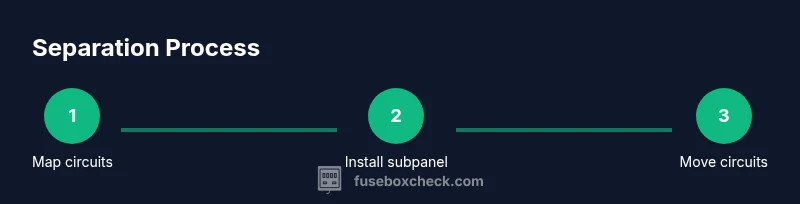
Map your existing circuits, check your service rating, and draft a plan for separation. Gather essential tools and safety gear, then review local permit requirements. Start small by isolating non-critical circuits or moving them to a temporary distribution point if feasible. Maintain a conservative mindset: if anything feels uncertain, pause and consult a qualified electrician to prevent costly mistakes or safety hazards.
Tools & Materials
- Voltage tester or multimeter(Verify no voltage on circuits before touching conductors)
- Insulated screwdrivers (flathead and Phillips)(Use tools rated for electrical work)
- Non-contact voltage detector(Quickly confirm live vs dead circuits)
- Wire strippers and needle-nose pliers(Prepare conductors and bends for feeders)
- Cable clamps, conduit fittings, and strain reliefs(Secure feeders and protect cables)
- New subpanel or distribution panel (if installing)(Depends on plan; sized per load calculations)
- Feeder cable of appropriate gauge (e.g., 4-6 AWG or per code)(Size based on service and load)
- Electrical tape, wire nuts, labeling tape(For secure connections and clear labeling)
- Flashlight or headlamp(Dim spaces around the panel require good lighting)
Steps
Estimated time: 6-12 hours
- 1
Map existing circuits
Create a current circuit map and note which breakers control each branch. This provides a baseline for what can be moved and what must stay on the main. A well-drawn map reduces confusion and speeds up the reconfiguration process.
Tip: Take a photo of the panel labeling before starting; you’ll reference it later. - 2
Power down and verify
Shut off the main breaker and verify there is no voltage on any exposed conductors with your tester. Do not rely on a single measurement; test multiple points to confirm a dead circuit.
Tip: Only one person should operate the main disconnect to avoid confusion. - 3
Identify target circuits for separation
Choose circuits that contribute to overloading the main panel or are high-demand (heaters, dryers, etc.). Plan to move these to a subpanel or dedicated feeders. Clearly mark these circuits on your plan.
Tip: Label circuits as you go to avoid miswiring later. - 4
Install or designate a subpanel
If your plan includes a subpanel, mount it with appropriate clearance and protections. Run a feeder from the main panel to the subpanel using the correct gauge and overcurrent protection.
Tip: Keep the subpanel in a dry, accessible location; avoid damp spaces. - 5
Run feeder cables and secure routing
Route feeder cables with proper supports, clamps, and protection. Keep feeders away from hot components and ensure they are not crushed or pinched by other equipment.
Tip: Use metal conduit or armored cable where required by code. - 6
Move circuits to the subpanel
Transfer the identified circuits to the subpanel, one by one. Ensure the breakers match the circuits and that load is balanced across phases if applicable.
Tip: Always double-check the feeder connection and the breaker ratings before energizing. - 7
Neutral and ground handling
In a subpanel, neutrals and grounds must be separated and bonded properly per code. Remove bonding strap if required and confirm a dedicated grounding path.
Tip: Do not bond neutrals to the panel enclosure in a subpanel where required separation exists. - 8
Test, label, and document
Restore power and test each circuit for proper operation. Verify no unusual heat or buzzing. Update the panel directory with new labels and keep a copy for future maintenance.
Tip: Create a digital backup of the final circuit map for quick reference. - 9
Conclude with a safety check
Review all safety measures, signage, and access clearance. If you can’t verify every detail, arrange an inspection by a licensed electrician.
Tip: If in doubt, avoid completing the work to prevent dangerous mistakes.
Your Questions Answered
What does separating a fuse box involve?
Separating a fuse box means redistributing circuits so that a subpanel or dedicated feeders service high-load or critical circuits. It requires circuit mapping, correct conductor sizing, and code-compliant wiring. It is a significant modification that should be approached with a clear plan and safety precautions.
Separating a fuse box means moving circuits to a subpanel or dedicated feeders with proper sizing and labeling. It’s a major change that should be planned carefully and, for many people, done with professional help.
Is it legal to separate a fuse box yourself?
DIY separation is allowed in some jurisdictions, but many regions require permits and inspections for subpanel installations or major rewiring. Always check your local electrical code and obtain any necessary approvals before starting.
You may be able to DIY in some places, but many codes require permits and inspections for subpanels. Check your local rules first.
Do I need a permit to separate a fuse box?
Most areas require permits for modifying the service or installing a subpanel. Permits ensure the work is inspected for safety and code compliance. Check with your local authority having jurisdiction before starting.
Permits are commonly required for subpanel work. Always verify with your local authority.
What is the difference between a main panel and a subpanel?
The main panel contains the service disconnect and feeds the branch circuits. A subpanel is fed by a separate feeder from the main panel and helps distribute power to specific areas or loads while keeping the main panel less congested.
A subpanel is a secondary distribution panel fed from the main panel, used to manage load and improve safety.
When should I hire a professional?
If you lack experience with feeder sizing, grounding/bonding, or code-compliant neutral separation, hire a licensed electrician. They can perform load calculations and ensure a safe, legal installation.
When in doubt about wiring, load calculations, or code rules, hire a licensed electrician.
What tools do I need to start safely?
Begin with a non-contact voltage tester, insulated screwdrivers, and a multimeter. Have labeling tape and wire nuts on hand. Use proper PPE and keep workspace dry and organized.
Start with a tester, insulated tools, and a multimeter, plus labeling gear for clarity.
Watch Video
Highlights
- Plan first, then touch a wire.
- Label every circuit clearly and update the map.
- Choose a safe location for a subpanel if needed.
- When in doubt, hire a licensed electrician for safety and code compliance.