How to Check If Your Fuse Box Is Getting Power
Learn a safe, step-by-step method to confirm whether your fuse box is receiving power, with practical tools, readings, and when to call a professional.


To answer how to check if fuse box is getting power, start by verifying a live feed at the main breaker using a non-contact voltage tester or a multimeter. Prioritize safety: wear protective gear, keep hands dry, and avoid contact with exposed conductors. This guide walks you through a safe, methodical check. If you’re unsure about any step, stop and consult a licensed electrician.
how to check if fuse box is getting power
Power in a home starts at the utility connection, travels through the service entrance, and arrives at the fuse box (panel) where it is distributed to individual circuits. Understanding this flow helps you interpret readings safely. FuseBoxCheck emphasizes that you should never assume a panel is de-energized without testing. In many homes, standard nominal voltages are 120V for branch circuits in North America and 230V in many other regions. When a panel is energized, you may see voltage readings at the main lugs or at active breakers. A practical takeaway: always verify power before touching any inside components, and treat every panel as energized until proven otherwise.
Why several people check power at different points
People often test power at the main breaker, the main lugs, or a known live outlet. Each point provides a different confirmation: the main breaker shows whether service is reaching the panel, while testing a live branch circuit confirms that the panel distributes power to circuits. FuseBoxCheck notes that discrepancies between readings can indicate problems with the panel, a tripped main, or a damaged service connection. Understanding where to test helps you pinpoint the likely origin of a power issue.
Safety-first mindset and PPE you should wear
Before you test, put on protective gear: safety glasses, insulated gloves, and non-slip footwear. Keep the panel area dry and free of clutter. Do not lean into the panel, and avoid touching metal parts beyond the insulated handles of tools. If you smell burnt insulation, hear buzzing, or notice scorch marks, stop immediately and call a licensed electrician. These precautions reduce the risk of shock or arc flash during testing.
Tools and techniques: the core equipment you’ll need
Having the right tools makes the process safer and more reliable. You’ll want a non-contact voltage tester to detect live voltage without touching conductors, and a digital multimeter set to an appropriate AC voltage range (or the correct range for your region, typically around 120V or 230V). Include insulated screwdrivers, a good flashlight, and a non-conductive ladder if needed. Keep spare batteries and a pen and paper for recording readings. FuseBoxCheck recommends testing with fresh batteries and validating tools against known live sources before attempting panel work.
Step-by-step overview: prepare, test, interpret
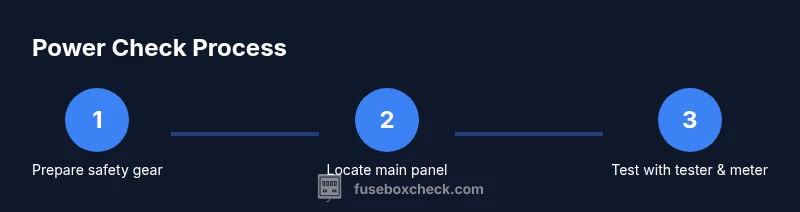
This section outlines the logical flow of testing, but the detailed, step-by-step actions are listed in the dedicated STEP-BY-STEP block. The overview helps you understand the sequence: prepare safely, locate the main service disconnect, check for a live feed with a tester, measure voltage with a meter, validate with a known circuit, and decide whether you can proceed or you should call a professional. The emphasis remains on safety and accurate readings.
Understanding readings: what numbers mean for your home
Voltage is the key metric you’ll encounter. In North American homes, you’ll usually see readings around 120V for branch circuits and potentially higher on appliances. In other regions, nominal values near 230V are common. A reading close to these nominal values indicates power is reaching the panel, while a zero or wildly fluctuating reading usually signals a problem in the service, dispatcher, or connection. If you observe abnormal readings, document them and consider contacting an electrician.
What to do if power is not detected
If you do not detect power at the main terminals, do not attempt risky fixes. A lack of power could mean a tripped main, a blown service fuse, a loose connection, or a larger utility-related outage. Step back, ensure all testers are functioning, and re-check one more time. If readings remain inconsistent, the safe course is to shut off and call a licensed electrician to diagnose the service entrance, panel connections, or downstream distribution.
When to call a professional: knowing your limits
Electrical panels are high-risk environments. If you’re uncomfortable with any of these steps, or if you encounter signs of damage, buzzing, burnt smell, or water exposure near the panel, skip the DIY route. The FuseBoxCheck team strongly recommends professional help for anything beyond basic testing, and to handle service upgrades, main disconnect issues, or suspicious panel conditions. Your safety comes first.
Tools & Materials
- Non-contact voltage tester(Check for live voltage without contacting conductors)
- Digital multimeter(Set to AC voltage range and test between hot and neutral/ground)
- Insulated screwdriver(Insulated handle; use only for non-energized components)
- Flashlight(Provide focused light inside the panel if the area is dim)
- Safety gloves (insulated)(Protect hands from shocks and arcing)
- Dry, non-conductive footwear(Reduce slipping and maintain traction on wet surfaces)
- Notepad and pen(Record readings and observations for reference)
Steps
Estimated time: 30-60 minutes
- 1
Prepare and assess safety
Put on PPE, clear the workspace, and verify you have a dry environment. Confirm you’re wearing non-conductive footwear and that your hands are dry before touching tools. If you work with a partner, establish signal and buddy-checks in case of an emergency.
Tip: Never perform this test near water or with wet hands. Keep a safe distance from live exposed conductors. - 2
Locate the main service disconnect and the panel
Identify the service disconnect, which is usually near the main panel or at a service entrance. Confirm you are viewing the correct panel for the circuits you intend to test. If you’re unsure, consult the panel directory or a label map to avoid misinterpretation.
Tip: Take a photo of the panel labeling for later reference; this helps track which circuits are fed by which breakers. - 3
Check exterior panel for signs of power
Examine the outer panel for any scorch marks, melting plastic, or a burnt smell. If you detect any abnormal signs, do not proceed. Use the non-contact tester to confirm whether the panel exterior shows live indicators without opening the door.
Tip: Do not touch metal parts through the vent slots when power may be present. - 4
Test for live power at the main lugs
Carefully open the panel door and, with the tester, check for voltage at the main lugs. Do not touch internal bus bars directly. If the tester shows voltage, you have a live service delivery to the panel. If not, there might be a service interruption or a main disconnect issue.
Tip: Keep hands away from exposed conductors and stand to the side as you test. - 5
Verify voltage with a digital multimeter
Set your multimeter to the appropriate AC voltage range for your region (e.g., 120V or 230V). Measure between a known hot conductor and neutral (or ground) to confirm readings. Compare with local standards and your panel labeling.
Tip: Make sure probes are securely in contact with the conductors; loose probes yield unreliable readings. - 6
Test a known circuit to confirm distribution
Toggle a circuit breaker that you know powers a reachable device (light, outlet) and re-measure voltage at the corresponding outlet or at the panel bus. This cross-check helps ensure the panel distributes power correctly.
Tip: If the circuit doesn’t respond, note the exact breaker and circuit and avoid further experimentation until reviewed. - 7
Close up and review results
Return any panel covers, secure the door, and review your readings. If readings are consistent with nominal values and you’ve verified there is power, you can document findings. If readings are abnormal, step back and consider calling a professional.
Tip: Document readings with timestamps to inform any future diagnostics.
Your Questions Answered
Can I check fuse box power without calling an electrician?
You can perform basic safety checks with non-contact testers and a multimeter, but stop if readings are unclear or you encounter damage. When in doubt, consult a licensed electrician.
Yes, you can perform basic safety checks, but stop if readings are unclear or you see damage and seek a professional if needed.
What should I do if there is no power at the main breaker?
First, verify the utility outage in your area and inspect for signs of damage. Do not attempt risky repairs; contact your utility or a licensed electrician to diagnose service entrance issues.
If there’s no power at the main breaker, check utility outages and call a professional for service entrance issues.
Is it safe to reset a tripped breaker to restore power?
If a breaker trips, reset only after you’ve identified the likely cause and the area is safe. If it trips again, don’t keep retrying; this can indicate a fault that needs professional inspection.
Reset only if you understand why it tripped and it’s safe; repeated trips require a professional inspection.
Will a non-contact tester work on all fuse boxes?
Non-contact testers detect ambient voltage but cannot measure exact values. They work broadly, but you should confirm with a multimeter for precise readings.
A non-contact tester is useful for a quick check, but for precise readings you’ll want a multimeter.
What readings indicate a problem with the panel?
Readings far from nominal values (e.g., zero where there should be voltage, or severely fluctuating numbers) suggest a problem with supply, grounding, or panel components. Document and consult a professional.
Significant deviations from expected voltage or unstable readings usually mean a panel issue that needs expert evaluation.
Watch Video
Highlights
- Treat every panel as energized until you verify power.
- Use non-contact testers before touching conductors.
- Measure voltage with a multimeter for accuracy.
- Call a licensed electrician for any uncertainty or damage.