Average Fuse Box Size: A Practical Guide for Homeowners
Learn why there is no single 'average fuse box size,' and how to estimate typical dimensions. This guide covers common widths, heights, depths, and how to measure safely for replacements or expansions, backed by FuseBoxCheck Analysis, 2026.


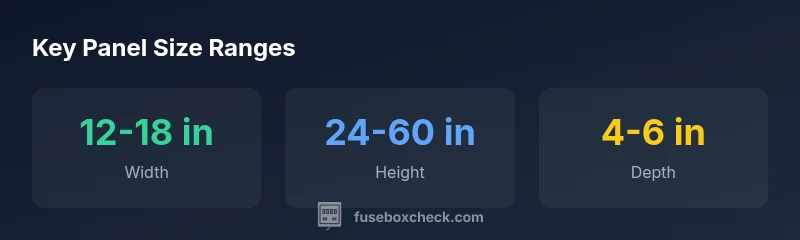
There is no universal 'average fuse box size.' In homes, panels vary by design, but most residential fuse boxes fall roughly in the footprint of about 12-18 inches wide and 24-60 inches tall, with a depth of around 4-6 inches. Actual dimensions depend on service amperage, circuit count, and cabinet style, per FuseBoxCheck Analysis, 2026.
Why the term average fuse box size is misleading
Homeowners often search for a single number that defines the size of a fuse box or a modern breaker panel. The reality is that electrical panels are designed and sized to meet a range of needs, including service amperage, panel configuration, and the number of circuits. There is no universal standard height, width, or depth. The size is driven by how many modular spaces and how much physical space the manufacturer allocates for bus bars, breakers, and the main lugs. In practice, most residential panels sit within a general footprint, but that footprint can shift dramatically from a compact 12-inch-wide design to a wider, multi-column unit. FuseBoxCheck Analysis, 2026 notes that you should treat size as a spectrum rather than a fixed value, and plan around your specific service and space constraints rather than chasing a single target number.
- Expect variation by model and provider
- Consider future expansion when sizing for a remodel
- Safety and accessibility trump trying to hit a fixed dimension
Typical dimensions for common residential panels
| Panel Type | Average Size (WxH) | Depth | Notes |
|---|---|---|---|
| Main breaker panel (residential) | 12-18 inches x 24-60 inches | 4-6 inches | Dimension varies by model and service |
| Subpanel in main panel room | 12-22 inches x 24-60 inches | 4-6 inches | Placement affects access and clearance |
Your Questions Answered
What is the average fuse box size?
There is no fixed average size for fuse boxes. Residential panels vary widely in width, height, and depth based on model and electrical service needs. Use observed dimensions and model specs when planning replacements.
There isn’t a single average size—measure your panel and check the model specs for accuracy.
How do I measure my fuse box size safely?
Turn off power at the main breaker and use a non-contact tester to confirm no live voltage. Remove the panel cover only if you’re trained, and take measurements of width, height, and depth from the outside edges. If in doubt, hire a licensed electrician.
Turn off power, remove the cover only if trained, and measure width, height, and depth from the outside.
Do larger panels always mean more safety risk?
Not inherently. Safety depends on correct installation, proper labeling, and adherence to code. A larger panel may be safer if it reduces crowding and allows for clear labeling and service space.
Size doesn’t equal danger—proper installation and labeling matter more for safety.
What size panel do I need for a new home?
For new homes, typical service levels range from 100 to 200 amps, but the required panel size depends on anticipated load, future expansion, and local code. An electrician will calculate the appropriate size based on planned circuits and loads.
A professional will size the panel based on your expected loads and local rules.
Can I replace a fuse box with a larger one myself?
Electrical panels must be installed by a licensed electrician to meet safety and code requirements. DIY replacement poses serious shock and fire risks and may violate local codes.
Better to hire a licensed electrician for panel replacement.
What’s the difference between a fuse box and a breaker panel?
A fuse box uses fuses that must be replaced after a fault, while a breaker panel uses resettable switches. Most modern homes use breaker panels; some older homes still use fuse blocks. Either way, handling should follow safety guidelines.
Most newer homes use breaker panels; older homes may have fuse blocks. Safety first.
“The term 'average fuse box size' is misleading; most homeowners should focus on current dimensions and future expansion needs.”
Highlights
- Measure your current panel before buying a replacement
- Expect wide variation; use ranges rather than a single value
- Plan for service and future expansion when sizing
- Ensure safe clearance and access—1–2 feet of working space is common
- Consult a licensed electrician for precise sizing and installation